
The Application Gallery features COMSOL Multiphysics® tutorial and demo app files pertinent to the electrical, structural, acoustics, fluid, heat, and chemical disciplines. You can use these examples as a starting point for your own simulation work by downloading the tutorial model or demo app file and its accompanying instructions.
Search for tutorials and apps relevant to your area of expertise via the Quick Search feature. Note that many of the examples featured here can also be accessed via the Application Libraries that are built into the COMSOL Multiphysics® software and available from the File menu.
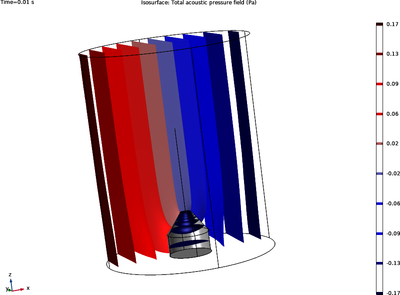
It is often not possible to insert a normal microphone directly into the sound field being measured. The microphone may be too big to fit inside the measured system, such as for in-the-ear measurements for hearing aid fitting. The size of the microphone may also be too large compared to ... Read More
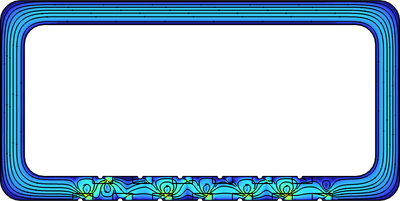
This tutorial uses a 2D model of an acoustically driven microfluidic pump. The acoustic microfluidic pump is driven by acoustic streaming originating from sharp edges in the microfluidic channel. It drives a flow around a closed microfluidic channel loop. The acoustic field is modeled ... Read More
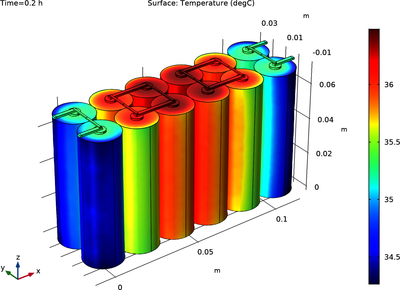
This example demonstrates how to model the temperature distribution in a battery pack during a 4C discharge. The pack is constructed by first coupling two cylindrical batteries in parallel. Six parallel-connected pairs are then connected in series to create the full pack. (This is also ... Read More
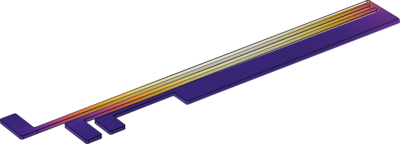
This tutorial model of a two-hot-arm thermal actuator couples three different physics phenomena: electric current conduction, heat conduction with heat generation, and structural stresses and strains due to thermal expansion. The model exists in three versions: Joule Heating of a ... Read More
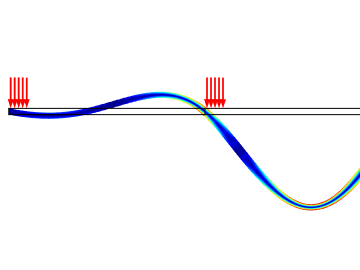
This example shows how to model a load which varies in space and time. A series of load pulses travel along a beam which is supported at equal distances. For some combinations of the traveling speed of the load pulses and the spacing between them, it is possible to excite resonances in ... Read More
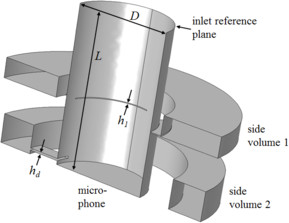
This is the model of an occluded ear canal simulator (a generic 711 coupler). Besides certain details the geometry corresponds to the Brüel & Kjær Ear Simulator Type 4157. The real life couplers are used for simulating the acoustics of a standardized human ear canal and can be used ... Read More
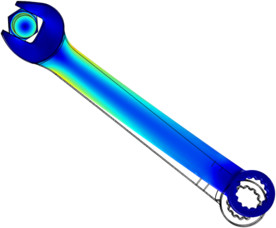
This tutorial demonstrates how to set up a simple static structural analysis. The analysis is exemplified on a combination wrench during the application of torque on a bolt. Despite its simplicity, and the fact that very few engineers would run a structural analysis before trying to turn ... Read More
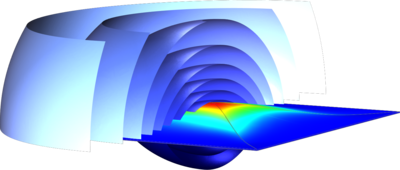
This model analyzes a piezoelectric microelectromechanical system (MEMS) speaker. The speaker, composed of four triangular membranes, uses a layer of lead zirconate titanate (PZT) material with two electrodes on top of a silicon layer as actuators. The triangular membranes are separated ... Read More
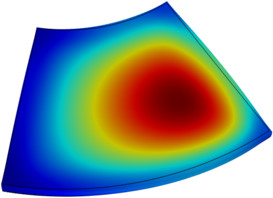
Tilted pad thrust bearings are used in rotating machineries with high thrust loading. The thrust load is transferred from a sliding part to a stationary part through hydrodynamic oil films. The tilted pad thrust bearing consists of a series of flat surfaces sliding over stationary tilted ... Read More
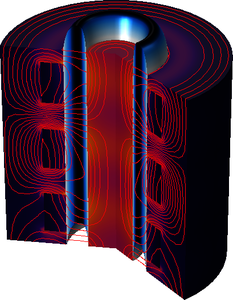
Induction pumps are used in high temperature cooling systems. The principle of operation is equivalent to a linear three phase induction motor. The lack of moving parts and the pumped liquid being kept in a hermetically closed system are clear advantages. This model shows how to simulate ... Read More


