
The Application Gallery features COMSOL Multiphysics® tutorial and demo app files pertinent to the electrical, structural, acoustics, fluid, heat, and chemical disciplines. You can use these examples as a starting point for your own simulation work by downloading the tutorial model or demo app file and its accompanying instructions.
Search for tutorials and apps relevant to your area of expertise via the Quick Search feature. Note that many of the examples featured here can also be accessed via the Application Libraries that are built into the COMSOL Multiphysics® software and available from the File menu.
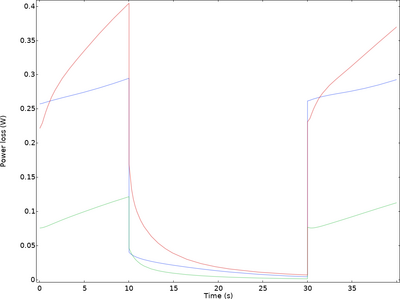
This example computes the power losses in a lithium-ion battery when exposed to high current pulses in a hybrid pulse power characterization (HPPC) test. Power loss contributions stemming from different phenomena are analyzed, as well as the total power losses pertaining to the ... Read More
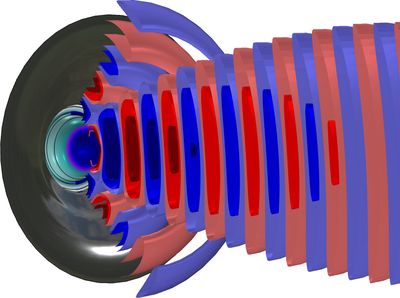
A tweeter is a high frequency driver used in loudspeaker systems. An ideal tweeter will produce a constant sound pressure level at a given distance in front of the driver independently of frequency, that is, a flat response. Ideally the tweeter will also, to a certain degree, maintain ... Read More
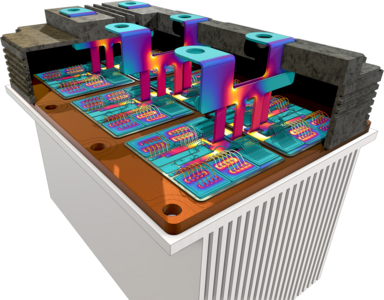
This industrial-scale proof of concept (POC) model demonstrates how to perform an electric-thermal analysis of a high-power insulated-gate bipolar transistor module (IGBT module). The module has a rated voltage of 1200 V, and nominal current of 1800 A. Using a stationary study the ... Read More
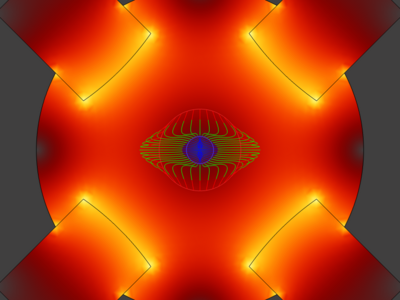
Just like optical lenses focus light, electric and magnetic lenses can be used for focusing beams of charged particles. This COMSOL Multiphysics model shows the path of B5+ ions passing through a focusing system of three magnetic quadrupoles. Each of the quadropoles focus the beam of ... Read More
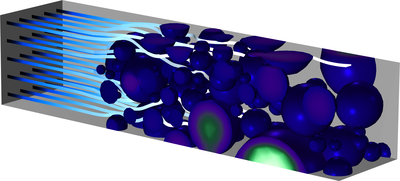
In this example, a heterogeneous NMC (Nickel-Manganese-Cobalt) electrode structure is generated from tomography data using a Model Method. Time-dependent discharge and electrochemical impedance spectroscopy (EIS) simulations are then made on the full 3D geometry. A solid mechanics ... Read More
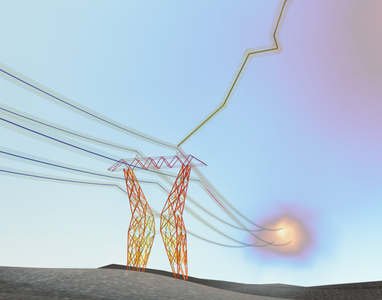
This model demonstrates the analysis of lightning surges on high voltage transmission line towers. Lightning carrying a current of 10 kA struck one of the tower's shielded wires. The induced voltage at the three-phase conductors are computed. Some highlights of this model: Perform ... Read More
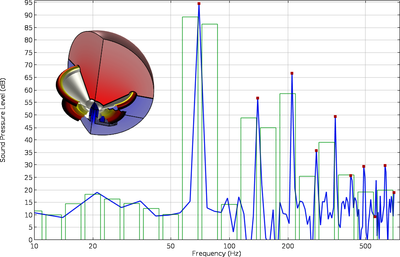
In this model, a full transient analysis of a loudspeaker driver is performed, which allow the modeling of nonlinear effects. It extends the linear frequency domain analysis done in the Loudspeaker Driver tutorial model. The analysis accounts for nonlinear behavior of the soft iron in ... Read More
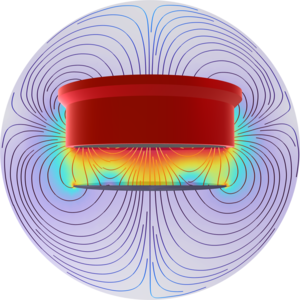
One-sided magnets are magnets designed to have both magnetic poles emerging from the same side of the magnet. This results in the magnetic flux being concentrated on one side of the magnet. These kinds of magnets are found in many applications from the common fridge magnet to particle ... Read More
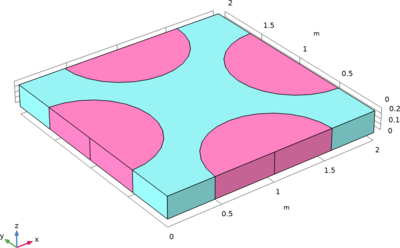
In this example, the micromechanical properties of a piezoelectric fiber composite are studied. The homogenized electromechanical properties of the composite are derived from the individual microscopic properties of matrix and fiber. Read More

The electrodes of a lithium-ion battery are porous and consist of an active solid electrode material, a binder, and pores filled with a liquid electrolyte. Expansion of the active material due to lithium intercalation changes the volume fraction of electrolyte-filled pores in the ... Read More


