
The Application Gallery features COMSOL Multiphysics® tutorial and demo app files pertinent to the electrical, structural, acoustics, fluid, heat, and chemical disciplines. You can use these examples as a starting point for your own simulation work by downloading the tutorial model or demo app file and its accompanying instructions.
Search for tutorials and apps relevant to your area of expertise via the Quick Search feature. Note that many of the examples featured here can also be accessed via the Application Libraries that are built into the COMSOL Multiphysics® software and available from the File menu.
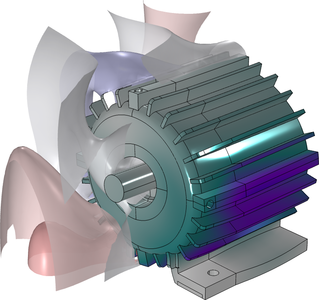
This model analyses the noise generated by an electric motor during its operation at different speeds of rotation. The type of electric motor analyzed, a permanent magnet synchronous motor (PMSM) uses permanent magnets in the rotor and a variable frequency current traveling through the ... Read More

Numerical modeling of Lamb waves, which belong to guided waves, is essential for the analysis and design of the structural health monitoring (SHM) systems for long range ultrasonic testing. The design of an SHM system based on guided waves consists of two main parts. In the first place, ... Read More
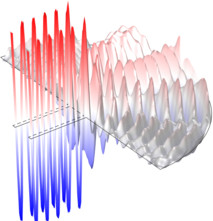
This example resembles the well-known double-slit interference experiment often demonstrated in schools with water waves or sound. The model mimics the plane-wave excitation with two thin waveguides leading to slits in a screen and computes the diffraction pattern on the opposite side of ... Read More

Coriolis flowmeters, also known as mass flowmeters or inertial flowmeters, measure the mass flow rate of a fluid traveling through it. It makes use of the fact that the fluid's inertia through an oscillating tube causes the tube to twist in proportion to the mass flow rate. Typically, ... Read More
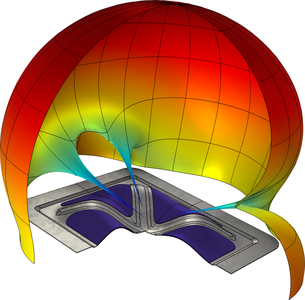
This model presents a method to analyze acoustic damping pads. These pads use a constrained layer of viscoelastic material to dissipate energy and thus reduce the energy radiated as noise. Damping pads are used in many different industries to reduce the noise generated by vibrating ... Read More
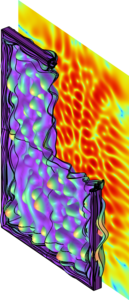
This model presents a practical and efficient method to compute the sound transmission loss (STL) through a building component. Specifically, this example treats the case of a double-glazed window. The method used here is valid for structural components that have a small influence on ... Read More
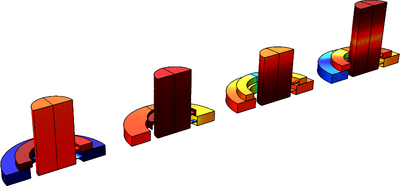
In this tutorial the geometry of an occluded ear-canal simulator is optimized to match the acoustic response of a given ear. The target data in this model stems from a simulation of an ear canal, but it can also be based on measurements, or a response specified by a standard. Read More
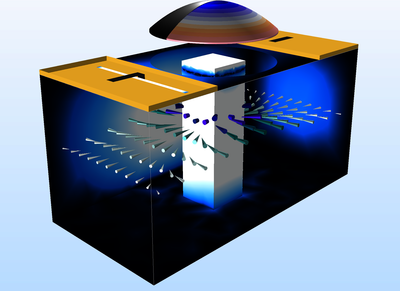
An evanescent mode cavity filter can be realized by adding a structure inside of the cavity. This structure changes the resonant frequency lower than the dominant mode of the unfilled cavity. A piezo actuator is used to control the size of a small air gap which provides the tunability of ... Read More
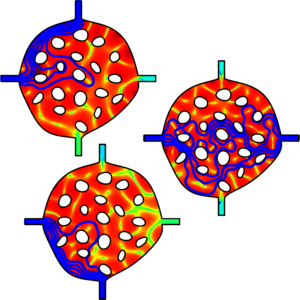
A demultiplexer is a device that directs different frequency bands to different outputs. In this tutorial model, we will design a demultiplexer by performing shape optimization on all initial circular boundaries in a sonic crystal (phononic crystal) configuration. The model uses shape ... Read More

For models with acoustic-structure couplings it is necessary to calculate the left eigenvectors to use the Frequency Domain, Modal solver. The model shows the necessary changes to the default settings of the eigenfrequency solver. Read More


