
The Application Gallery features COMSOL Multiphysics® tutorial and demo app files pertinent to the electrical, structural, acoustics, fluid, heat, and chemical disciplines. You can use these examples as a starting point for your own simulation work by downloading the tutorial model or demo app file and its accompanying instructions.
Search for tutorials and apps relevant to your area of expertise via the Quick Search feature. Note that many of the examples featured here can also be accessed via the Application Libraries that are built into the COMSOL Multiphysics® software and available from the File menu.
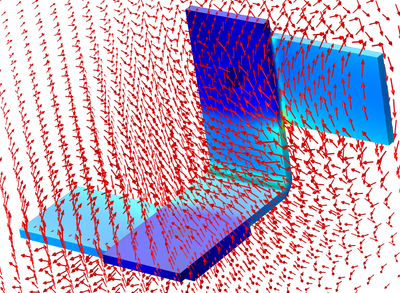
This is a busbar configuration with an AC analysis. The configuration is similar to the introductory tutorial in the book Introduction to COMSOL Multiphysics. However, two conductors are added to represent a more realistic case of magnetic fields surrounding the busbar. The results ... Read More
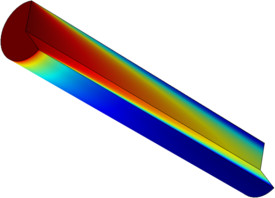
Chemical engineering students can model a nonideal tubular reactor, including radial and axial variations in temperature and composition, and investigate the impact of different operating conditions with this easy-to-use app. The process described by the Tubular Reactor with ... Read More
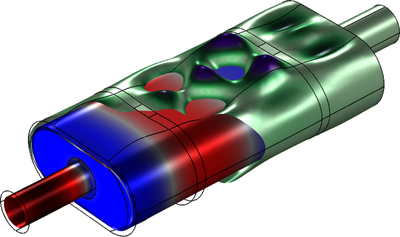
This model describes the pressure wave propagation in a muffler for an internal combustion engine. The purpose of the model is to show how to analyze both inductive and resistive damping in pressure acoustics as well as coupling the fluid to the surrounding elastic shell structure of the ... Read More
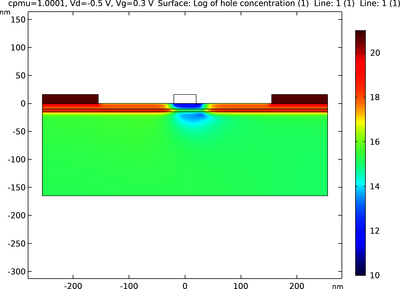
This tutorial analyzes the DC characteristics of an InSb p-Channel FET, using the density-gradient theory to add the effect of quantum confinement to the conventional drift-diffusion formulation, without a large increase of computational resources. The confinement effect is applied both ... Read More
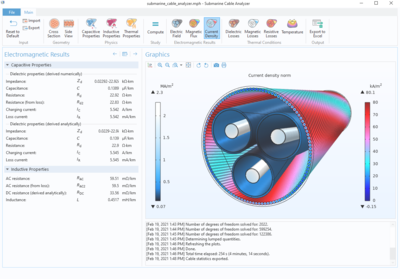
This application demonstrates how the Application Builder in the COMSOL Multiphysics® software can be used to make advanced cable modeling available to a general audience. At its core is a multiphysics model based on the technology introduced in the Cable Tutorial Series. The ... Read More
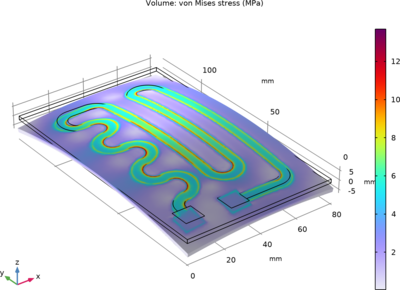
Small heating circuits find use in many applications. For example, in manufacturing processes, they heat up reactive fluids. The device in this tutorial example consists of an electrically resistive layer deposited on a glass plate. The layer results in Joule heating when a voltage is ... Read More
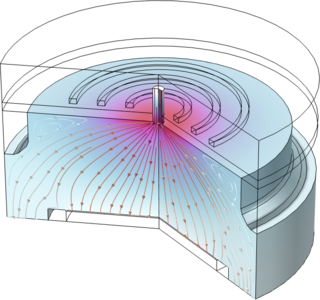
This tutorial studies the deposition of amorphous silicon using an inductively coupled plasma reactor with a silane/argon gas mixture. It examines how the deposition rate varies across the wafer as a function of silane mole fraction and input power. Read More
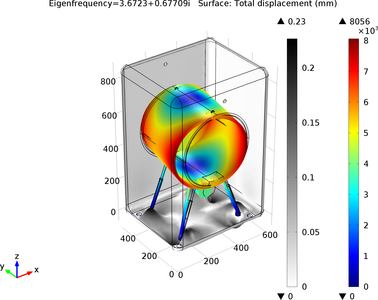
Vibration and noise in washing machines, due to the non-uniform distribution of clothes in the barrel, is a common problem worth studying and optimizing for. This model simulates a multibody dynamics model of a horizontal-axis portable washing machine. An eigenfrequency analysis is ... Read More
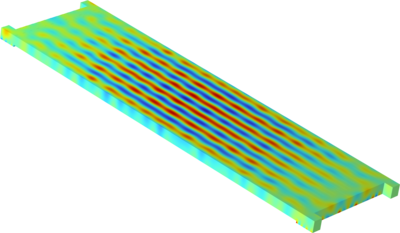
Lamb-wave resonators are useful components for many radio-frequency applications. This example shows how you model an aluminum nitride Lamb wave resonator and perform eigenfrequency and frequency-response analyses to characterize the device. The tutorial uses the Electric Currents in ... Read More
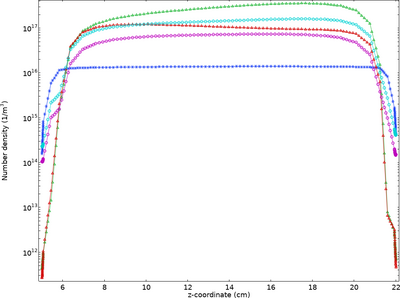
This tutorial model solves for an inductively coupled plasma reactor in a mixture of SF6/argon. The model computes the fluid flow and gas heating. Important aspects and strategies for modeling electronegative discharges are discussed. Read More


