
The Application Gallery features COMSOL Multiphysics® tutorial and demo app files pertinent to the electrical, structural, acoustics, fluid, heat, and chemical disciplines. You can use these examples as a starting point for your own simulation work by downloading the tutorial model or demo app file and its accompanying instructions.
Search for tutorials and apps relevant to your area of expertise via the Quick Search feature. Note that many of the examples featured here can also be accessed via the Application Libraries that are built into the COMSOL Multiphysics® software and available from the File menu.
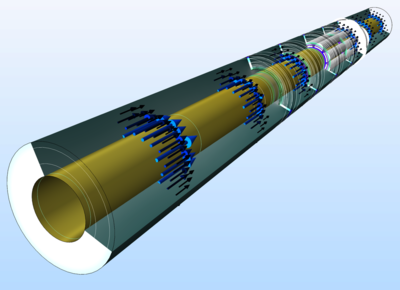
A very wide band coaxial low-pass filter is designed using a 2D axisymmetric model. To address the wide band frequency response with a fine frequency resolution, the model is built with a transient physics interface first. Then, S-parameters are calculated using a time-to-frequency ... Read More
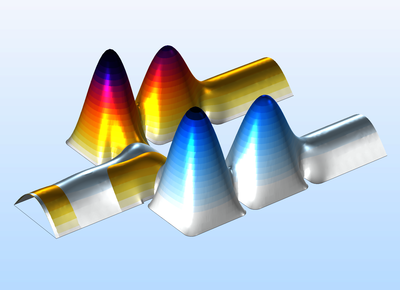
A diplexer is a device that combines or splits signals into two different frequency bands, widely used in mobile communication systems. This model simulates splitting properties using a simplified 2D geometry. The computed S-parameters and electric fields at the lower and upper bands ... Read More
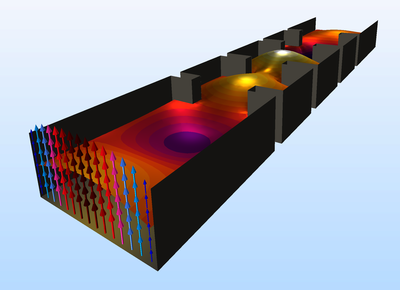
A conductive diaphragm, an iris, placed transverse to a waveguide aperture causes a discontinuity and generates shunt reactance. Bandpass frequency response can be achieved from cascaded cavity resonators combined with these reactive elements which can be created by inserting a series of ... Read More
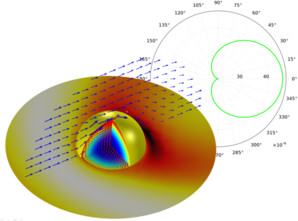
This model demonstrates the simulation of the scattering of a plane wave of light by a gold nanosphere. The scattering is computed for the optical frequency range over which gold can be modeled as a material with negative complex-valued permittivity. The far-field pattern and losses are ... Read More
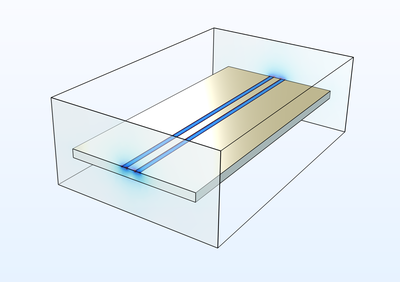
This tutorial example shows how to set port features in a physics interface when designing a coplanar waveguide (CPW) circuit that is useful for mmWave applications. Read More
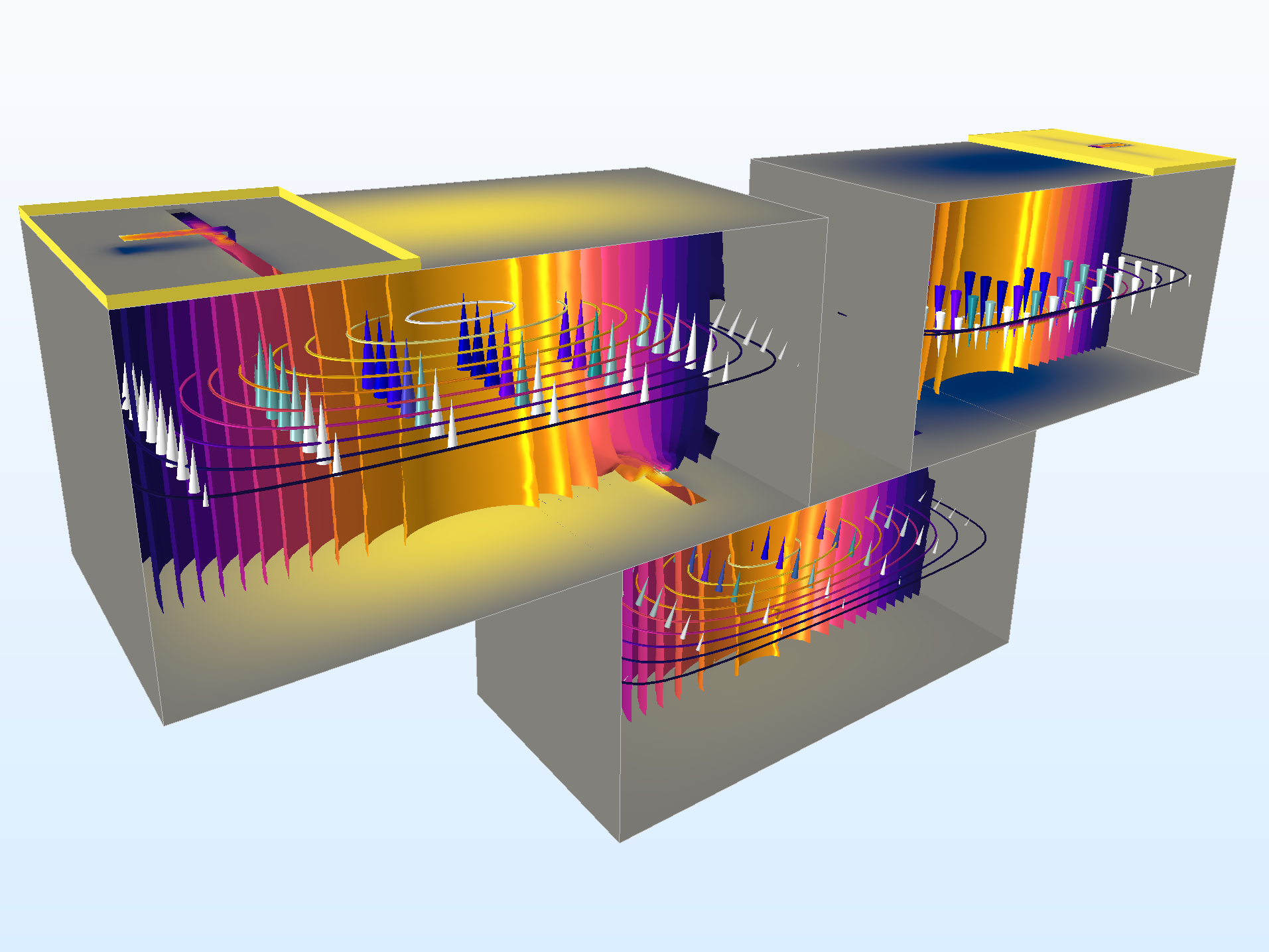
A cascaded cavity filter provides much better bandpass filter performance compared to a single cavity. Out-of-band rejection improves dramatically using a cascaded design. This model uses three rectangular cavity filters coupled via slots. The calculated S-parameters show excellent out ... Read More
Electromagnetic waves that are confined to propagate along a surface, such as surface plasmon polaritons (SPPs), are of great research interest due to their potential applications in nanoscale manipulation of light. This model demonstrates how to set up a simulation of the propagation ... Read More
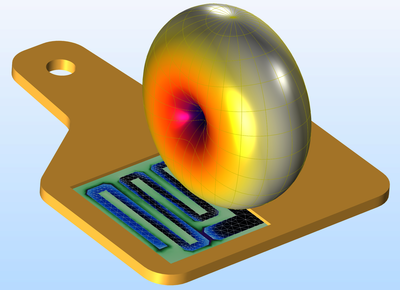
UHF RFID tags are widely used for identifying and tracking animals. This model simulates a passive radio-frequency identification (RFID) tag for the UHF frequency range. With respect to the chip transponder’s complex impedance, a reflection coefficient is computed. This is done using an ... Read More
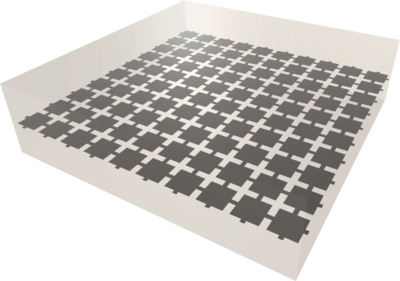
Graphene, carbon atoms arranged in a two-dimensional hexagonal lattice has sparked tremendous research and application interests since its experimental discovery about two decades ago. Besides being ultrathin, this material exhibits a plethora of interesting properties, including high ... Read More
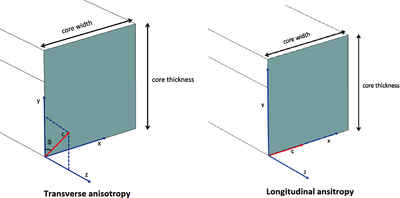
In this model, a modal analysis is performed while parametrically sweeping the length of a waveguide from 0.5 um to 4 um to derive the dispersion curve for the anisotropic core. Both transverse and longitudinal anisotropy are considered in two different models. These models are ... Read More


