
The Application Gallery features COMSOL Multiphysics® tutorial and demo app files pertinent to the electrical, structural, acoustics, fluid, heat, and chemical disciplines. You can use these examples as a starting point for your own simulation work by downloading the tutorial model or demo app file and its accompanying instructions.
Search for tutorials and apps relevant to your area of expertise via the Quick Search feature. Note that many of the examples featured here can also be accessed via the Application Libraries that are built into the COMSOL Multiphysics® software and available from the File menu.
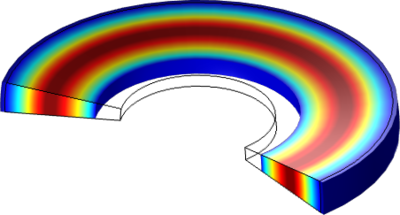
This example illustrates how to combine different Creep material models. Here a Norton–Bailey model (primary creep) is combined with a Norton model (secondary creep). This example is a continuation of the model thermally induced creep. Read More
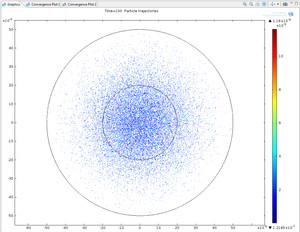
Transport which is purely diffusive in nature can be modeled using a Brownian force. This model shows how to add such a force in the Particle Tracing for Fluid Flow physics interface. Particle diffusion in a fluid is modeled with the diffusion equation and the Particle Tracing for Fluid ... Read More
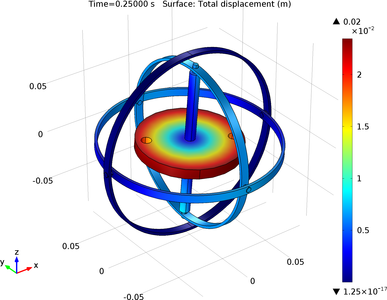
Gyroscopes are used for measuring the orientation or maintaining the stability of airplanes, spacecraft, and submarines vehicles in general. They are also used as sensors in inertial guidance systems. This model demonstrates the modeling of a mechanical gyroscope. It analyzes the ... Read More

Anisotropic hyperelastic materials are used for modeling collagenous soft tissue in arterial walls. The Arterial Wall Mechanics application describes a section of an artery based on the Holzapfel–Gasser-Ogden hyperelastic material model. In this example the dynamic behavior of the artery ... Read More

This model demonstrates how to setup a Time Domain to Frequency FFT study for a distributed Bragg reflector (DBR) structure. The results agree well with the results of a regular Frequency domain study. Read More
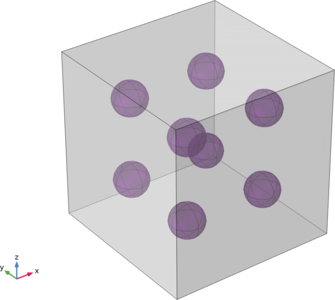
In this example, the homogenized elastic and viscoelastic properties of a particulate composite are computed based on the individual properties of elastic particles embedded in a viscoelastic matrix. Periodic boundary conditions are applied to a unit cell of the particulate composite ... Read More
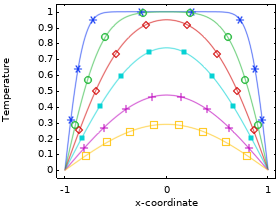
This simple example covers the heating of a finite slab and how the temperature varies with time. We will set up the problem in COMSOL Multiphysics after which we compare the solution to the analytical solution. Read More
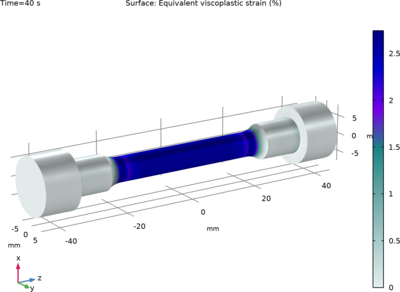
Most metals and alloys undergo viscoplastic deformation at high temperatures. In case of cyclic loading, a constitutive law with both isotropic and kinematic hardening is necessary to describe effects such as ratcheting, cyclic softening/hardening, and stress relaxation. The Lemaitre ... Read More
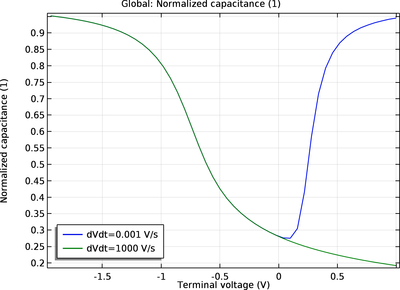
The metal-silicon-oxide (MOS) structure is the fundamental building block for many silicon planar devices. Its capacitance measurements provide a wealth of insight into the working principles of such devices. This tutorial constructs a simple 1D model of a MOS capacitor (MOSCAP). Both ... Read More
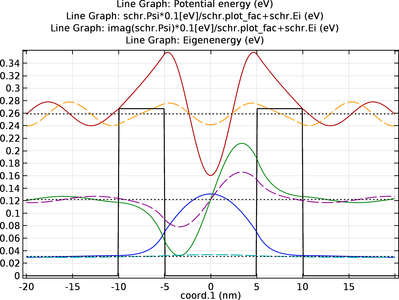
The double barrier structure is of interest because of its application in semiconductor devices such as resonant-tunneling diodes. This verification example demonstrates the Schrödinger Equation interface to set up a simple 1D GaAs/AlGaAs double barrier structure to analyze the ... Read More


