
The Application Gallery features COMSOL Multiphysics® tutorial and demo app files pertinent to the electrical, structural, acoustics, fluid, heat, and chemical disciplines. You can use these examples as a starting point for your own simulation work by downloading the tutorial model or demo app file and its accompanying instructions.
Search for tutorials and apps relevant to your area of expertise via the Quick Search feature. Note that many of the examples featured here can also be accessed via the Application Libraries that are built into the COMSOL Multiphysics® software and available from the File menu.
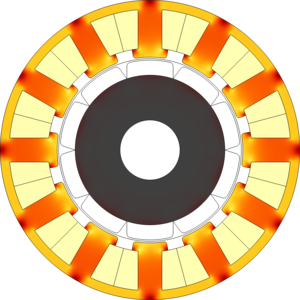
In this tutorial, a PM motor with 10 rotor poles and 12 stator slots is modeled in 2D, to capture the torque ripple over an electrical period and map the volumetric loss density in the rotor and stator iron. Read More
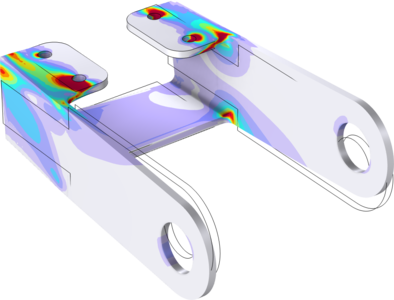
The bracket model tutorials are used as an introduction to the features and functionality within the Structural Mechanics Module. The following features are introduced: The following features are introduced: The fundamentals: static linear analysis Parametric study Including initial ... Read More

In small PEM fuel cell systems (in the sub-100 W range) no active devices for cooling or air transport are normally used. This is due to the desire to minimize parasitic power losses from pumps and fans, and to reduce the system complexity, size, and cost. The reactants at the cathode ... Read More
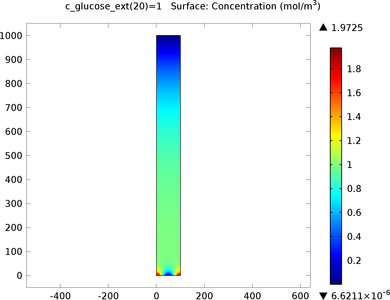
Electrochemical glucose sensors use amperometric methods to measure the concentration of glucose in a sample. This example models the diffusion of glucose and ferri/ferrocyanide redox mediators in a unit cell of electrolyte above an interdigitated electrode. The sensor gives a linear ... Read More
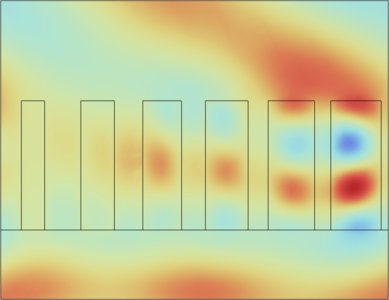
This model demonstrates how to simulate a metasurface beam deflector that uses anomalous refraction. The structure itself is a repeated array of six posts (so-called meta elements). The periodicity of the individual posts is 500 nm, so the full structure of six posts is 3 um wide. The ... Read More
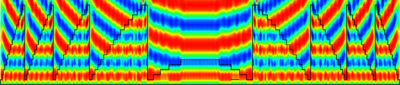
This model simulates a 16-level, first-order, focusing Fresnel lens with 50 µm diameter and 150 µm focal length. In one simulation, the Electromagnetic Waves, Frequency Domain interface computes the electric field in the Fresnel lens and the surrounding air domain extended to the focal ... Read More

This model demonstrates how to optimize the charging profile of a battery using gradient based optimization. The optimization solver minimizes the time required for charging the battery from 0% to 90% state of charge, while at the same time constraining the amount lithium inventory lost ... Read More
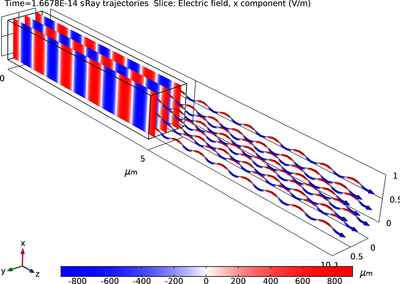
This tutorial shows how to set up a ray release based on the incident electric field at a boundary. First the Electomagnetic Waves, Frequency Domain interface is used to solve for the electric field of a plane wave. Then rays are released with initial intensity and polarization matching ... Read More
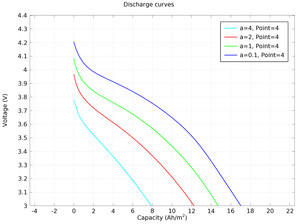
This model demonstrates the Lithium-Ion Battery interface for studying the discharge and charge of a lithium-ion battery for a given set of material properties. The geometry is in one dimension and the model is isothermal. Battery developers can use the model to investigate the influence ... Read More
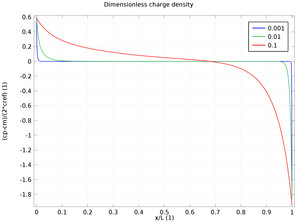
In the diffuse double layer and within the first few nanometers of an electrode surface, the assumption of electroneutrality is not valid due to charge separation. Typically, the diffuse double layer may be of interest when modeling very thin layers of electrolyte including those in ... Read More


