
The Application Gallery features COMSOL Multiphysics® tutorial and demo app files pertinent to the electrical, structural, acoustics, fluid, heat, and chemical disciplines. You can use these examples as a starting point for your own simulation work by downloading the tutorial model or demo app file and its accompanying instructions.
Search for tutorials and apps relevant to your area of expertise via the Quick Search feature. Note that many of the examples featured here can also be accessed via the Application Libraries that are built into the COMSOL Multiphysics® software and available from the File menu.
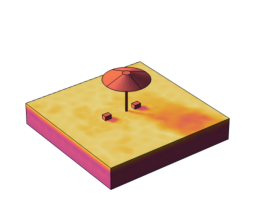
This tutorial model illustrates how to analyze the thermal effects of the sun as an external radiative source and considers wavelength-dependent surface emissivities. Specifically, the model features two coolers containing beverage cans that are exposed to ambient conditions and a beach ... Read More
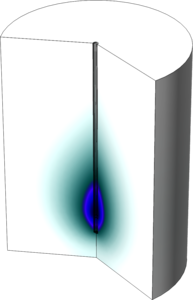
Electromagnetic heating is ideally suited for modeling in COMSOL Multiphysics. This model shows the area of hyperthermic oncology but the modeling issues and techniques are generally applicable to any problem involving electromagnetic heating. The purpose of this model is to compute the ... Read More
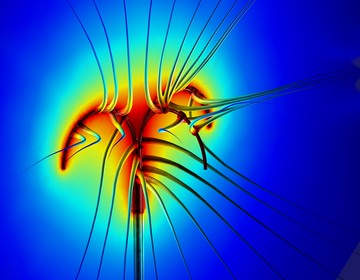
One method for removing cancerous tumors from healthy tissue is to heat the malignant tissue to a critical temperature that kills the cancer cells. This example accomplishes the localized heating by inserting a four-armed electric probe through which an electric current runs. Equations ... Read More
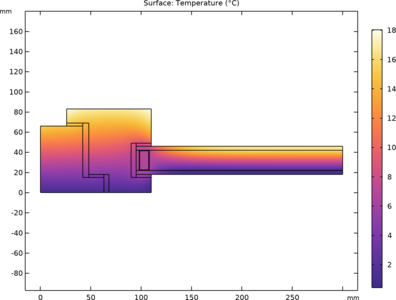
During the design of a building, environmental issues have gained considerable influence in the entire project. One of the first concerns is to improve thermal performances. In this process, simulation software are key tools to model thermal losses and performances in the building. The ... Read More
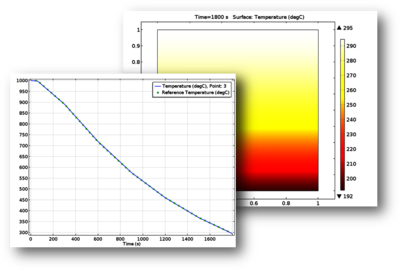
This entry is a compilation of some examples from DIN EN 1991-1-2 (Actions on structures exposed to fire). Models that are included: 1. Cooling (HT) 2. Heating (HT) 3. Heat transfer through multiple layers (HT) 4. Thermal elongation (SME, thermal stress) 5. Thermal expansion (SME, HT, ... Read More
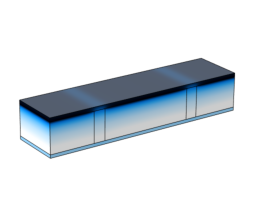
This 2D stationary model computes heat and moisture transport in a wall composed of different hygroscopic materials. A comparison with the Glaser method is given for the temperature and relative humidity solutions. The effect of the use of a vapor barrier is also investigated. Read More