
The Application Gallery features COMSOL Multiphysics® tutorial and demo app files pertinent to the electrical, structural, acoustics, fluid, heat, and chemical disciplines. You can use these examples as a starting point for your own simulation work by downloading the tutorial model or demo app file and its accompanying instructions.
Search for tutorials and apps relevant to your area of expertise via the Quick Search feature. Note that many of the examples featured here can also be accessed via the Application Libraries that are built into the COMSOL Multiphysics® software and available from the File menu.
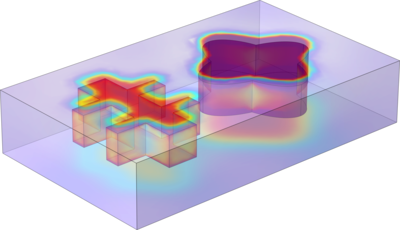
This example shows how to image the interior permittivity of a box by applying a potential difference on the boundaries of the box. The result is a surface charge density that depends on the permittivity of the medium inside the box. Read about this tutorial model in our blog post "The ... Read More
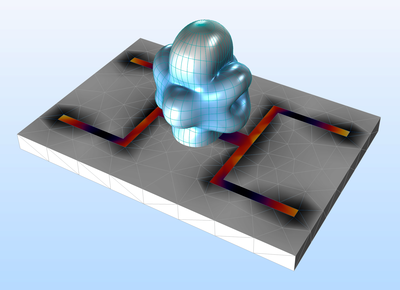
A wideband antenna study, such as an S-parameter or far-field pattern analysis, can be obtained by performing a transient response analysis and a time-to-frequency fast Fourier transform (FFT). This model runs a time dependent study first and then transforms the dependent variable, the ... Read More
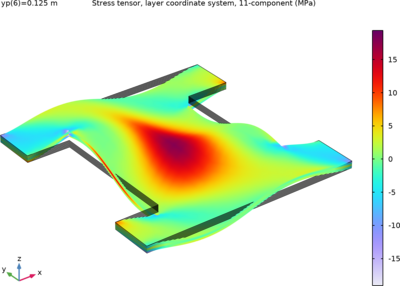
Composite materials are often used in structural applications because their properties, such as stiffness and strength, can be tailored to meet specific requirements. This makes them attractive alternatives to traditional engineering materials. Composites are also used in applications ... Read More
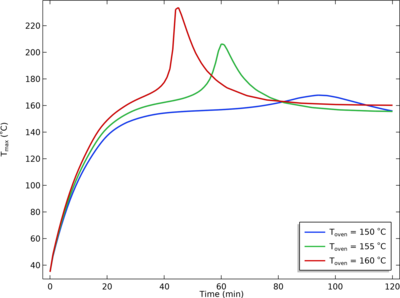
This example simulates the temperature dynamics in cylindrical battery, initially at room temperature, after being placed in an oven. As the temperature increases, various exothermal decomposition reactions are activated, which in turn result in further heating of the battery. Read More
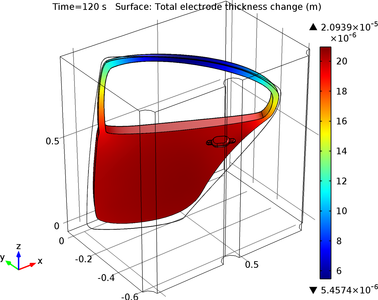
This example models electrocoating of paint onto a car door in a time-dependent simulation. The deposited paint is highly resistive which results in lowered local deposition rates for coated areas. A primary current distribution in combination with a film resistance model is used to ... Read More
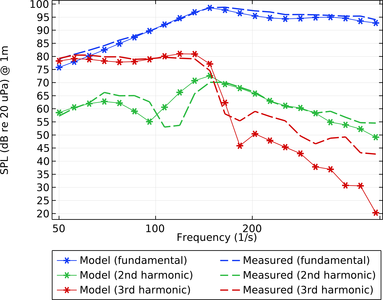
An automotive midwoofer is modeled using the lumped parameter approach. The electrical and mechanical components are modeled using a lumped electric circuit, which is coupled to a finite element model for the acoustics using the Lumped Speaker Boundary feature. The large signal ... Read More
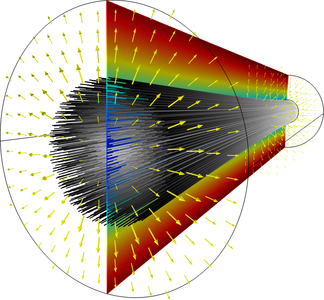
When modeling the propagation of charged particle beams at high currents, the space charge force generated by the beam significantly affects the trajectories of the charged particles. Perturbations to these trajectories, in turn, affect the space charge distribution. The Charged ... Read More
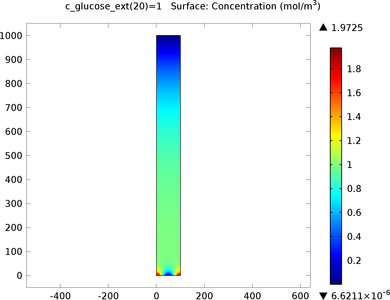
Electrochemical glucose sensors use amperometric methods to measure the concentration of glucose in a sample. This example models the diffusion of glucose and ferri/ferrocyanide redox mediators in a unit cell of electrolyte above an interdigitated electrode. The sensor gives a linear ... Read More
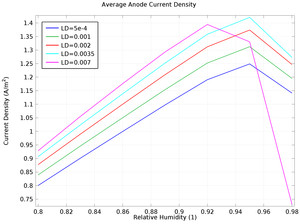
This model simulates atmospheric galvanic corrosion of an aluminum alloy in contact with steel. The electrolyte film thickness depends on the relative humidity of the surrounding air and the salt load density of NaCl crystals on the metal surface. Empirical expressions for the oxygen ... Read More
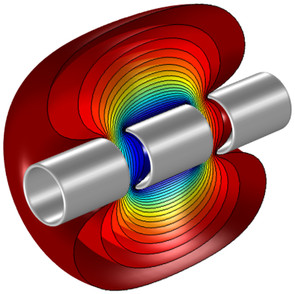
An Einzel lens is an electrostatic device used for focusing charged particle beams. It may be found in cathode ray tubes, ion beam and electron beam experiments, and ion propulsion systems. This particular model consists of three axially aligned cylinders. The outer cylinders are ... Read More


