
The Application Gallery features COMSOL Multiphysics® tutorial and demo app files pertinent to the electrical, structural, acoustics, fluid, heat, and chemical disciplines. You can use these examples as a starting point for your own simulation work by downloading the tutorial model or demo app file and its accompanying instructions.
Search for tutorials and apps relevant to your area of expertise via the Quick Search feature. Note that many of the examples featured here can also be accessed via the Application Libraries that are built into the COMSOL Multiphysics® software and available from the File menu.

Many piezoelectric materials are ferroelectric. Ferroelectric materials exhibit nonlinear polarization behavior, such as hysteresis and saturation at large applied electric fields. In addition, the polarization and mechanical deformations in such materials can be strongly coupled due to ... Read More
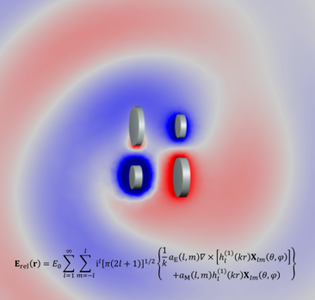
The multipole expansion is a powerful tool for analyzing electromagnetic waves scattered by small objects. In the expansion, the scattered field is represented as a superposition of the fields created by a finite set of point multipoles. Each point multipole is connected to a unique ... Read More
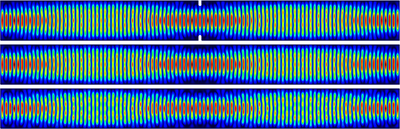
This model demonstrates three different ways to find the eigenfrequencies of a rectangular metallic cavity. The first method uses an eigenfrequency study step together with the Electromagnetic Waves, Beam Envelopes interface. Here, it is important to define a wave vector for the physics ... Read More
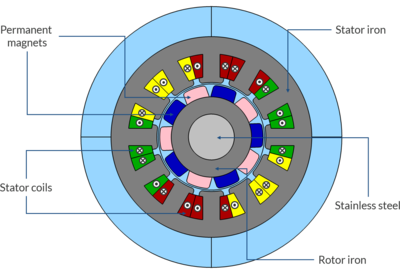
This is a primer model of a permanent magnet machine. It is a generic model that can be modified to simulate a motor or generator. It demonstrates different capabilities of COMSOL Multiphysics® to examine aspects of machine design, such as air gap magnetomotive force (MMF), ... Read More
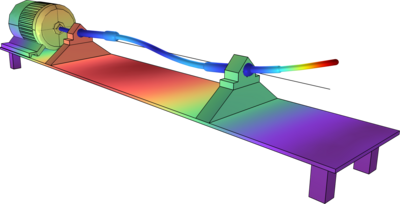
Active magnetic bearings are often used for controlling the vibration level in mechanical systems. In this example, a motor driven rotor system in which the speed of the system is gradually increased is considered. The system vibrates due to existing imbalances. As the rotor speed ... Read More
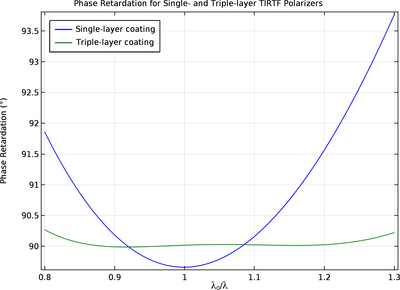
The capability to alter the polarization of light is crucial to a wide variety of optical devices. For example, the polarization of light has a significant effect on the performance of optical isolators, attenuators, and beam splitters. By assigning a specific polarization to light, most ... Read More
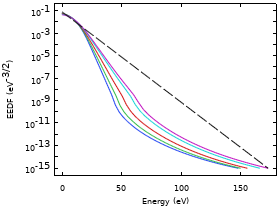
This tutorial models an ICP reactor by solving plasma fluid type equations fully coupled with the homogeneous and time-independent electron Boltzmann equation in the classical two-term approximation. The approximated Boltzmann equation is solved for each position of space and is coupled ... Read More
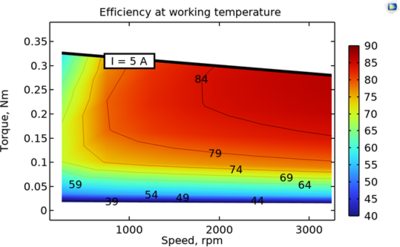
This a continuation of the permanent magnet motor model available here . In this model, an heat transfer analysis has been performed to compute the temperature rise for various stator current and rotor speed. A detailed analysis on torque, and losses in iron and copper have then been ... Read More
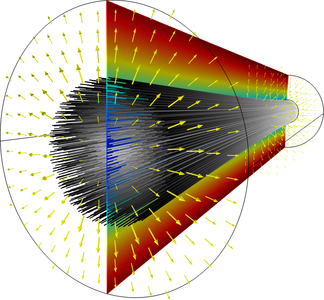
When modeling the propagation of charged particle beams at high currents, the space charge force generated by the beam significantly affects the trajectories of the charged particles. Perturbations to these trajectories, in turn, affect the space charge distribution. The Charged ... Read More

This tutorial model of a two-hot-arm thermal actuator couples three different physics phenomena: electric current conduction, heat conduction with heat generation, and structural stresses and strains due to thermal expansion. The model exists in three versions: Joule Heating of a ... Read More


