
The Application Gallery features COMSOL Multiphysics® tutorial and demo app files pertinent to the electrical, structural, acoustics, fluid, heat, and chemical disciplines. You can use these examples as a starting point for your own simulation work by downloading the tutorial model or demo app file and its accompanying instructions.
Search for tutorials and apps relevant to your area of expertise via the Quick Search feature. Note that many of the examples featured here can also be accessed via the Application Libraries that are built into the COMSOL Multiphysics® software and available from the File menu.
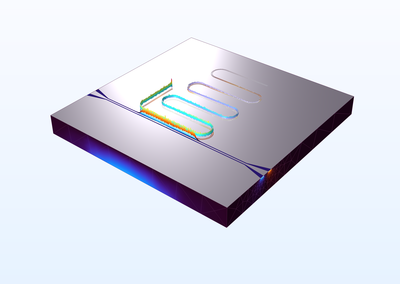
Developments in the last decade have made circuit quantum electrodynamics (cQED) the leading architecture for quantum computation. cQED is the solid-state version of cavity QED, which studies the basic light-matter interactions at the quantum level. This model examines one of the main ... Read More

This model demonstrates how to use topology optimization with milling constraints to design a metalens that focuses a single wavelength to a point. This involves transferring the optimized results to another component so the result can be verified using an explicit geometry ... Read More
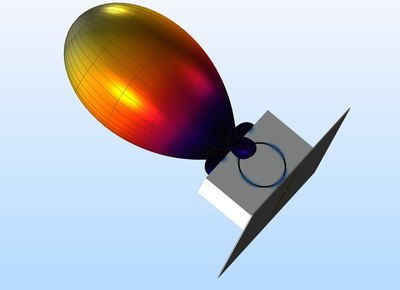
A dielectric resonator placed near a radiating element can be used to increase directivity and gain. Here, a block of quartz dielectric, with additional passive metallic antenna elements, is placed above a slot antenna. The fields in and around the antenna are solved for. The far field ... Read More
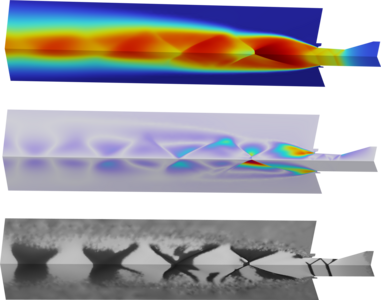
In this example, the High Mach Number Flow, Low Reynolds Number k-e interface is used to compute the compressible turbulent flow from a rectangular nozzle. Mesh refinement based on the estimation of the shock strength and the shear-layer strength is employed to achieve appropriate ... Read More
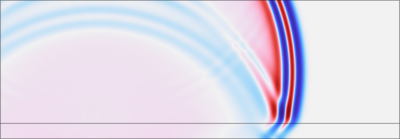
This tutorial studies the propagation of sound in the presence of a porous absorber in the time domain. It demonstrates how to model a porous absorber using the local and extended reacting approximations and compares the two approaches for absorbers of various thickness. The dissipative ... Read More
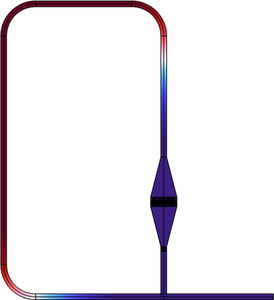
The models simulate the working mechanism of traveling wave thermoacoustic engines. Similary to the standing wave engines, the traveling wave engines make use of the coupling between the fluid motion and the temperature change experienced by the fluid to generate acoustic energy. ... Read More
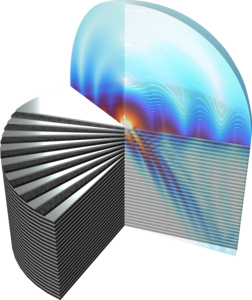
The modal dispersion in a metamaterial can be engineered by changing the type of material and dimension of the composing unit cells. For instance, a periodically organized subwavelength metal–dielectric layered metamaterial exhibits an anisotropic dispersion characteristic in the ... Read More
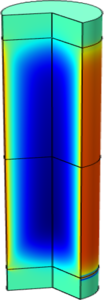
A gate-all-around MOSFET consists of a nanowire with a gate electrode wrapped around the circumference. Since the entire nanowire forms the channel, this configuration provides the best possible electrostatic control of the channel and offers a good candidate for the miniaturization of ... Read More
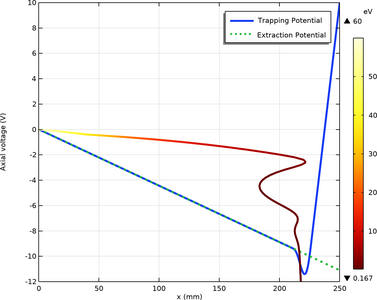
A radio frequency quadrupole ion trap utilizes a radio frequency quadrupole (RFQ) in order to trap an ion beam. A continuous high energy ion beam is first cooled and converted into a spatially confined bunch, which can then be released with minimal heating of the beam. The device is also ... Read More
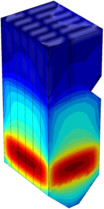
This model uses the discrete-ordinates method (DOM) to analyze the radiative heat transfer in a utility boiler with internal obstacles. DOM is one of the most useful radiation models for prediction of radiative heat fluxes on the furnace walls of a combustion chamber. With this model, ... Read More