
The Application Gallery features COMSOL Multiphysics® tutorial and demo app files pertinent to the electrical, structural, acoustics, fluid, heat, and chemical disciplines. You can use these examples as a starting point for your own simulation work by downloading the tutorial model or demo app file and its accompanying instructions.
Search for tutorials and apps relevant to your area of expertise via the Quick Search feature. Note that many of the examples featured here can also be accessed via the Application Libraries that are built into the COMSOL Multiphysics® software and available from the File menu.
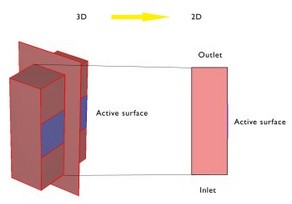
This model demonstrates how to model phenomena defined in different dimensions in a fully coupled manner using COMSOL Multiphysics. Whereas in most cases the reaction rate expression is defined as a function of the concentrations of the reactants and products, in adsorption reactions ... Read More
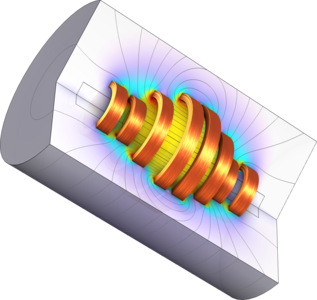
This example shows how to use the Optimization Module to find a coil geometry giving a uniform magnetic field on axis and minimal field near the axis ends. Read More

Turbulent flow, SSG-LRR interface is used to analyze fully developed turbulent flow in an axially rotating pipe and in a swirling jet emanating from such a pipe. The resulting flow pattern in the pipe is characterized by slower-than-solid-body rotation. Axial velocity of the swirling jet ... Read More
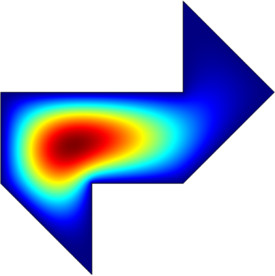
Striking a drum excites a spectrum of vibration modes that together make up the instrument’s characteristic sound or acoustic signal. These vibration modes correspond to the eigenmodes, or eigenfunctions, of the drum’s membrane. Thus you can study this problem by solving eigenvalue ... Read More
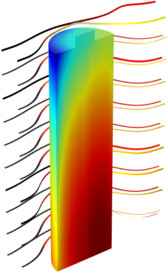
This example simulates the heat profile in an air-cooled cylindrical battery in 3d. The battery is placed in a matrix in a battery pack. The thermal model is coupled to a 1d-battery model that is used to generate a heat source in the active battery material. The model requires the ... Read More
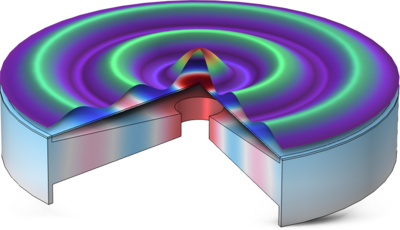
This example of a simple axisymmetric condenser microphone includes all the relevant physics and determines the microphone sensitivity as well as microphone capacitance for the specific simplified microphone geometry and material parameters. It solves a fully coupled multiphysics model ... Read More
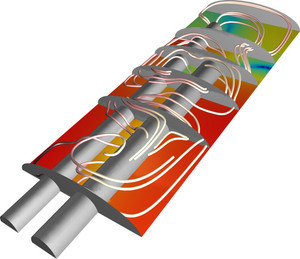
Reflective mufflers are best suited for the low-frequency range where only plane waves can propagate in the system, while dissipative mufflers with fibers are efficient in the mid- to high-frequency range. Dissipative mufflers based on flow losses, on the other hand, also work at low ... Read More
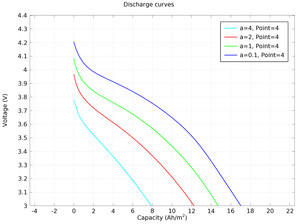
This model demonstrates the Lithium-Ion Battery interface for studying the discharge and charge of a lithium-ion battery for a given set of material properties. The geometry is in one dimension and the model is isothermal. Battery developers can use the model to investigate the influence ... Read More
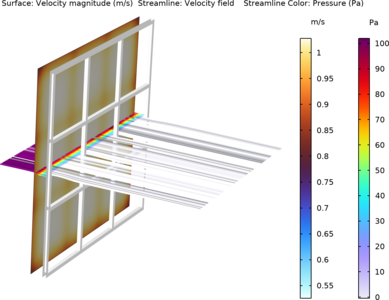
This example demonstrates simulation of a turbulent flow in a geometry with an air filter. Porous material of the filter induces an abrupt pressure drop and drastic increase of turbulence level inside the filter. Read More
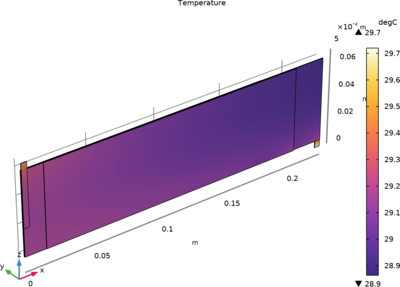
This example replicates the results of the Jelly Roll tutorial example using a flattened representation of the wound spiral-based geometry. See that model entry for details on the background, original geometry, materials, and the general physics setup. Mapping the original problem to a ... Read More


