
The Application Gallery features COMSOL Multiphysics® tutorial and demo app files pertinent to the electrical, structural, acoustics, fluid, heat, and chemical disciplines. You can use these examples as a starting point for your own simulation work by downloading the tutorial model or demo app file and its accompanying instructions.
Search for tutorials and apps relevant to your area of expertise via the Quick Search feature. Note that many of the examples featured here can also be accessed via the Application Libraries that are built into the COMSOL Multiphysics® software and available from the File menu.
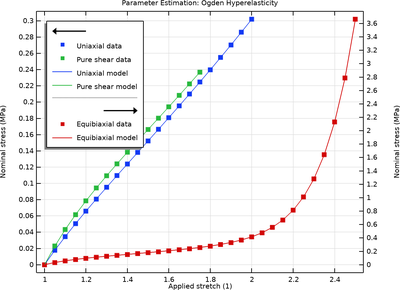
This tutorial model demonstrates how to set up a parameter estimation study for fitting the material parameters of an Ogden hyperelastic model to experimental data. The procedure considers multiple load cases under large deformations, which is often necessary to obtain constitutive ... Read More
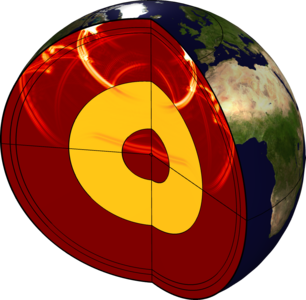
This tutorial model analyzes the propagation of seismic waves through Earth's internal structure. The model uses a 2D axisymmetric geometry to represent the material discontinuities and the variation of properties through the concentric layers of the earth. A simplified earthquake ... Read More

This model studies the temperature effects on the viscoelastic stress relaxation in a long thick-walled cylinder. In particular, decay of the stresses under the influence of the temperature field during a period of two hours is studied. A four-term generalized Maxwell model represents ... Read More
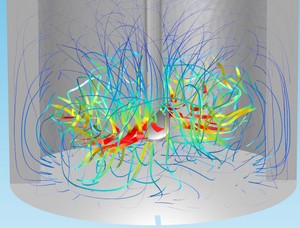
This model exemplifies the use of the Rotating Machinery interface, which allows you to model moving rotating parts in, for example, stirred tanks, mixers, and pumps. The Rotating Machinery interface formulates the Navier-Stokes equations in a rotating coordinate system. Parts that are ... Read More
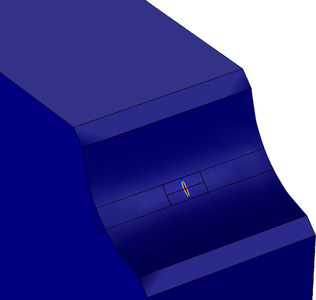
When a linear guide is loaded above the manufacturer's specification limit, one concern is whether the contact loads will introduce fatigue spalling. In this system analysis, the entire guide has been analyzed and the mostly damaging contact load has been identified to occur on a rail ... Read More
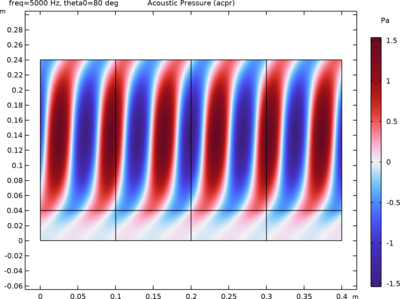
This is a 2D model of an anisotropic porous absorbing material. The absorption coefficient alpha are determined as functions of frequency for three different incidence angles. The example uses Periodic Floquet boundary conditions. The model uses two different methods for modeling the ... Read More
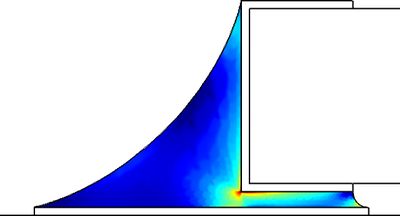
A surface mount resistor is subjected to thermal cycling. The difference in the thermal expansion of different materials will introduce stresses in the structure. The solder which connects the resistor with the printed circuit board is seen as the weakest link in the assembly. It ... Read More
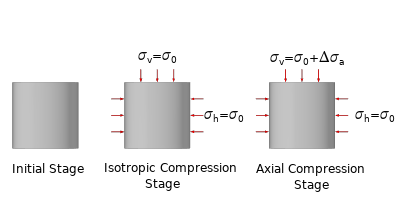
In this example, monotonic and cyclic triaxial tests are simulated using the Hardening Soil Small Strain material model. The model captures the effects of small strain stiffness and hysteresis under cyclic loading. The stress-strain relationship matches the hyperbolic curve reported in ... Read More
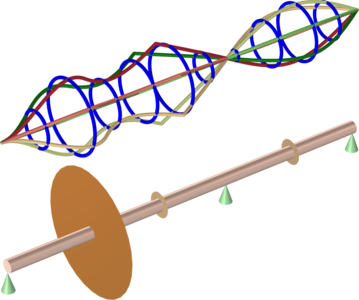
In this example, learn how to model two rotors connected by a spline coupling. The first rotor is a fixed cantilevered rotor and the second rotor is supported. The model assumes that only translational motion is coupled between the rotors through the coupling, while the rotations of both ... Read More
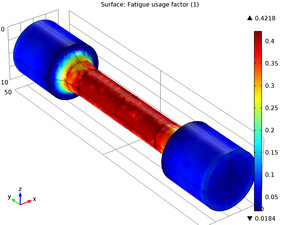
A benchmark model for the fatigue module. A cylindrical test is subjected to non-proportional loading. Three stress based models: Findley, Matake, Normal stress, are compared to analytical values and to each other. The non-smooth behavior of the Matake model is captured and discussed. Read More