
The Application Gallery features COMSOL Multiphysics® tutorial and demo app files pertinent to the electrical, structural, acoustics, fluid, heat, and chemical disciplines. You can use these examples as a starting point for your own simulation work by downloading the tutorial model or demo app file and its accompanying instructions.
Search for tutorials and apps relevant to your area of expertise via the Quick Search feature. Note that many of the examples featured here can also be accessed via the Application Libraries that are built into the COMSOL Multiphysics® software and available from the File menu.
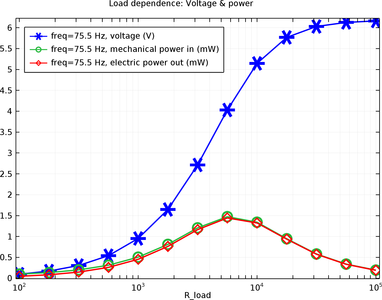
This model shows how to analyze a simple, cantilever based, piezoelectric energy harvester. A sinusoidal acceleration is applied to the energy harvester and the output power is evaluated as a function of frequency, load impedance and acceleration magnitude. Read More
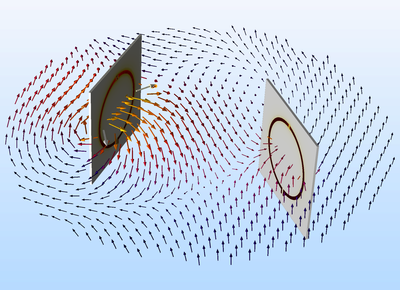
This model addresses the concept of wireless power transfer by studying the energy coupling between two circular loop antennas tuned for UHF RFID frequency whose size is reduced using chip inductors. The circular loop antenna provides inherent inductive coupling by its shape, and it can ... Read More
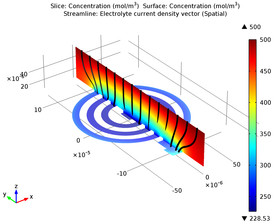
This example models the deposition of an inductor coil in 3D. The geometry includes the extrusion of the deposition pattern into an isolating photoresist mask, and a diffusion layer on top of the photoresist. The mass transfer of copper ions in the electrolyte has a major impact on the ... Read More
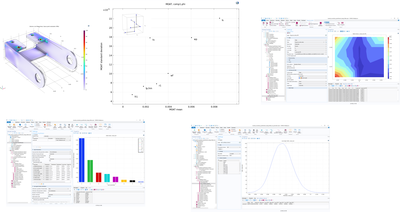
This example demonstrates how to use the Uncertainty Quantification Module by running a series of uncertainty quantification studies for a steel bracket. This type of bracket can be used to install an actuator that is mounted on a pin placed between the two holes in the bracket arms. ... Read More
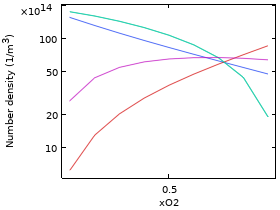
This tutorial model solves for an inductively coupled plasma reactor in a mixture of argon/oxygen. The model computes the fluid flow and gas heating. Important aspects and strategies for modeling electronegative discharges are discussed. Read More
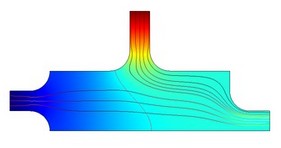
This model shows how a flow model can be coupled to a process control mechanism. Controlling application parameters according to other application parameters is important within process engineering. Most control mechanisms use the data at a wall or an outlet to control inlet ... Read More

Some conventional three-port power dividers are resistive power dividers and T-junction power dividers. Such dividers are either lossy or not matched to the system reference impedance at all ports. In addition, isolation between two coupled ports is not guaranteed. The Wilkinson power ... Read More
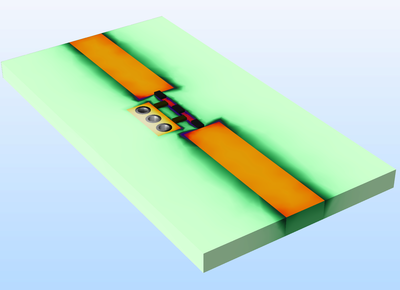
Passive devices can be designed using lumped element features if both the operating frequency of the device and the insertion loss of lumped elements are low. This example simulates two types of lumped element filters that are similar to lumped ports, except that they are strictly ... Read More
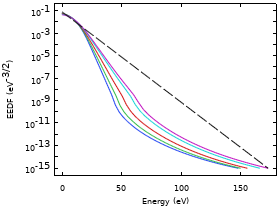
This tutorial models an ICP reactor by solving plasma fluid type equations fully coupled with the homogeneous and time-independent electron Boltzmann equation in the classical two-term approximation. The approximated Boltzmann equation is solved for each position of space and is coupled ... Read More
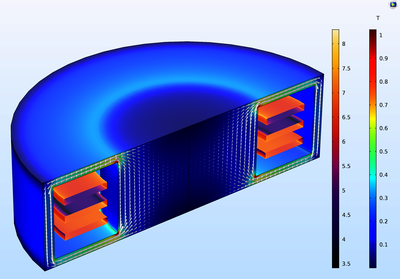
Inductive devices experience capacitative coupling between conductors at high frequencies. Modeling this phenomenon requires that you describe electric fields that have components both parallel with and perpendicular to the wire. This consideration might lead to the conclusion that a 3D ... Read More