
The Application Gallery features COMSOL Multiphysics® tutorial and demo app files pertinent to the electrical, structural, acoustics, fluid, heat, and chemical disciplines. You can use these examples as a starting point for your own simulation work by downloading the tutorial model or demo app file and its accompanying instructions.
Search for tutorials and apps relevant to your area of expertise via the Quick Search feature. Note that many of the examples featured here can also be accessed via the Application Libraries that are built into the COMSOL Multiphysics® software and available from the File menu.
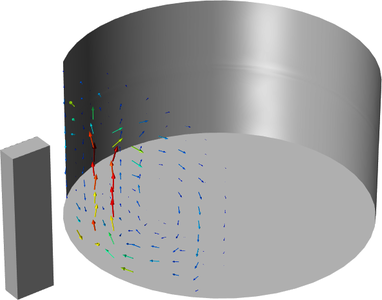
This is a tutorial how to set up electric machinery in 3D using a combination of the magnetic fields and magnetic fields no currents interfaces. Read More
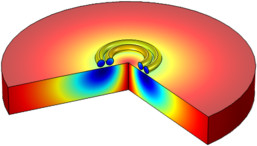
A time-varying current induces a time-varying magnetic field. The magnetic field induces currents in neighboring conductors. The induced currents are called eddy currents. In this model, the phenomenon is illustrated by a time-harmonic field simulation as well as a transient analysis, ... Read More
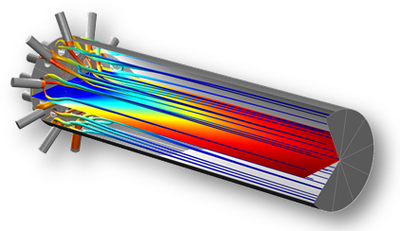
In a polymerization reactor for polyester manufacturing, the mixing in the reactor is achieved by impinging turbulent jets of reactants onto each other. The turbulence affects the reaction kinetics and quality of the polymer linkage. Turbulent flows involving rapid reaction kinetics are ... Read More
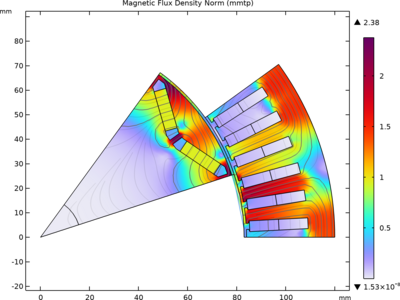
Obtaining the steady-state performance is an essential task for the electric motor designer. As with many electromagnetic devices, the steady-state condition of an electric motor is when electric and magnetic field variations have stabilized to periodic variations. That is when ... Read More

Turbulent flow, SSG-LRR interface is used to analyze fully developed turbulent flow in an axially rotating pipe and in a swirling jet emanating from such a pipe. The resulting flow pattern in the pipe is characterized by slower-than-solid-body rotation. Axial velocity of the swirling jet ... Read More
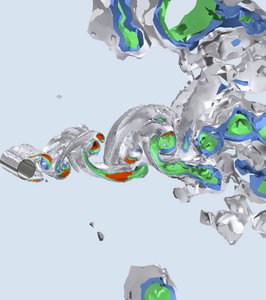
The model compare the two RANS models SST and SST-SAS for turbulent flow around a cylinder. The SST-SAS model resolve more transversal turbulent structures compared to the SST model. Read More
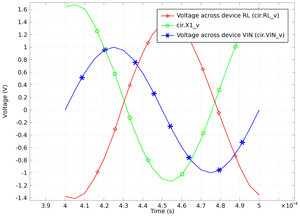
This model shows how to combine an electric circuit simulation with a finite element simulation. The finite element model is an inductor with a nonlinear magnetic core and 1000 turns, where the number of turns is modeled using a distributed current technique. The circuit is imported ... Read More
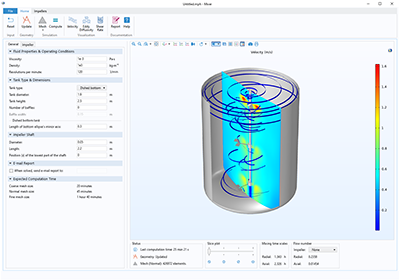
This app demonstrates the following: Multiple tabs in the ribbon Geometry parts and parameterized geometries Parts and cumulative selections can be used to automatically set domain and boundary settings in the embedded model Adding or removing geometry parts with different geometrical ... Read More

The Turbulent flow, Elliptic Blending R-ε interface is used to analyze fully developed turbulent flow in a spanwise rotating channel. Due to the influence of the Coriolis force on turbulence, profiles of the flow variables are skewed at moderate rotation rates. An asymmetry between the ... Read More
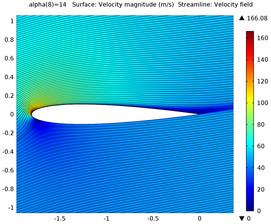
This model simulates the flow around an inclined NACA 0012 airfoil at different angles of attack using the SST turbulence model. The results show good agreement with the experimental lift data of Ladson and the pressure data of Gregory and O’Reilly. Read More


