
The Application Gallery features COMSOL Multiphysics® tutorial and demo app files pertinent to the electrical, structural, acoustics, fluid, heat, and chemical disciplines. You can use these examples as a starting point for your own simulation work by downloading the tutorial model or demo app file and its accompanying instructions.
Search for tutorials and apps relevant to your area of expertise via the Quick Search feature. Note that many of the examples featured here can also be accessed via the Application Libraries that are built into the COMSOL Multiphysics® software and available from the File menu.
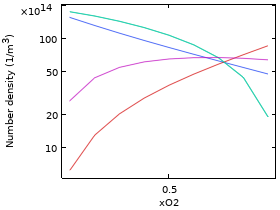
This tutorial model solves for an inductively coupled plasma reactor in a mixture of argon/oxygen. The model computes the fluid flow and gas heating. Important aspects and strategies for modeling electronegative discharges are discussed. Read More
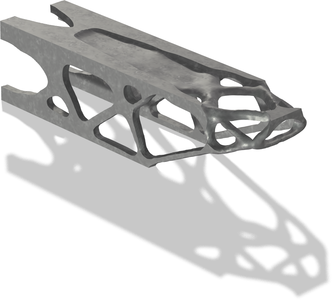
This model demonstrates how to design a beam without low Eigenfrequencies by combining the Density Model feature in the Topology Optimization interface with the Stationary Then Eigenfrequency study step. Read More

This model shows how to set up a simulation of flow through a fractured reservoir. The reservoir includes a discrete fracture network (DFN), where the fractures have a randomized distribution of position, size, orientation and aperture. The model uses the Discrete Fracture Network Add ... Read More
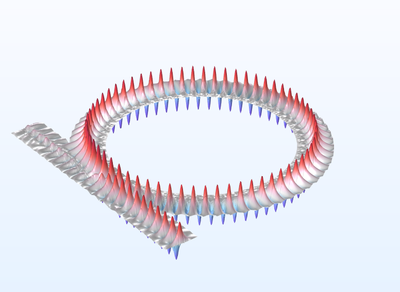
This example calculates the spectral properties of a 3D optical ring resonator. The model demonstrates how to use parts from the Wave Optics Parts Library and how to setup the Field Continuity boundary condition at boundaries, where there is a jump in the predefined phase approximation. Read More
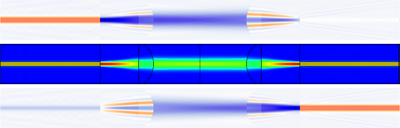
Focusing a laser beam onto the tip of a single mode fiber is a common way to couple light. To achieve good coupling efficiency, the spatial mode of the light field has to match the spatial mode of the fiber. In this model, we use the beam envelopes method to compute a small free-space ... Read More
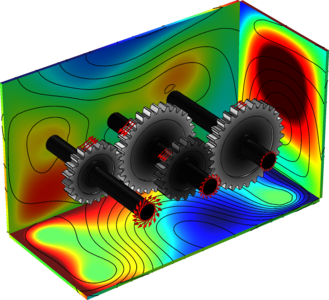
This model simulates vibrations in a compound gear train. Spur gears, used to model the gear train, are mounted on rigid shafts. The shafts are supported by an elastic housing at both ends. The gear mesh is assumed to be elastic with varying stiffness, which is the source of vibration. A ... Read More
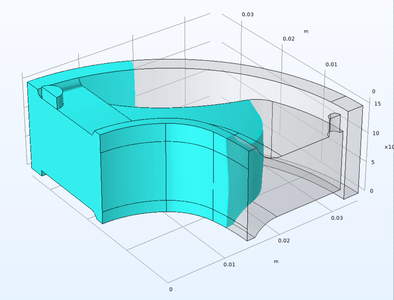
This tutorial shows how to set up a 3D simulation of rubber injection molding. A phase field method is used to track the interface between the rubber and the displaced air. The rubber is modeled as shear-thinning inelastic non-Newtonian power law fluid with a fluid-consistency ... Read More
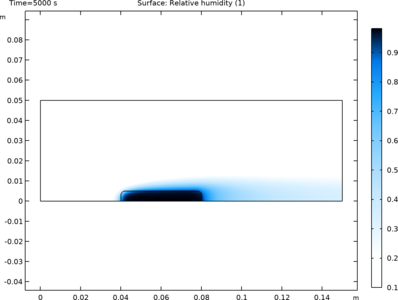
Drying of porous media is an important process in the food and paper industry among others. Many physical effects must be considered: fluid flow, heat transfer with phase change, and transport of participating liquids and gases. All of these effects are strongly coupled, and predefined ... Read More


