
The Application Gallery features COMSOL Multiphysics® tutorial and demo app files pertinent to the electrical, structural, acoustics, fluid, heat, and chemical disciplines. You can use these examples as a starting point for your own simulation work by downloading the tutorial model or demo app file and its accompanying instructions.
Search for tutorials and apps relevant to your area of expertise via the Quick Search feature. Note that many of the examples featured here can also be accessed via the Application Libraries that are built into the COMSOL Multiphysics® software and available from the File menu.
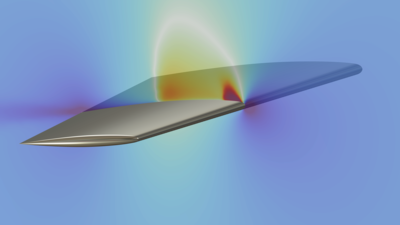
This example demonstrates how to set up the classical external-flow problem of solving for the high-speed, compressible, turbulent flow over the ONERA-M6 wing. The problem involves finding a steady-state solution of the flow field around the 3D, swept wing geometry, immersed in a ... Read More
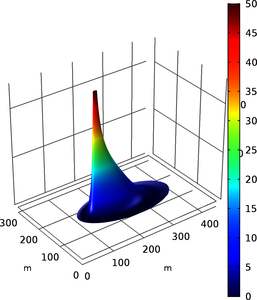
This model tracks a contaminant that enters an aquifer at a point, such as an injection well or toxic spill, and spreads through the aquifer with time. The model has an analytic solution developed by Wilson and Miller. This analytic solution has been used to test several dedicated fluid ... Read More
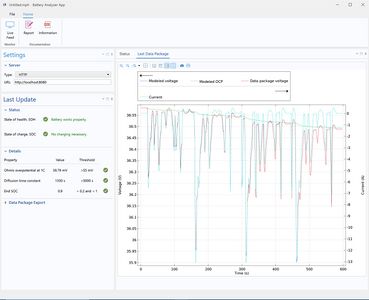
These two apps can be run to set up a digital twin of an electric scooter battery. The Digital Twin Simulator of an Electric Scooter Battery (the "simulator" app) simulates the use of an electric scooter and generates battery current and voltage data over time. The Digital Twin ... Read More
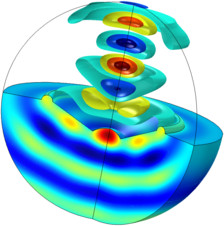
This is a model of a moving-coil loudspeaker where a lumped parameter analogy represents the behavior of the electrical and mechanical speaker components. The Thiele-Small parameters (small-signal parameters) serve as input to the lumped model, which is represented by an Electric Circuit ... Read More
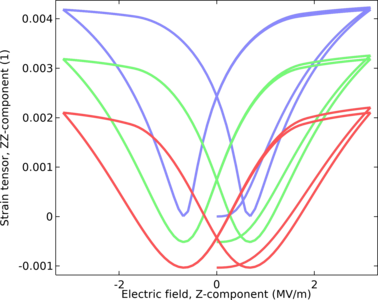
Many piezoelectric materials are ferroelectric. Ferroelectric materials exhibit nonlinear polarization behavior, such as hysteresis and saturation at large applied electric fields. In addition, the polarization and mechanical deformations in such materials can be strongly coupled due to ... Read More
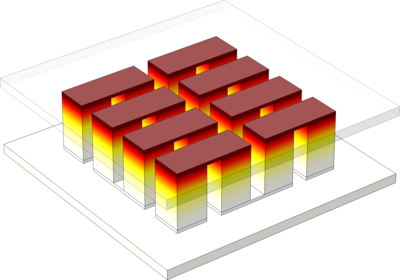
This app demonstrates the following: Visualizing material appearance, color, and texture Showing info below the graphics about geometry parameters, results and performance depending on the selected plot action Thermoelectric coolers are widely used for electronics cooling in various ... Read More
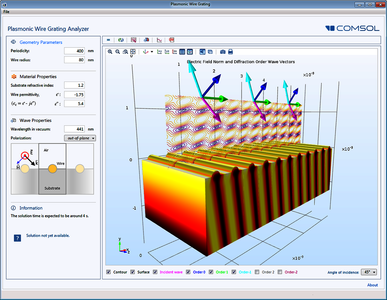
Surface plasmon-based circuits are being used in applications such as plasmonic chips, light generation, and nanolithography. The Plasmonic Wire Grating Analyzer application computes the coefficients of refraction, specular reflection, and first-order diffraction as functions of the ... Read More
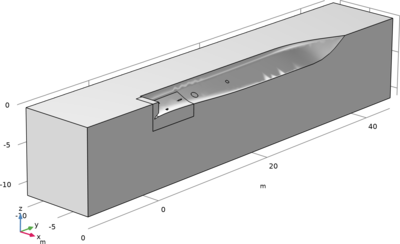
Example for a geometry sequence to create a ship hull using Loft. The different cross sections are defined using Dimensions and Constraints. Read More
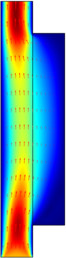
This is a tutorial model of the coupling between flow of a fluid in an open channel and a porous block attached to one of the channel walls. The flow is described by the Navier-Stokes equation in the free region and a Forchheimer-corrected version of the Brinkman equations in the porous ... Read More
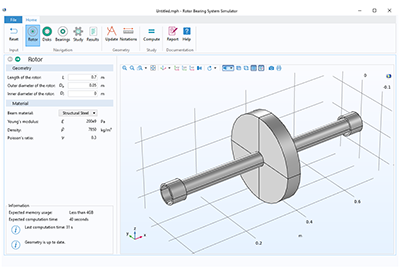
This app demonstrates the following: Navigation system using toggle buttons in the ribbon and Back/Forward buttons in the settings window Selecting predefined or user-defined materials Using a table for input of geometry objects The app simulates a rotor bearing system consisting of ... Read More


