
The Application Gallery features COMSOL Multiphysics® tutorial and demo app files pertinent to the electrical, structural, acoustics, fluid, heat, and chemical disciplines. You can use these examples as a starting point for your own simulation work by downloading the tutorial model or demo app file and its accompanying instructions.
Search for tutorials and apps relevant to your area of expertise via the Quick Search feature. Note that many of the examples featured here can also be accessed via the Application Libraries that are built into the COMSOL Multiphysics® software and available from the File menu.

This model presents a study of the current density distribution in a solid oxide fuel cell (SOFC). The model includes the full coupling between the mass balances at the anode and cathode, the momentum balances in the gas channels, the gas flow in the porous electrodes, the balance of ... Read More
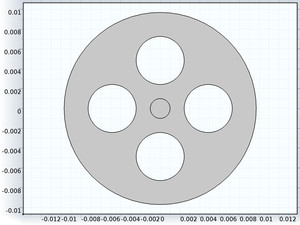
A quadrupole mass filter (QMF) is a key component of a modern mass spectrometer. A QMF uses direct current (DC) and alternating current (AC) electric fields to analyze positive or negative ions by mass to charge ratio. A QMF consists of 4 parallel rods spaced equidistantly, the ratio of ... Read More
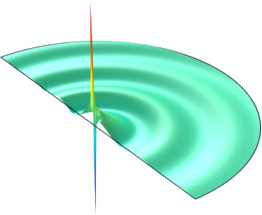
We have all noticed the Doppler effect when an ambulance passes by with its sirens blaring. The siren’s pitch suddenly drops the moment the ambulance starts moving away from you. Another effect you can notice is how the siren’s sound is very loud when nearby, but as soon as the ... Read More
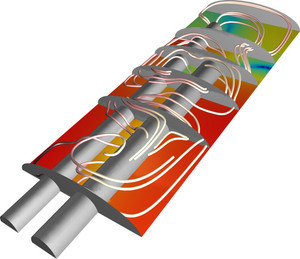
Reflective mufflers are best suited for the low-frequency range where only plane waves can propagate in the system, while dissipative mufflers with fibers are efficient in the mid- to high-frequency range. Dissipative mufflers based on flow losses, on the other hand, also work at low ... Read More
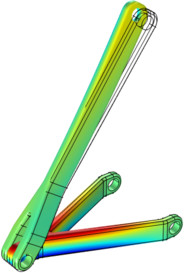
A hinge between two mechanical components is modeled by coupling two rigid connectors. This method can be used for simulating many types of mechanisms. In mechanical assemblies, parts are sometimes connected so that they are free to move relative to each other in one or more degrees of ... Read More
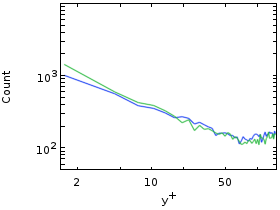
In this benchmark model, solid particles are released in a fully developed turbulent channel flow. The particles are subjected to a drag force that includes contributions from the fluid turbulence, implemented using a Continuous Random Walk (CRW) model. Because the turbulence in the ... Read More
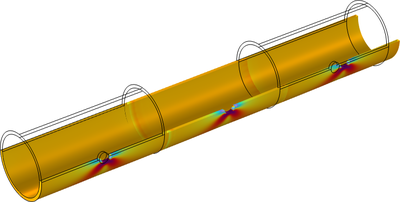
This tutorial model shows how to model a structure using both shell and solid elements, and how to create the transition between them. Results are compared between the shell solution and the full 3D solution, and the effects of the transition are highlighted. Read More
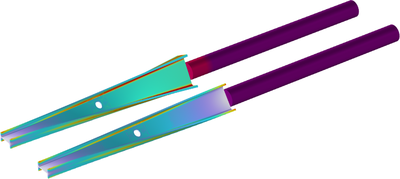
This example demonstrates the use of the Solid-Beam Connection multiphysics coupling to create transitions between the Solid Mechanics and Beam interfaces. Two different connection types are discussed, and a comparison of the stress distributions at the transition is made. Read More
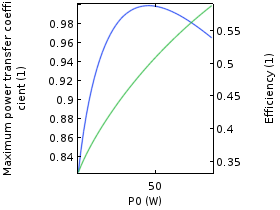
This tutorial drives a capacitively coupled plasma with an L-type matching network at high and low powers. At low power, where the harmonics in the current are low, prefect matching is obtained at the chosen power value. Sweeps over power, frequency, and pressure are performed and their ... Read More
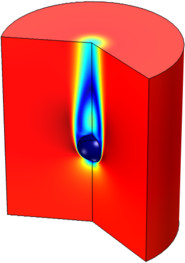
The first stop for polluted water entering a water work is normally a large tank, where large particles are left to settle. Generally, gravity settling is an economical method of separating particles. If the fluid in the tank is moving at a controlled low velocity, the particles can be ... Read More