
The Application Gallery features COMSOL Multiphysics® tutorial and demo app files pertinent to the electrical, structural, acoustics, fluid, heat, and chemical disciplines. You can use these examples as a starting point for your own simulation work by downloading the tutorial model or demo app file and its accompanying instructions.
Search for tutorials and apps relevant to your area of expertise via the Quick Search feature. Note that many of the examples featured here can also be accessed via the Application Libraries that are built into the COMSOL Multiphysics® software and available from the File menu.
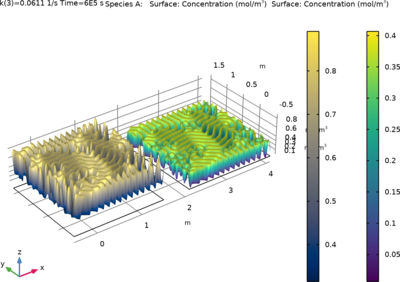
A deceptively simple system of two species and two reactions, describing the autocatalytic conversion of a substance, is shown to display a surprisingly exotic behavior. Starting from a 0D CSTR description, a 2D reaction-diffusion problem is formulated showing rich patterns stemming from ... Read More
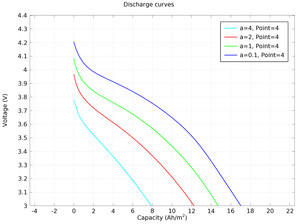
This model demonstrates the Lithium-Ion Battery interface for studying the discharge and charge of a lithium-ion battery for a given set of material properties. The geometry is in one dimension and the model is isothermal. Battery developers can use the model to investigate the influence ... Read More
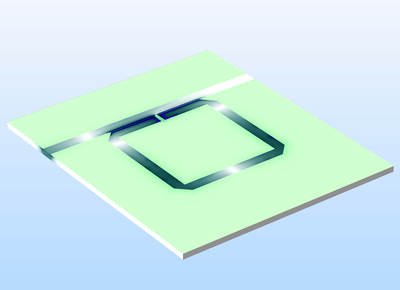
A split ring resonator (SRR) has a band-stop frequency response that rejects a certain range of frequency. This type of SRR structure is popularly used as a resonator itself and can be combined periodically to build artificial meta-materials. In this model, a printed SRR on a ... Read More
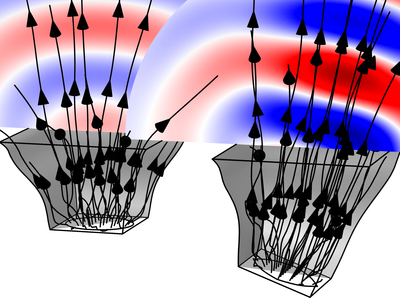
This model demonstrates how to use the Control Function feature to perform shape optimization on a rectangular horn for an improved on axis response. The results of the initial design are exported to a new component via a Filter dataset. Further, the off-axis spatial response is improved ... Read More
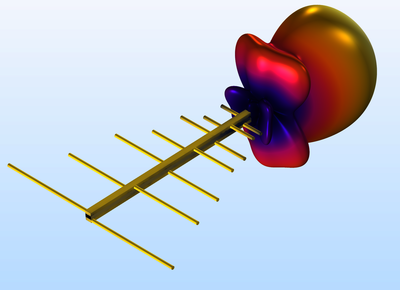
The shape of a log-periodic antenna resembles that of a Yagi-Uda antenna, but is composed of a coplanar array to achieve a wider bandwidth. It is also known as a wideband or frequency-independent antenna. All metallic parts are modeled using the perfect electric conductor (PEC) boundary ... Read More
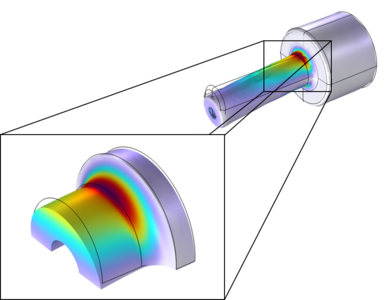
This model shows how to perform a submodeling analysis in order to evaluate structural stress. Using a submodel helps to compute the results in a refined geometry detail while applying loads and constraints in the global model. Read More
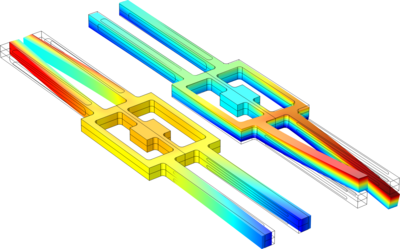
This model shows how to analyze a tuning fork based piezoelectric rate gyroscope. The reverse piezoelectric effect is used to drive an in-plane tuning fork mode. This mode is coupled to an out of plane mode by the Coriolis force and the resulting out of plane motion is sensed by the ... Read More
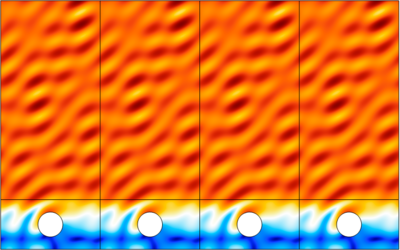
This is a model of acoustic absorption by a porous acoustic open cell foam. In porous materials the sound propagates in a network of small interconnected pores. Because the dimensions of the pores are small, losses occur due to thermal conduction and viscous friction. Acoustic foams are ... Read More


