
The Application Gallery features COMSOL Multiphysics® tutorial and demo app files pertinent to the electrical, structural, acoustics, fluid, heat, and chemical disciplines. You can use these examples as a starting point for your own simulation work by downloading the tutorial model or demo app file and its accompanying instructions.
Search for tutorials and apps relevant to your area of expertise via the Quick Search feature. Note that many of the examples featured here can also be accessed via the Application Libraries that are built into the COMSOL Multiphysics® software and available from the File menu.
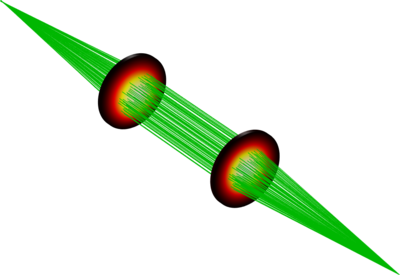
A modern high-power industrial fiber laser system can deliver up to 3kW of single-mode laser radiation on to surfaces to be cut, drilled, welded or marked. Even using highly transmissive materials, the optical component used to focus the laser beam onto target surfaces can be affected ... Read More
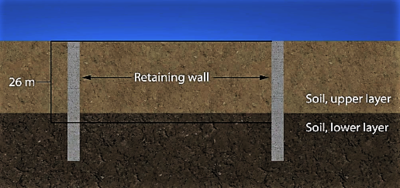
This example shows how to model a deep excavation. The main application area of this type of modeling is in civil engineering. In this case, the in situ lateral pressure acting on the retaining wall during the soil excavation is modeled with boundary loads. The soil assumes Drucker ... Read More
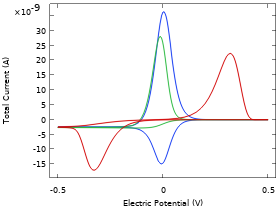
For an electrochemical reaction to occur, the reacting species usually needs to adsorb to the electrode surface before undergoing reduction or oxidation, after which the resulting product species desorbs back into the electrolyte. If the rate of adsorption or desorption is slow in ... Read More
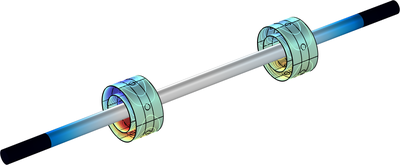
In this model, a turbocharger supported on two floating ring bearings is studied. The film forces on the ring cause it to rotate within the bearing. In steady state, the ring rotates at a constant angular speed and the torque on the ring due to the inner and outer films are balanced. ... Read More
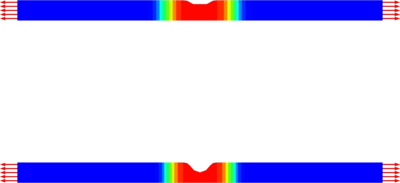
In this tutorial model, different methods for modeling brittle damage are compared in a simple model of a uniaxially loaded bar. The localization of the deformation during fracture is studied using different discretization orders and regularization methods. Read More
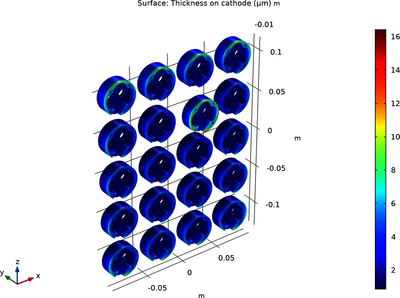
When several components are to be electroplated they are typically mounted on a rack in the electroplating bath. An important aspect is then achieving a uniform thickness of the plated layer for all components mounted on the rack. This example model allows for investigating the effect ... Read More
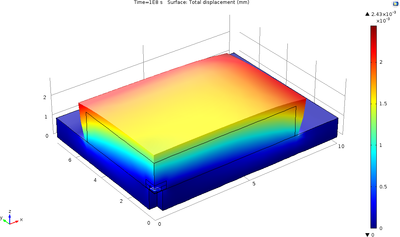
Modern integrated circuits are available as plastic encapsulated microcircuits (PEM). These devices are molded out of polymeric materials and epoxy resins in order to protect the internal semiconductors. Unfortunately, polymeric mold compounds absorb moisture when exposed to a humid ... Read More
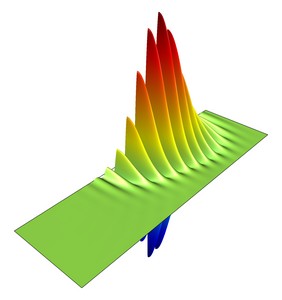
It is possible to generate harmonics that are multiples of the frequency of laser light by using nonlinear optical materials. This model demonstrates second harmonic generation using transient wave simulation and nonlinear material properties. A YAG (lambda=1.06 micron) laser beam is ... Read More
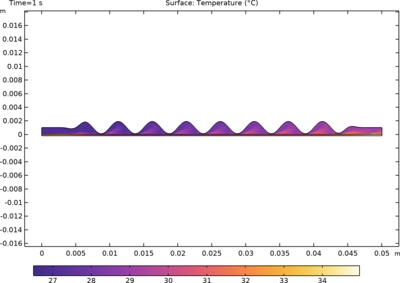
The heat exchanger in this tutorial model contains a dynamic wall with an oscillating wave shape. The deformation induces mixing in the fluid and reduces the formation of thermal boundary layers. Hence, it increases heat transfer between the walls and the fluid. In addition, the wave ... Read More
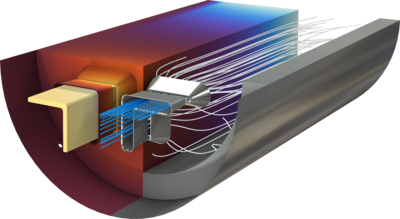
In massive forming processes like rolling or extrusion, metal alloys are deformed in a hot solid state with material flowing under ideally plastic conditions. Such processes can be simulated effectively using computational fluid dynamics, where the material is considered as a fluid with ... Read More


