
The Application Gallery features COMSOL Multiphysics® tutorial and demo app files pertinent to the electrical, structural, acoustics, fluid, heat, and chemical disciplines. You can use these examples as a starting point for your own simulation work by downloading the tutorial model or demo app file and its accompanying instructions.
Search for tutorials and apps relevant to your area of expertise via the Quick Search feature. Note that many of the examples featured here can also be accessed via the Application Libraries that are built into the COMSOL Multiphysics® software and available from the File menu.
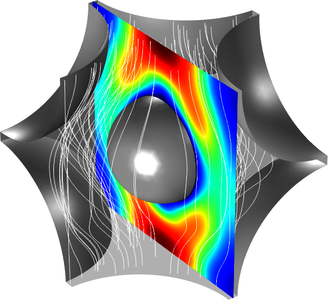
This example shows how to estimate the permeability of a porous material by creating a detailed fluid flow model in a small unit cell. The result of the model is a lumped permeability of the material, which can be used in homogenized models using Darcy's law or the Brinkman equations. ... Read More
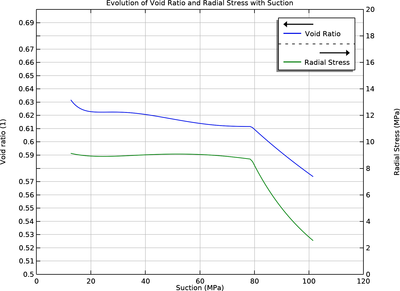
In this example, the Extended Barcelona Basic Model (BBMx) is used to model oedometer, uniaxial swelling, triaxial, and constrained swelling tests on bentonite clays in order to recover the hydromechanical characteristics of the soil samples. There is a good qualitative agreement ... Read More
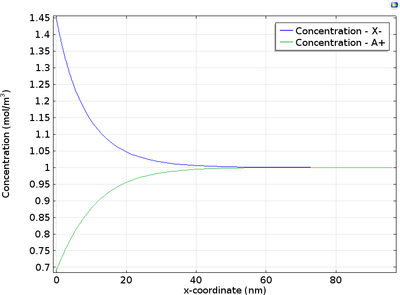
At the electrode-electrolyte interface, there is a thin layer of space charge in a diffuse double layer. This may be of interest when modeling devices such as electrochemical capacitors and nanoelectrodes. This tutorial example shows how to couple the Nernst-Planck equations to the ... Read More
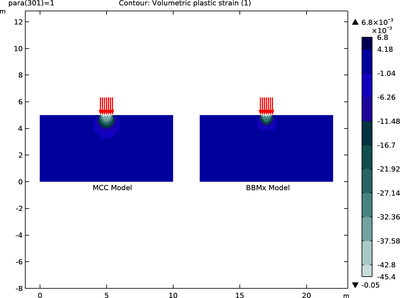
In this example, a settlement and heave analysis of a shallow foundation resting on an unsaturated soil stratum is conducted with the Modified Cam-Clay and Extended Barcelona Basic soil models. The effect of pore suction due to movements in the phreatic line and the resulting settlement ... Read More
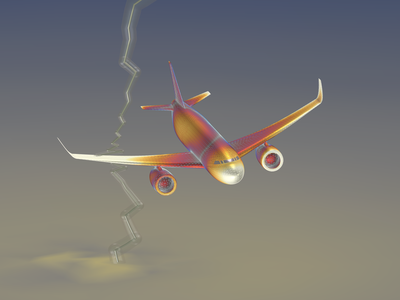
The model demonstrates how to compute the induced voltage of a wire loop inside an airplane under different electromagnetic shielding conditions. Read More
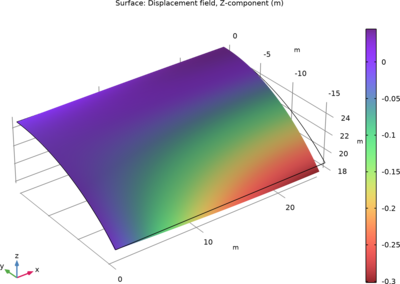
In this example a thin curved membrane is built and solved using the Shell interface. This model is a widely used benchmark model denoted the Scordelis-Lo roof. The computed maximum z-deformation is compared with the value given in Proposed Standard Set of Problems to Test Finite ... Read More
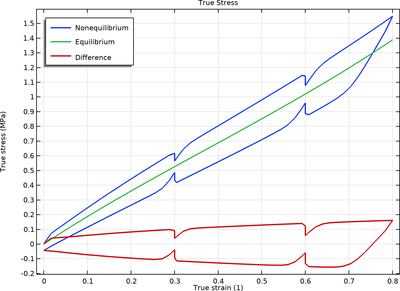
In this example, the Bergstrom–Boyce material model is used to capture the nonequilibrium behavior of carbon-black-filled chloroprene rubber under a strain history that alternates compression with relaxation. Results are verified against experimental and numerical results taken from ... Read More
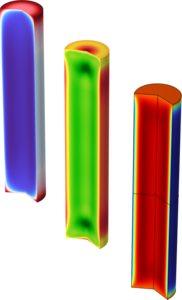
A steel billet is quenched in oil from its austenitic state. A 2D axisymmetric model is used to simulate the coupled problem of austenite decomposition, heat transfer, and solid mechanics. During the quenching process, the austenite decomposes into a combination of ferrite, pearlite, ... Read More
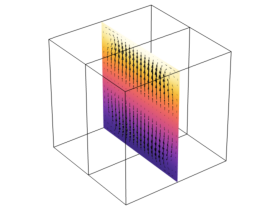
This example studies the stationary state of free convection in a cavity filled with water and bounded by two vertical plates. To generate the buoyancy flow, the plates are heated at different temperatures, bringing the regime close to the transition between laminar and turbulent. To ... Read More
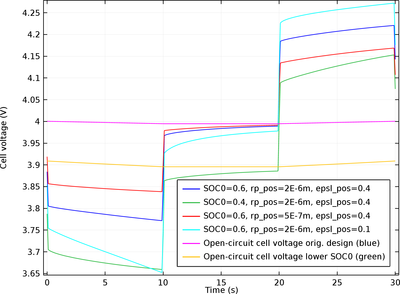
This tutorial digs deeper into the investigation of rate capability in a battery and shows how the Lithium-Ion Battery interface is an excellent modeling tool for doing this. The rate capability is studied in terms of polarization (voltage loss) or the internal resistance causing this ... Read More