
The Application Gallery features COMSOL Multiphysics® tutorial and demo app files pertinent to the electrical, structural, acoustics, fluid, heat, and chemical disciplines. You can use these examples as a starting point for your own simulation work by downloading the tutorial model or demo app file and its accompanying instructions.
Search for tutorials and apps relevant to your area of expertise via the Quick Search feature. Note that many of the examples featured here can also be accessed via the Application Libraries that are built into the COMSOL Multiphysics® software and available from the File menu.
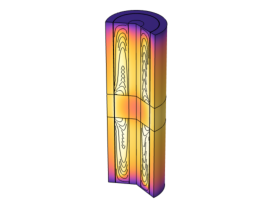
Fluid dampers are used in military devices for shock isolation and in civil structures for suppressing earthquake-induced shaking and wind-induced vibrations, among many other applications. Fluid dampers work by dissipating the mechanical energy into heat. This model shows the phenomenon ... Read More
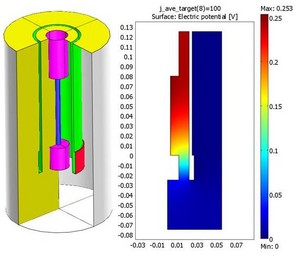
Rotating cylinder Hull cells are an important experimental tool in electroplating and electrodeposition and are used for the measurement of nonuniform current distribution, mass transport, and throwing power of plating baths. The model reproduces the results for a commercially available ... Read More
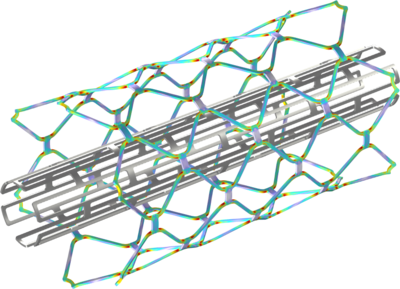
A stent is a wire-mesh tube used to open a coronary artery during angioplasty, a process for the removal or compression of plaque. Their design is of significance for percutaneous transluminal angioplasty with stenting. During this procedure, a stent is deployed into the blood vessel by ... Read More
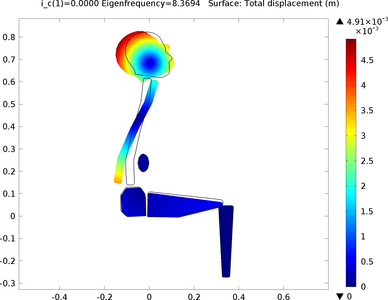
The dynamic response of a human body in any vibration environment can be predicted using this biomechanical model. In the automobile industry for instance, this model can be used in ride quality simulation and designing vibration isolators such as seats. In this example, a ... Read More

This tutorial models the intercoupled electrochemical reactions, charge and species transport as well as heat transfer in a polymer electrolyte membrane (PEM) fuel cell. For the gas flow fields, straight channels are used on the hydrogen anode side, whereas a mesh structure is used on ... Read More
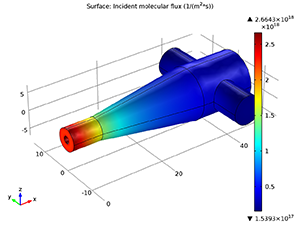
This model computes the transmission probability through an RF coupler using both the angular coefficient method available in the Free Molecular Flow interface and a Monte Carlo method using the Mathematical Particle Tracing interface. The computed transmission probability determined by ... Read More
This model computes the trajectory of an ion in a uniform magnetic field using the Newtonian, Lagrangian and Hamiltonian formulations available in the Mathematical Particle Tracing interface. Read More
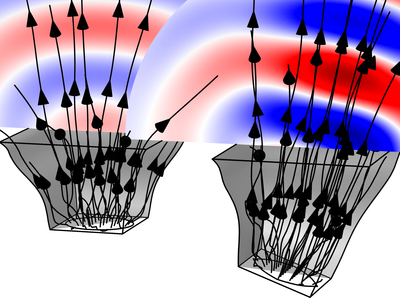
This model demonstrates how to use the Control Function feature to perform shape optimization on a rectangular horn for an improved on axis response. The results of the initial design are exported to a new component via a Filter dataset. Further, the off-axis spatial response is improved ... Read More
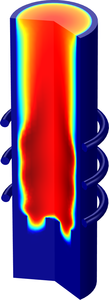
This model investigates the electrical and thermal characteristics of an inductively coupled plasma torch at atmospheric pressure. The discharge is assumed to be in local thermodynamic equilibrium. Read More
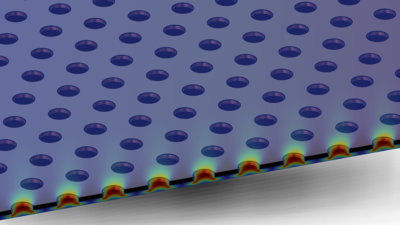
This tutorial model is of a micro perforated plate (also known as MPP) backed by a vibrating structure. This is a typical configuration in, for example, a MEMS microphone. The vibrating structure is not modeled explicitly, but just assigned a vibration velocity. The vibrating structure ... Read More


