
The Application Gallery features COMSOL Multiphysics® tutorial and demo app files pertinent to the electrical, structural, acoustics, fluid, heat, and chemical disciplines. You can use these examples as a starting point for your own simulation work by downloading the tutorial model or demo app file and its accompanying instructions.
Search for tutorials and apps relevant to your area of expertise via the Quick Search feature. Note that many of the examples featured here can also be accessed via the Application Libraries that are built into the COMSOL Multiphysics® software and available from the File menu.
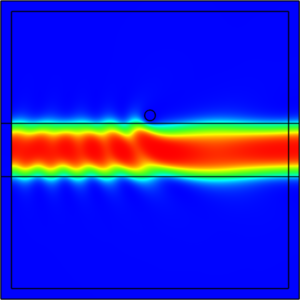
This model includes a dielectric slab waveguide with a small lossy metallic object nearby. The object causes light to be scattered, absorbed, and both reflected and transmitted along the waveguide. Learn more in this accompanying blog post: Modeling a Scatterer Near an Optical Waveguide Read More
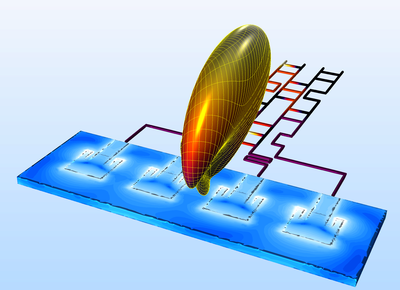
A Butler matrix is a passive beamforming feed network. It is a cost-effective feed network for phased array antennas because the circuit can be fabricated in the form of microstrip lines and is a viable solution for performing beam scanning without deploying expensive active devices. ... Read More
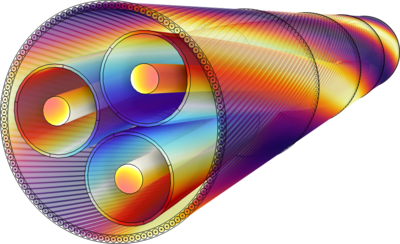
In this set of eight tutorial models and associated documentation, you can investigate the resistive, capacitive, inductive, and thermal properties of a standard three-core lead-sheathed XLPE HVAC submarine cable with twisted magnetic armor (500 mm2, 220 kV). The series includes a 2D, 2D ... Read More
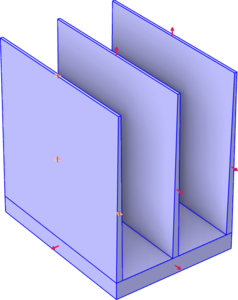
These tutorial models show how to use the tools to assist with defining surface-to-surface radiation models. In the first model, radiation direction symbols are used to find an unexpected configuration where the opacity is not correctly defined. In the other, the topology check ... Read More
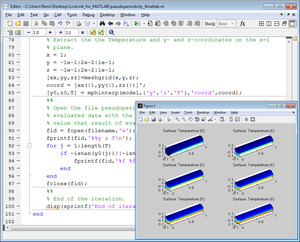
This model simulates convective heat transfer in a channel filled with water. To reduce memory requirements, the model is solved repeatedly on a pseudo-periodic section of the channel. Each solution corresponds to a different section, and before each solution step the temperature at the ... Read More

A plane electromagnetic wave is incident on a metallic sphere partially embedded on a substrate. In this electromagnetic scattering problem, the far-field variables are computed for a few elevation angles of incidence. Read More
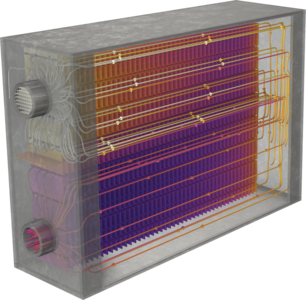
This tutorial model shows how a plate-fin heat exchanger made of aluminum is used to cool down hot oil with colder air. In order to maximize heat transfer, the heat exchanger is made of a porous aluminum matrix in which the hot oil flows. Heat is conducted through aluminum fins in ... Read More
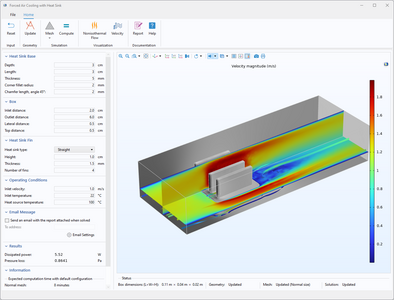
This app demonstrates the following: Geometry parts and parameterized geometries Sending an email with a report when the computation is finished User-defined email server settings which is useful when running compiled standalone applications Options for setting different mesh sizes ... Read More
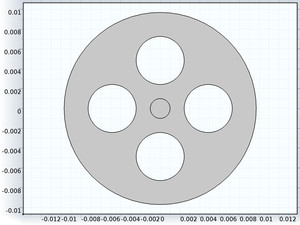
A quadrupole mass filter (QMF) is a key component of a modern mass spectrometer. A QMF uses direct current (DC) and alternating current (AC) electric fields to analyze positive or negative ions by mass to charge ratio. A QMF consists of 4 parallel rods spaced equidistantly, the ratio of ... Read More
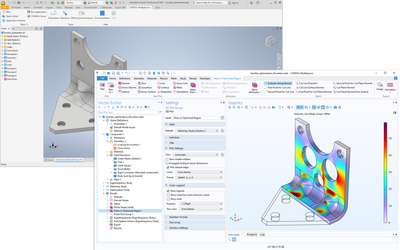
This example minimizes the mass of a bracket that is synchronized from Inventor® via the LiveLink™ interface. There are limits both for the lowest natural frequency, and for the maximum stress in a static load case. The size and position for a number of geometrical features is ... Read More


