
The Application Gallery features COMSOL Multiphysics® tutorial and demo app files pertinent to the electrical, structural, acoustics, fluid, heat, and chemical disciplines. You can use these examples as a starting point for your own simulation work by downloading the tutorial model or demo app file and its accompanying instructions.
Search for tutorials and apps relevant to your area of expertise via the Quick Search feature. Note that many of the examples featured here can also be accessed via the Application Libraries that are built into the COMSOL Multiphysics® software and available from the File menu.
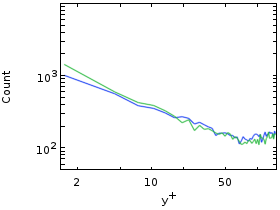
In this benchmark model, solid particles are released in a fully developed turbulent channel flow. The particles are subjected to a drag force that includes contributions from the fluid turbulence, implemented using a Continuous Random Walk (CRW) model. Because the turbulence in the ... Read More
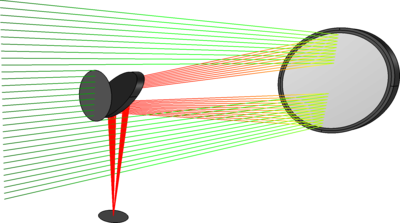
Newtonian telescopes, first invented in 1668 by Isaac Netwon, are still used today because of their low cost and simple design. Rays of light propagate from sources located at infinity, into the telescope. The rays reflect off a parabolic mirror, onto a flat mirror, and into the focal ... Read More

The Ion Range Benchmark model simulates the passage of energetic protons through silicon with both ionization losses and nuclear scattering. The initial energy of the protons is varied using a parametric sweep from 1 keV to 100 MeV. The average path length of the protons is compared to ... Read More
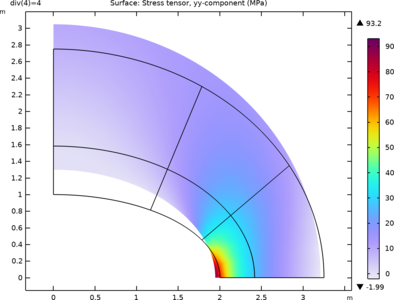
This is a benchmark model for a plane stress problem. The accuracy of the computed stress concentration is evaluated, and a mesh convergence study is performed for different element types. Read More
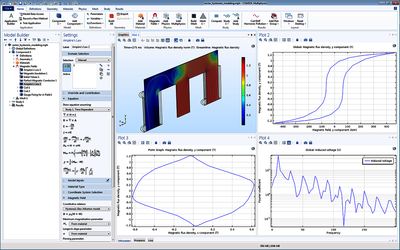
This tutorial is a benchmark model that reproduces the Testing Electromagnetic Analysis Method (TEAM) Problem 32, which evaluates numerical methods for the simulation of anisotropic magnetic hysteresis. A hysteretic three-limbed laminated iron core is subject to a time-varying magnetic ... Read More
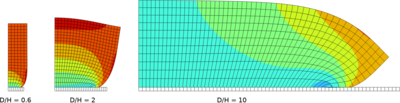
Polymer hydrogels consist of a crosslinked network of long-chained polymers that has imbibed a large number of solvent molecules. Such materials are used in many biomedical applications, such as targeted drug delivery, tissue engineering, and stimuli-sensitive actuators. This benchmark ... Read More
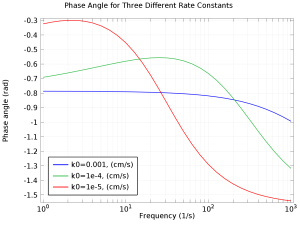
Electrochemical impedance spectroscopy (EIS) is a common technique in which a small oscillating perturbation is applied to an electrochemical system in order to investigate kinetic and transport properties. This example models EIS for a range of electrode reaction rates. Nyquist and Bode ... Read More
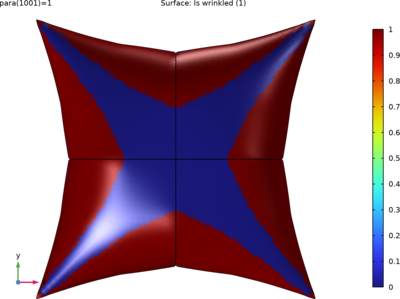
A square airbag made of a hyperelastic, compressible neo-Hookean material is inflated using pressurized air. Compressive stresses trigger wrinkling in some regions of the thin airbag. In this example, the wrinkling behavior is modeled using tension field theory, which gives a correct ... Read More


