
The Application Gallery features COMSOL Multiphysics® tutorial and demo app files pertinent to the electrical, structural, acoustics, fluid, heat, and chemical disciplines. You can use these examples as a starting point for your own simulation work by downloading the tutorial model or demo app file and its accompanying instructions.
Search for tutorials and apps relevant to your area of expertise via the Quick Search feature. Note that many of the examples featured here can also be accessed via the Application Libraries that are built into the COMSOL Multiphysics® software and available from the File menu.

This model shows how to use the scattered-field formulation to compute the transmission coefficient for impinging P and S plane elastic waves onto a finite-size phononic crystal. The transmission tends to zero in the frequency ranges corresponding to P- and S-wave band gaps, as ... Read More
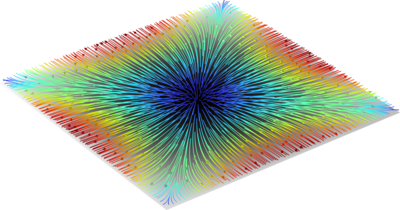
This example describes how to simulate the flow of a thin film of fluid in the gap between two rectangular plates, one of them with a porous facing, when the fluid is squeezed as a consequence of the relative motion between the plates. The model accounts for the ingress and egress of ... Read More
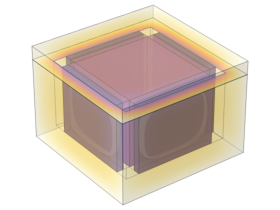
This example solves the heat transfer in an isothermal box aimed at transporting refrigerated articles such as medical materials for 24 hours. In this case, the box has to keep the contents cold for a long period of time while respecting storage temperature restrictions between 2°C and 8 ... Read More
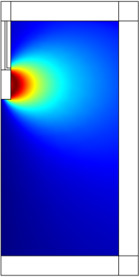
This model presents a 2D axisymmetric dipolar microwave plasma source sustained through resonant heating of the electrons. This is known as electron cyclotron resonance (ECR), which occurs when a suitable high magnetic flux density is present along with the microwaves. This is an ... Read More
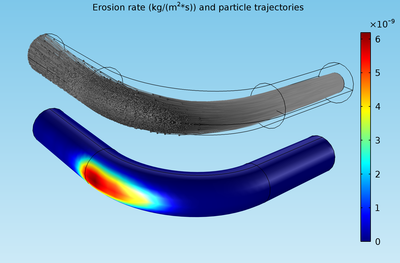
The Particle Tracing for Fluid Flow interface is used to compute the erosion of a pipe bend. The amount of material lost is computed using different erosion models. Read More
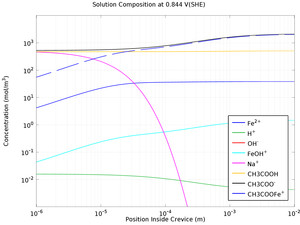
Mass transport limitations within thin crevices can often result in the local electrochemistry to differ significantly between the crevice opening (mouth) and end (tip), and as a result of the differences in local chemistry, corrosion may occur. This example models crevice corrosion of ... Read More

Shape optimization with respect to fatigue properties is not supported, but fatigue properties are well correlated with the maximum stress. The model demonstrates how optimization with respect to a p-norm of the von Mises stress can be used to improve fatigue properties without ... Read More
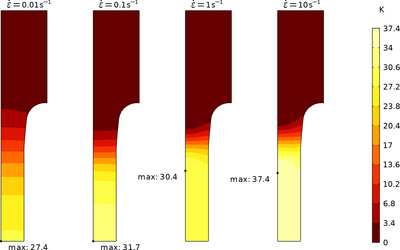
In this example, a tensile test is simulated at four different strain rates. The Johnson–Cook hardening law is used to model the strain rate dependency of the plastic hardening. The temperature distribution and thermal expansion caused by the heating generated by the plastic ... Read More


