
The Application Gallery features COMSOL Multiphysics® tutorial and demo app files pertinent to the electrical, structural, acoustics, fluid, heat, and chemical disciplines. You can use these examples as a starting point for your own simulation work by downloading the tutorial model or demo app file and its accompanying instructions.
Search for tutorials and apps relevant to your area of expertise via the Quick Search feature. Note that many of the examples featured here can also be accessed via the Application Libraries that are built into the COMSOL Multiphysics® software and available from the File menu.
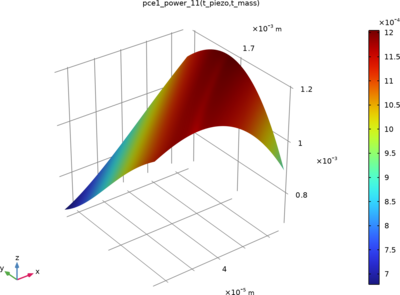
Uncertainty Quantification (UQ) is used to study the effect of manufacturing variation on the performance of Piezoelectric Energy Harvester. This tutorial shows how UQ studies are specified for a frequency domain study that calculates the energy harvester's power output. Read More
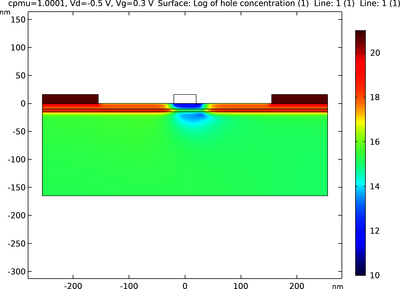
This tutorial analyzes the DC characteristics of an InSb p-Channel FET, using the density-gradient theory to add the effect of quantum confinement to the conventional drift-diffusion formulation, without a large increase of computational resources. The confinement effect is applied both ... Read More
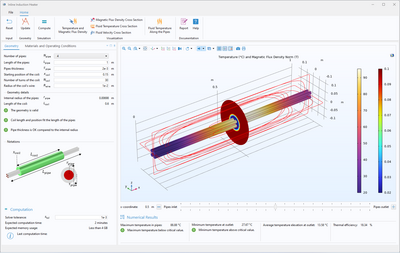
This app demonstrates the following: A model using symmetry while the results are visualized in full 3D Provides info if the results are above or below certain critical values Selecting predefined or user-defined materials Error control of geometry parameters using methods and ... Read More
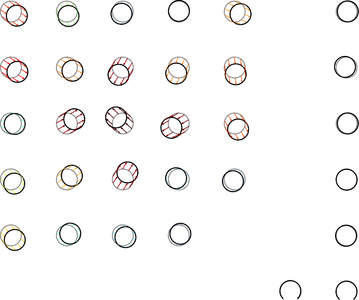
This model builds on the photonic crystal model, where a photonic crystal structure is studied. This structure has a band gap, so only waves within a specific frequency range will propagate through the outlined guide geometry. This model changes the position of the pillars in order to ... Read More
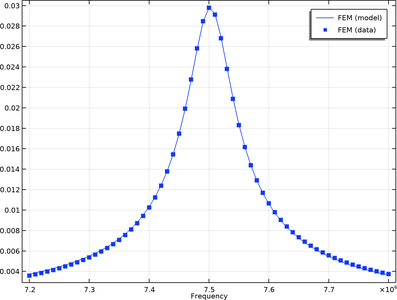
This tutorial demonstrates how a lumped model of a MEMS transducer can be derived from its FEM model. It includes an FEM model of a capacitive micromachined ultrasonic transducer (CMUT) and the corresponding lumped model created using the Lumped Mechanical System (LMS) interface. The ... Read More
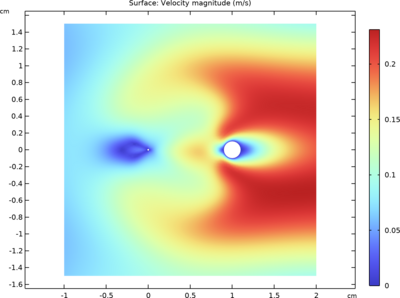
This model simulates the velocity of the ionic wind generated by a wire-to-wire corona discharge. Ionic wind, created by the movement of charged particles in an electric field, can be harnessed for various applications, including cooling electronic components and enhancing heat ... Read More
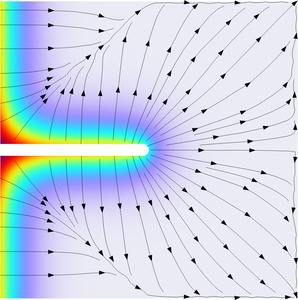
Hydrogen embrittlement refers to the degradation of metal ductility due to the absorption of hydrogen. The metal becomes more brittle and thus cracks might initiate at lower stress levels. It is important to estimate hydrogen concentration and the speed at which it diffuses into the ... Read More

The Ion Range Benchmark model simulates the passage of energetic protons through silicon with both ionization losses and nuclear scattering. The initial energy of the protons is varied using a parametric sweep from 1 keV to 100 MeV. The average path length of the protons is compared to ... Read More
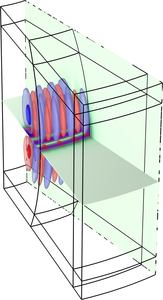
Dielectric microspheres can support whispering gallery modes with high optical quality factors. This model illustrates how to compute the different eigenmodes and resonance frequencies. The resonance frequencies are either filtered by their spatial localization in the resonator or by ... Read More
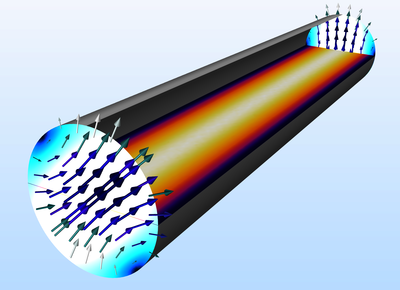
This model of a circular waveguide demonstrates how to use ports with numerical solution of the port modes. It illustrates how to align the polarization of degenerate port modes and in particular how to model and excite the TE11 mode of circular waveguides in 3D. Read More


