
The Application Gallery features COMSOL Multiphysics® tutorial and demo app files pertinent to the electrical, structural, acoustics, fluid, heat, and chemical disciplines. You can use these examples as a starting point for your own simulation work by downloading the tutorial model or demo app file and its accompanying instructions.
Search for tutorials and apps relevant to your area of expertise via the Quick Search feature. Note that many of the examples featured here can also be accessed via the Application Libraries that are built into the COMSOL Multiphysics® software and available from the File menu.
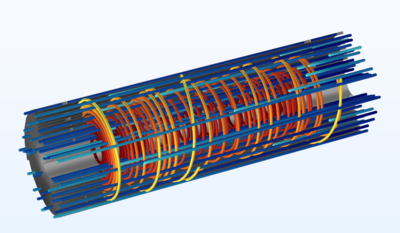
This example models a small reverse osmosis water desalination unit. The unit consists of a spirally wound semi-permeable membrane through which the water is forced under high pressure. The membrane retains the salt, such that on the permeate side fresh water is produced and on the ... Read More

Turbulent flow, SSG-LRR interface is used to analyze fully developed turbulent flow in an axially rotating pipe and in a swirling jet emanating from such a pipe. The resulting flow pattern in the pipe is characterized by slower-than-solid-body rotation. Axial velocity of the swirling jet ... Read More
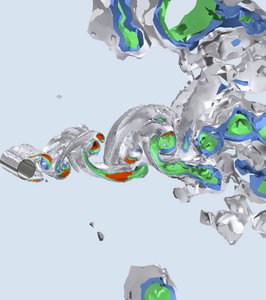
The model compare the two RANS models SST and SST-SAS for turbulent flow around a cylinder. The SST-SAS model resolve more transversal turbulent structures compared to the SST model. Read More
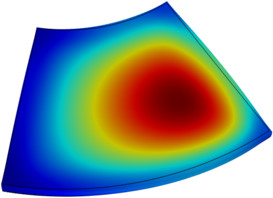
Tilted pad thrust bearings are used in rotating machineries with high thrust loading. The thrust load is transferred from a sliding part to a stationary part through hydrodynamic oil films. The tilted pad thrust bearing consists of a series of flat surfaces sliding over stationary tilted ... Read More
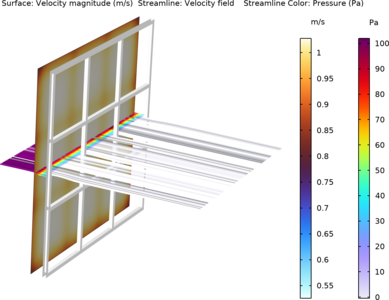
This example demonstrates simulation of a turbulent flow in a geometry with an air filter. Porous material of the filter induces an abrupt pressure drop and drastic increase of turbulence level inside the filter. Read More
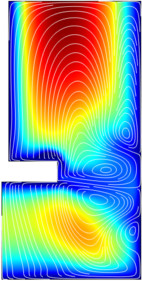
Swirl flow is an application that involves steady rotational flow around an axis. Rather than modeling this process in 3D, COMSOL Multiphysics provides a 2D axisymmetric interface where the flow in the rotational direction is still included in the equations. This example shows the ... Read More

In this model the high speed turbulent gas flow in a converging and diverging nozzle is modeled using the High Mach Number Flow interface. The diffuser is transonic in the sense that the flow at the inlet is subsonic, but due to the contraction and the low outlet pressure, the flow ... Read More
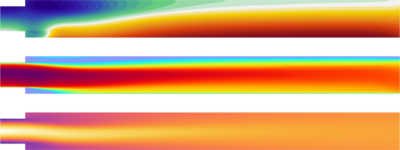
Turbulent flow, Elliptic Blending R-ε interface is used to analyze fully developed turbulent flow in a spanwise rotating channel. Due to the influence of Coriolis force on turbulence, profiles of the flow variables are skewed at moderate rotation rate. The asymmetry between cyclonic ... Read More

This example considers the natural convection of air above a smoldering incense stick. This kind of flow often shows a transition from laminar to turbulent which is nicely visualized by the smoke produced by the slow burning of the incense. The model uses the Nonisothermal Flow, LES RBVM ... Read More

Nucleate boiling occurs when a liquid is heated by a source hotter than the saturated fluid temperature but with a heat flux below the critical heat flux. In this regime, high heat flux are possible due to the evaporation of the liquid. This model aims to demonstrate the calculation of ... Read More


