
The Application Gallery features COMSOL Multiphysics® tutorial and demo app files pertinent to the electrical, structural, acoustics, fluid, heat, and chemical disciplines. You can use these examples as a starting point for your own simulation work by downloading the tutorial model or demo app file and its accompanying instructions.
Search for tutorials and apps relevant to your area of expertise via the Quick Search feature. Note that many of the examples featured here can also be accessed via the Application Libraries that are built into the COMSOL Multiphysics® software and available from the File menu.

We present the results from a comparison of the level set, phase field, and moving mesh methods for modeling free liquid surfaces in the COMSOL Multiphysics® software. The comparison is carried out using an example problem. The example studies the formation of surface waves ... Read More
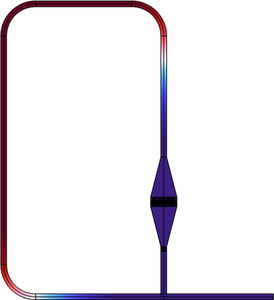
The models simulate the working mechanism of traveling wave thermoacoustic engines. Similary to the standing wave engines, the traveling wave engines make use of the coupling between the fluid motion and the temperature change experienced by the fluid to generate acoustic energy. ... Read More
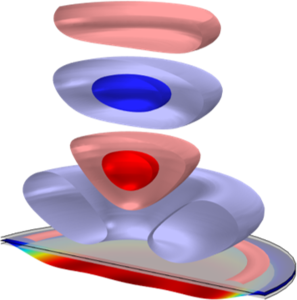
This tutorial demonstrates a full electro-vibroacoustic analysis of a conceptual electrostatic speaker driver, composed of thin conducting plastic diaphragm residing between two perforated metal sheets called grids or stators. When an audio signal is applied to the grids (out of phase), ... Read More
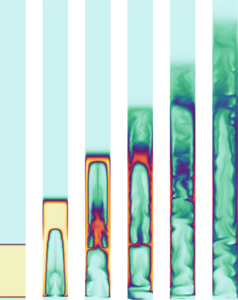
Circulating fluidized beds are widely used in the food & beverage, pharmaceutical, chemical, and energy industries to achieve efficient contact between solid and fluid reactants. This model visualizes how a circulating fluidized bed operates. In the model, the dispersed phase, which ... Read More
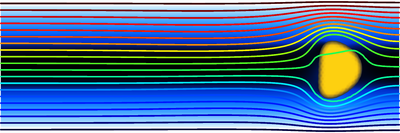
Applying an electric field across a suspension of immiscible liquids may stimulate droplets of the same phase to coalesce. The method known as electrocoalescence has important applications, for instance, in the separation of oil from water. To model electrocoalescence, you need to solve ... Read More
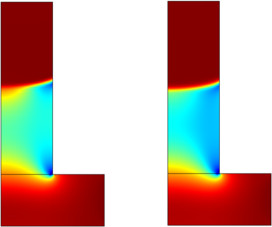
This example studies a narrow vertical cylinder placed on top of a reservoir filled with water. Because of wall adhesion and surface tension at the air/water interface, water rises through the channel. Surface tension and wall adhesive forces are often used to transport fluid through ... Read More
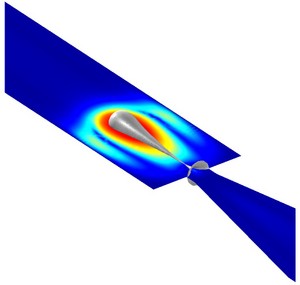
Although initially invented to be used in printers, inkjets have been adopted for other application areas, such as within the life sciences and microelectronics. Simulations can be useful to improve the understanding of the fluid flow and to predict the optimal design of an inkjet for a ... Read More
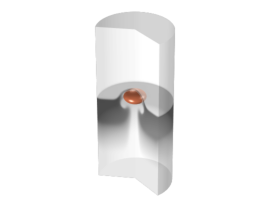
This example simulates an oil droplet rising through a suspension. The suspension is initially stratified, with a dense layer between two clear layers. The droplet is initially located in the bottom clear layer. The particles in the suspension start to sediment toward the bottom of the ... Read More
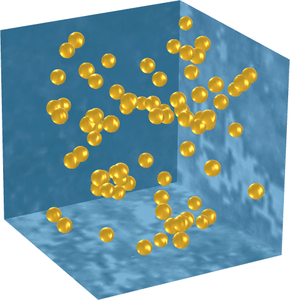
Recovery of precious metals in recycling of electronics, or extraction from ore, is usually performed through leaching of the metal into an aqueous phase. Precious metals require the use of an oxidant, and often, a complexant. In the case of gold, the cyanide anion (CN-) forms a soluble ... Read More
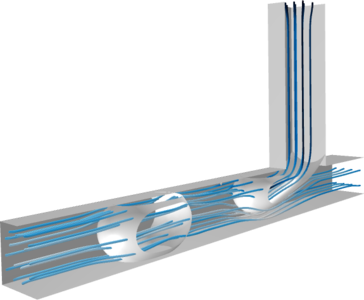
Emulsions consist of small liquid droplets immersed in an immiscible liquid and widely occur in the production of food, cosmetics, fine chemicals, and pharmaceutical products. The quality of the product is typically dependent on the size of the droplets. Simulating these processes can ... Read More


