
The Application Gallery features COMSOL Multiphysics® tutorial and demo app files pertinent to the electrical, structural, acoustics, fluid, heat, and chemical disciplines. You can use these examples as a starting point for your own simulation work by downloading the tutorial model or demo app file and its accompanying instructions.
Search for tutorials and apps relevant to your area of expertise via the Quick Search feature. Note that many of the examples featured here can also be accessed via the Application Libraries that are built into the COMSOL Multiphysics® software and available from the File menu.
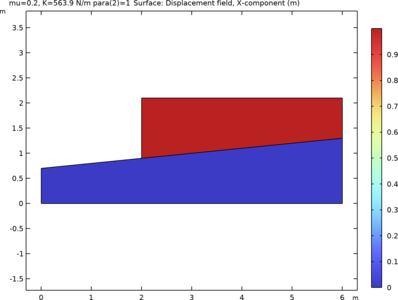
A contactor wedge is subject to a gravity load and is forced to slide due to a boundary load over a rigid target wedge surface, both infinitely wide. Horizontal linear springs are also connected between the left vertical boundary and the ground. This is a large sliding problem including ... Read More
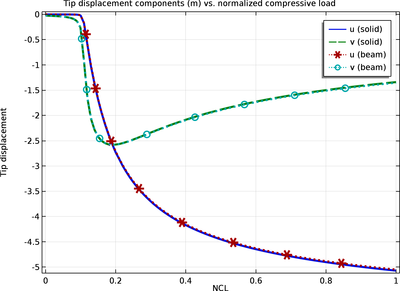
This example studies the deflection of a cantilever beam undergoing very large deflections. The beam is modeled using both the Solid Mechanics interface and the Beam interface. The results are compared with each other and with a benchmark solution from NAFEMS. In addition, a linear ... Read More
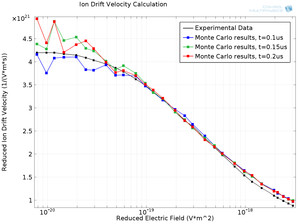
The drift velocity of Ar+ is calculated using a Monte Carlo simulation in which the elastic collisions of Argon ions with ambient neutrals are explicitly modeled. The model uses energy-dependent collision cross-section data from experiment. The average ion velocity values are consistent ... Read More
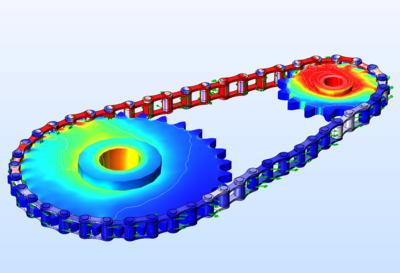
Chain drives are used for transmitting power from one shaft to another, located at some distance. This example demonstrates how to model a chain sprocket assembly in 3D. The geometry consists of a roller chain wrapped around two sprockets. All components are assumed to be elastic. The ... Read More
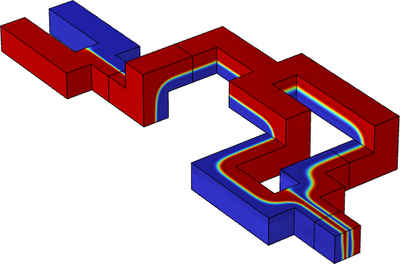
This example models a split-and-recombine mixer channel in which a tracer fluid is introduced and mixed by multilamination. Diffusion is removed from the model using an extremely low diffusion coefficient so that any numerical diffusion can be studied in the lamination interfaces. The ... Read More
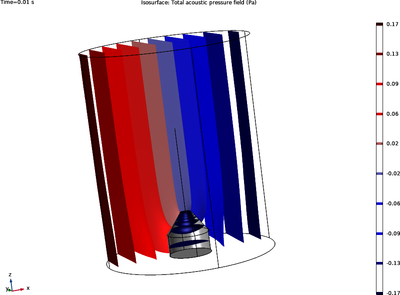
It is often not possible to insert a normal microphone directly into the sound field being measured. The microphone may be too big to fit inside the measured system, such as for in-the-ear measurements for hearing aid fitting. The size of the microphone may also be too large compared to ... Read More
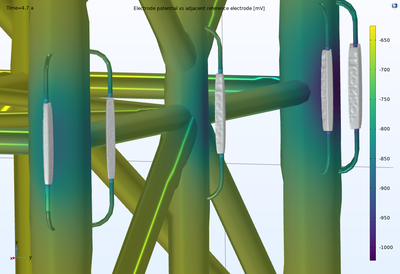
This tutorial models the cathodic protection of an oil rig structure during a time period of 15 years. As a result of the consumption of the sacrificial anodes, the protective capabilities system are reduced over time. The anode shape change in the model is defined by using the Level ... Read More
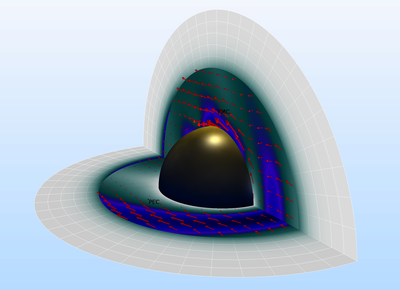
A classic benchmark problem in computational electromagnetics is to solve for the radar cross section (RCS) of a sphere in free space illuminated by a plane wave. This model solves for the RCS of a metallic sphere that has a very high conductivity, which can be treated as a material with ... Read More
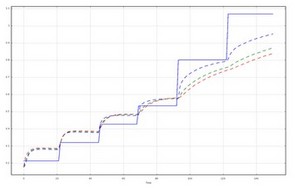
The first model describes the simultaneous flow of two immiscible fluids in porous media - here air displaces water in a multi-step inlet pressure experiment. We solve for the pressure and the degree saturation for the air and water within a representative volume and so track saturation ... Read More
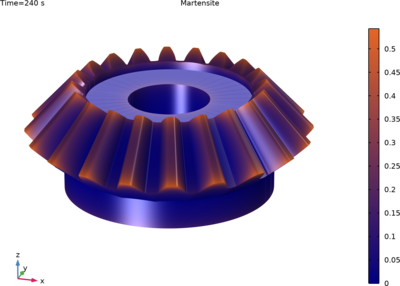
A 3D model is used to simulate the cooling of a bevel gear from an austenitic state. Phase material properties and phase transformation data are imported into the model. The final phase composition and the residual stress state are computed. Phenomena such as thermal strains, phase ... Read More


