
The Application Gallery features COMSOL Multiphysics® tutorial and demo app files pertinent to the electrical, structural, acoustics, fluid, heat, and chemical disciplines. You can use these examples as a starting point for your own simulation work by downloading the tutorial model or demo app file and its accompanying instructions.
Search for tutorials and apps relevant to your area of expertise via the Quick Search feature. Note that many of the examples featured here can also be accessed via the Application Libraries that are built into the COMSOL Multiphysics® software and available from the File menu.
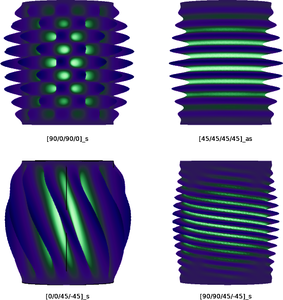
Buckling is a structural instability that can lead to failure of a component even without initial material failure. Computation of the critical buckling loads and mode shapes can therefore be important from a design viewpoint, even though it has previously been determined that the ... Read More
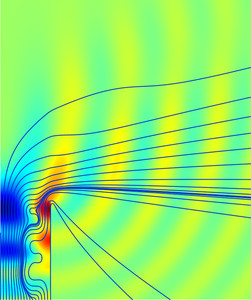
This example models the radiation of fan noise from the annular duct of a turbofan aeroengine. When the jet stream exits the duct, a vortex sheet appears along the extension of the duct wall due to the surrounding air moving at a lower speed. The near field on both sides of the vortex ... Read More
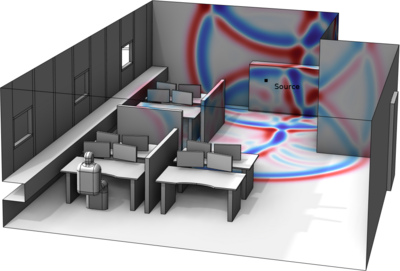
In this tutorial, the acoustics of an open-plan office space are analyzed using a wave-based approach in the time domain. An initial pulse is released and the room response is analyzed. Realistic frequency-dependent impedance conditions for the ceiling, carpet, and gypsum walls are ... Read More
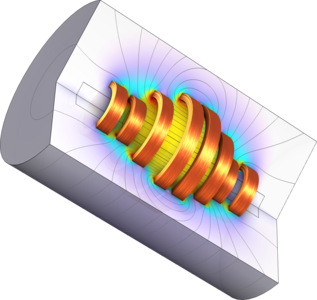
This example shows how to use the Optimization Module to find a coil geometry giving a uniform magnetic field on axis and minimal field near the axis ends. Read More

Seawater intrusion is a critical issue in coastal regions, where it endangers both freshwater supplies and the overall quality of groundwater. This example showcases seawater intrusion in a coastal aquifer where a pumping well is located at some distance from the shoreline. The model ... Read More
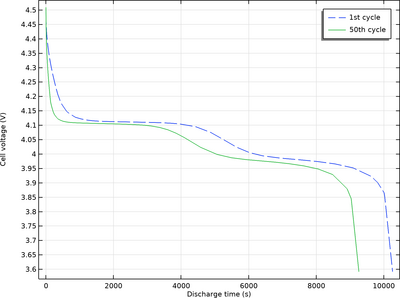
Some positive electrode materials are known to deteriorate in overcharged lithium-ion battery cells. Predominantly, manganese containing electrode materials such as LMO and NMC can loose capacity due to manganese dissolving from the materials at overcharge. This decomposition is a ... Read More
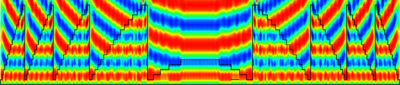
This model simulates a 16-level, first-order, focusing Fresnel lens with 50 µm diameter and 150 µm focal length. In one simulation, the Electromagnetic Waves, Frequency Domain interface computes the electric field in the Fresnel lens and the surrounding air domain extended to the focal ... Read More
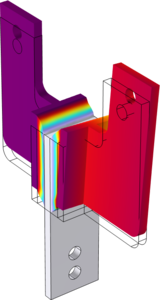
This example performs the analysis of a viscoelastic damper. The damper is intended for reduction of wind-induced and seismic vibrations in buildings and other tall structures. Read More
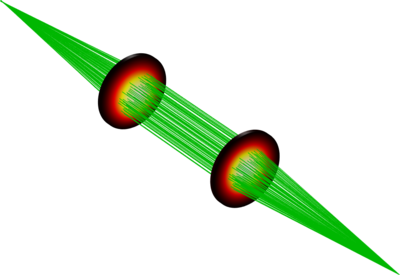
A modern high-power industrial fiber laser system can deliver up to 3kW of single-mode laser radiation on to surfaces to be cut, drilled, welded or marked. Even using highly transmissive materials, the optical component used to focus the laser beam onto target surfaces can be affected ... Read More
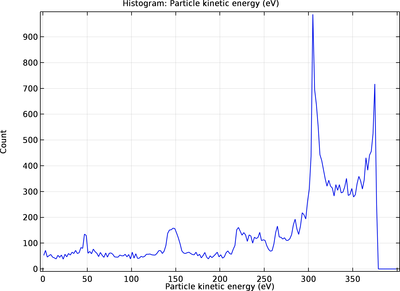
This model computes the ion energy distribution function (IEDF) for a commercial capacitively coupled plasma reactor. The results show good agreement with experimental data. Read More


