
The Application Gallery features COMSOL Multiphysics® tutorial and demo app files pertinent to the electrical, structural, acoustics, fluid, heat, and chemical disciplines. You can use these examples as a starting point for your own simulation work by downloading the tutorial model or demo app file and its accompanying instructions.
Search for tutorials and apps relevant to your area of expertise via the Quick Search feature. Note that many of the examples featured here can also be accessed via the Application Libraries that are built into the COMSOL Multiphysics® software and available from the File menu.
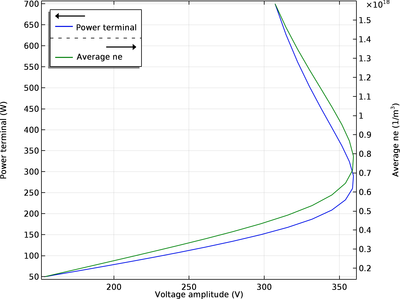
Capacitively coupled RF discharges can operate in two distinct regimes depending on the discharge power. In the low power regime, known as the alpha regime, the electric field oscillation is responsible to heat and create electrons. In the high power regime, known as gamma regime, the ... Read More
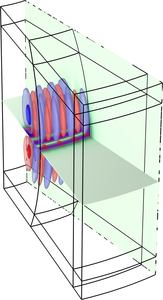
Dielectric microspheres can support whispering gallery modes with high optical quality factors. This model illustrates how to compute the different eigenmodes and resonance frequencies. The resonance frequencies are either filtered by their spatial localization in the resonator or by ... Read More
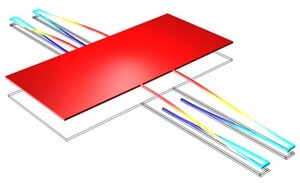
Surface micromachined thin films are often subject to residual stress. This COMSOL Multiphysics example describes a thin film resonator with straight or folded cantilever beam springs. The resonance frequencies of the resonator are affected by thermal stress. Using folded springs ... Read More
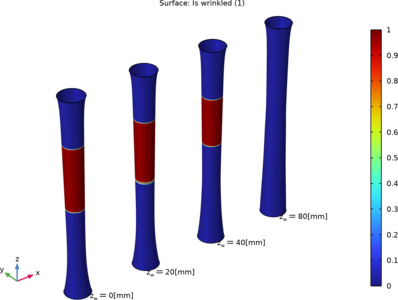
In this example, wrinkling is studied in a cylindrical membrane of nonuniform thickness under axial and pressure loading. The membrane is modeled as an incompressible Mooney–Rivlin material. During axial stretching, certain portions of the membrane undergo wrinkling; however, the ... Read More
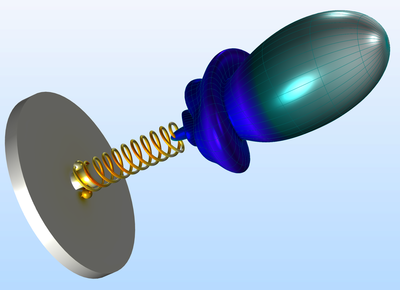
A helical antenna has two major modes. One is normal mode and the other is axial mode. When the helical antenna is operating at the normal mode, its far-field radiation pattern is similar to the torus shaped pattern of a classic dipole antenna. At the axial mode, the helical antenna is ... Read More
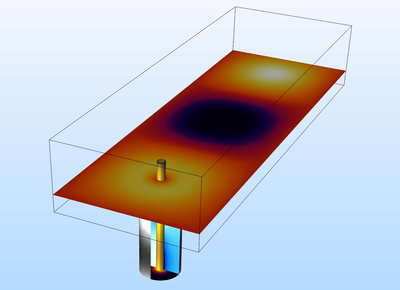
Feeding a waveguide from a coaxial cable is a straightforward way to achieve electromagnetic waves inside a waveguide. Due to its small size and circular shape, the cable contributes significantly to the overall size of the problem. It is therefore necessary to keep the cable as short as ... Read More
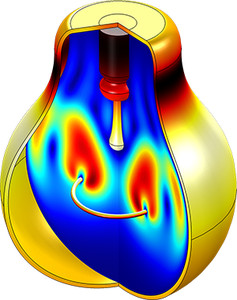
This model treats the free convection of argon gas within a light bulb. It shows the coupling of heat transport (conduction, radiation and convection) to momentum transport (non-isothermal flow) induced by density variations caused by temperature. COMSOL Multiphysics model makes it ... Read More
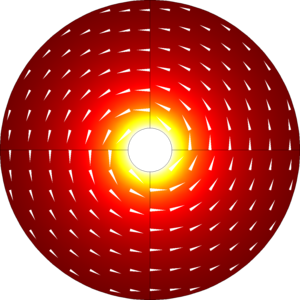
The coaxial cable (coax) is one of the most ubiquitous transmission line structures. It is composed of a central circular conductor, surrounded by an annular dielectric, and shielded by an outer conductor. This model computes the electric and magnetic field distribution inside of the ... Read More
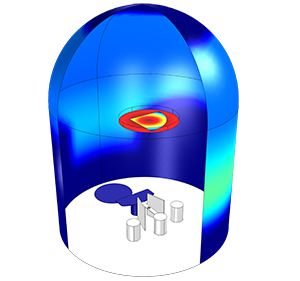
This model shows how to compute the thickness of a thermally evaporated gold film. The thickness of the deposited film is computed both on the walls of the chamber and on the sample. Read More
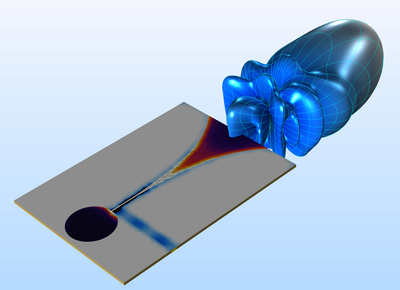
A tapered slot antenna, also known as a Vivaldi antenna, is useful for wide band applications. Here, an exponential function is used for the taper profile. The objective of this model is to compute the far-field pattern and to compute the impedance of the structure. Good matching is ... Read More


