
The Application Gallery features COMSOL Multiphysics® tutorial and demo app files pertinent to the electrical, structural, acoustics, fluid, heat, and chemical disciplines. You can use these examples as a starting point for your own simulation work by downloading the tutorial model or demo app file and its accompanying instructions.
Search for tutorials and apps relevant to your area of expertise via the Quick Search feature. Note that many of the examples featured here can also be accessed via the Application Libraries that are built into the COMSOL Multiphysics® software and available from the File menu.
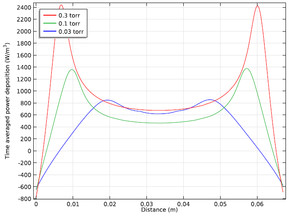
The underlying physics of a capacitively coupled plasma is rather complicated, even for rather simple geometric configurations and plasma chemistries. This model benchmarks the Capacitively Coupled Plasma physics interface against many different codes. Read More
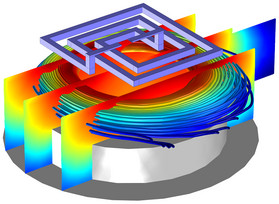
The COMSOL® software includes capabilities for 3D plasma modeling. In this example, a square coil is placed on top of a dielectric window and is electrically excited at 13.56 MHz. A plasma is formed in the chamber beneath the dielectric window, which contains argon gas at low ... Read More

In small PEM fuel cell systems (in the sub-100 W range) no active devices for cooling or air transport are normally used. This is due to the desire to minimize parasitic power losses from pumps and fans, and to reduce the system complexity, size, and cost. The reactants at the cathode ... Read More
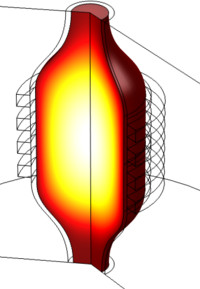
This model simulates a plasma at medium pressure (2 torr) where the plasma is still not in local thermodynamic equilibrium. At low pressures the two temperatures are decoupled but as the pressure increases the temperatures tend towards the same limit. Read More
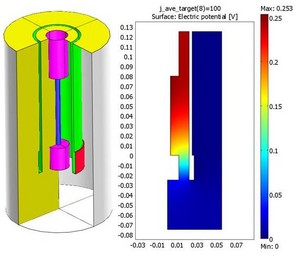
Rotating cylinder Hull cells are an important experimental tool in electroplating and electrodeposition and are used for the measurement of nonuniform current distribution, mass transport, and throwing power of plating baths. The model reproduces the results for a commercially available ... Read More
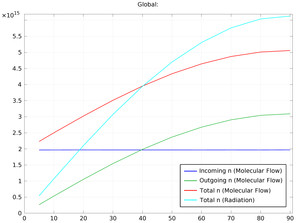
This model computes the particle flux, number density and pressure on the surface of a plate that rotates in a highly directional molecular flow. The results obtained are compared with those from other, approximate, techniques for computing molecular flows. Read More
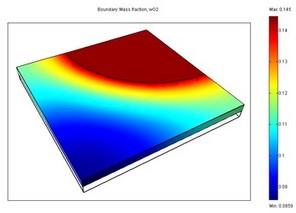
A stationary 3D model of a generic fuel cell cathode describing the mass fraction distribution of oxygen, water, and nitrogen, as well as the current distribution. The model uses Darcy's Law to describe convection, and couples this to Maxwell-Stefan diffusivities to also describe mass ... Read More
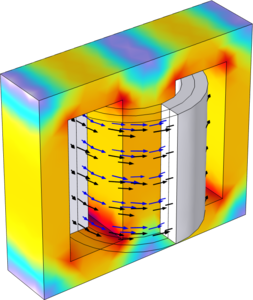
This is the transient model of a single phase E-core transformer using a homogenized approach for the multi-turn primary and secondary coils. The model includes the effect of magnetic saturation (B–H curve) in the core and shows how to connect the transformer model to the external ... Read More
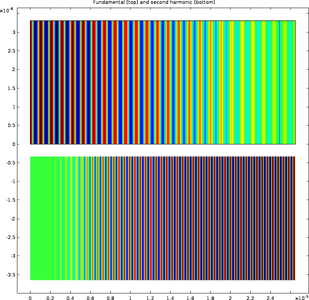
It is more difficult to generate laser emissions in the short-wavelength part of the visible and near visible part of the electromagnetic spectrum than in the long-wavelength part. Nonlinear frequency mixing makes it easier to generate new short wavelengths from existing laser ... Read More
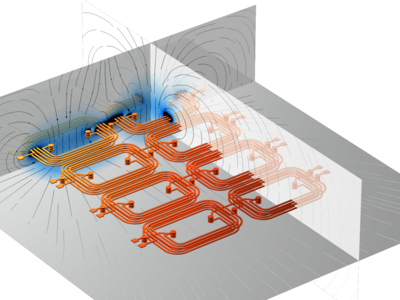
This model demonstrates how to use the Magnetic Fields, Currents Only interface together with the Stationary Source Sweep with Initialization study to compute the inductance matrix of PCB coils with a number of 12. Read More