
The Application Gallery features COMSOL Multiphysics® tutorial and demo app files pertinent to the electrical, structural, acoustics, fluid, heat, and chemical disciplines. You can use these examples as a starting point for your own simulation work by downloading the tutorial model or demo app file and its accompanying instructions.
Search for tutorials and apps relevant to your area of expertise via the Quick Search feature. Note that many of the examples featured here can also be accessed via the Application Libraries that are built into the COMSOL Multiphysics® software and available from the File menu.
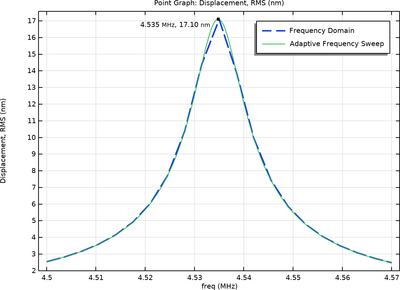
This tutorial shows how to model a miniaturized magnetostrictive antenna developed for use inside living cells. The stress in the antenna, the magnetic flux density, the current density, and the displacement of the tip of the device are investigated at the resonance frequency. Read More
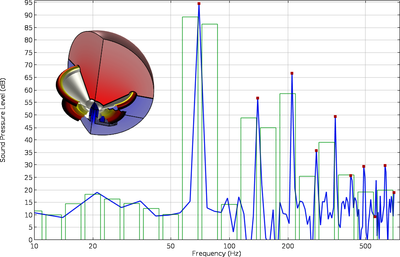
In this model, a full transient analysis of a loudspeaker driver is performed, which allow the modeling of nonlinear effects. It extends the linear frequency domain analysis done in the Loudspeaker Driver tutorial model. The analysis accounts for nonlinear behavior of the soft iron in ... Read More
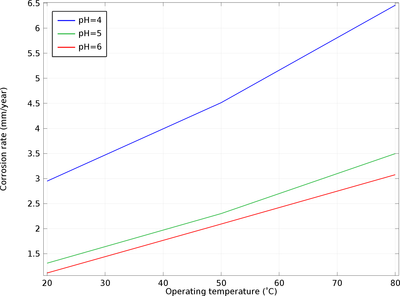
Carbon dioxide in aqueous solution is highly corrosive and can cause significant damage to steel designs. Such conditions arise in pipes used in a variety of applications, especially within the petrochemical industry. In this tutorial example, turbulent flows consisting of carbon ... Read More
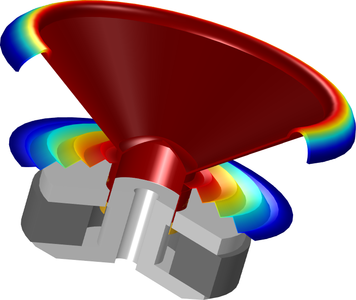
This example shows how to model a loudspeaker driver of the dynamic cone type, common for low and medium frequencies. The analysis is carried out in the frequency domain and thus represents the linear behavior of the driver. The model analysis includes the total electric impedance and ... Read More

Nucleate boiling occurs when a liquid is heated by a source hotter than the saturated fluid temperature but with a heat flux below the critical heat flux. In this regime, high heat flux are possible due to the evaporation of the liquid. This model aims to demonstrate the calculation of ... Read More
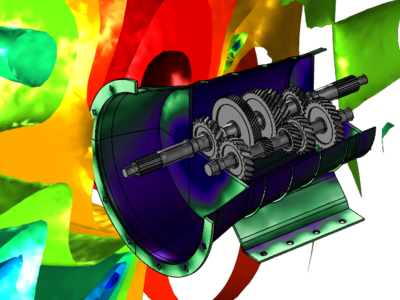
A gearbox is used to transfer power from an engine to its associated wheels or cogs, which can result in radiating noise to the surroundings. This is due to the transmission of undesired lateral and axial forces on the bearings and housing, while transmitting power from one shaft to the ... Read More
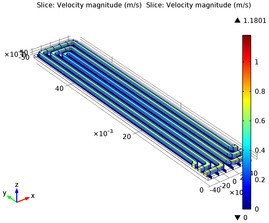
This example models the flow and mass transport in the channels and the gas diffusion layer (GDL) of a polymer electrolyte fuel cell. The cathode electrode reaction is modeled as a boundary condition, where the local current density depends on the overpotential and the local oxygen ... Read More
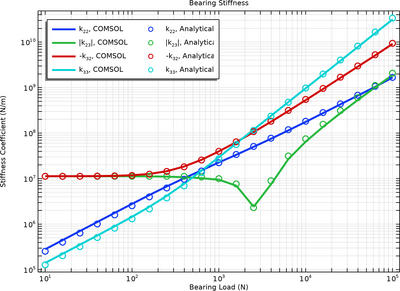
When analyzing rotors, it is common that bearings are modeled through their effective dynamic coefficients about a static equilibrium position. This model illustrates how to compute such coefficients for a cylindrical journal bearing. The bearing length is kept much smaller than its ... Read More
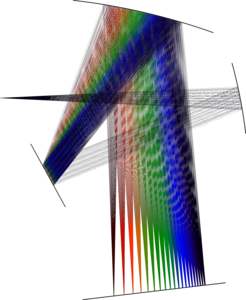
A Czerny-Turner monochromator spatially separates polychromatic light into a series of monochromatic rays. This model simulates a crossed Czerny-Turner configuration that consists of a spherical collimating mirror, a planar diffraction grating, a spherical imaging mirror, and an array ... Read More
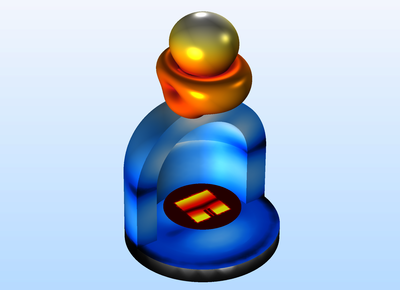
A radome minimizes losses and improves radiation characteristics of an antenna through its design. The structure can be optimized to minimize the transmission loss and also designed to improve radiation characteristics including antenna directivity and side lobes. Shown in the model is ... Read More


