
The Application Gallery features COMSOL Multiphysics® tutorial and demo app files pertinent to the electrical, structural, acoustics, fluid, heat, and chemical disciplines. You can use these examples as a starting point for your own simulation work by downloading the tutorial model or demo app file and its accompanying instructions.
Search for tutorials and apps relevant to your area of expertise via the Quick Search feature. Note that many of the examples featured here can also be accessed via the Application Libraries that are built into the COMSOL Multiphysics® software and available from the File menu.
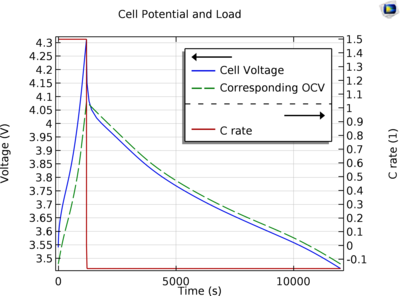
This app can be used as a design tool to develop an optimized battery configuration for a specific application. The application computes the capacity, energy efficiency, heat generation, and capacity losses due to parasitic reactions of a battery for a specific load cycle. Various ... Read More
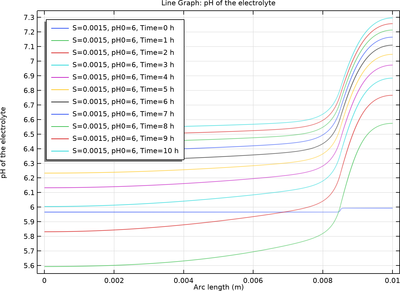
The model simulates atmospheric corrosion of a galvanic couple, comprising of an Al-Co-Ce metallic coating and an aluminum alloy, which is in contact with electrolyte film of 100 micrometer thickness. The corrosion inhibitors are released from the metallic coating and are transported ... Read More
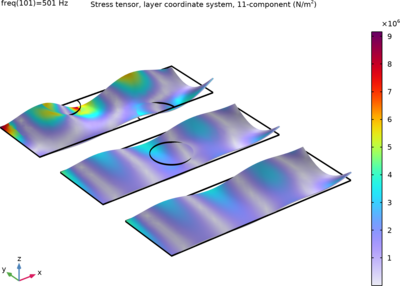
Delamination or the separation of layers is a common failure mode in laminated composite materials. Various factors, including loading, defects in the material, and environmental conditions can trigger the initiation and propagation of layer separation. This leads to degraded structural ... Read More
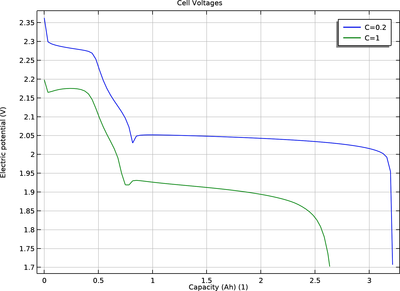
Lithium-sulfur (Li-S) batteries are used in niche applications with high demands for specific energy densities, which may be as high as 500-600 Wh/kg. The chemistry is fairly complex, since multiple polysulfide species participate in the various charge transfer reactions. The chemistry ... Read More
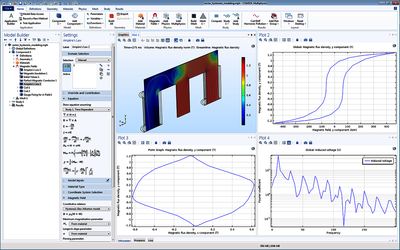
This tutorial is a benchmark model that reproduces the Testing Electromagnetic Analysis Method (TEAM) Problem 32, which evaluates numerical methods for the simulation of anisotropic magnetic hysteresis. A hysteretic three-limbed laminated iron core is subject to a time-varying magnetic ... Read More
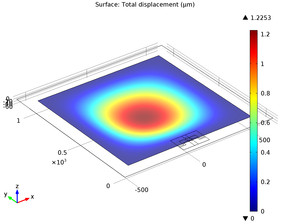
Piezoresistive pressure sensors were some of the first MEMS devices to be commercialized. Compared to capacitive pressure sensors, they are simpler to integrate with electronics, their response is more linear and they are inherently shielded from RF noise. They do, however, usually ... Read More
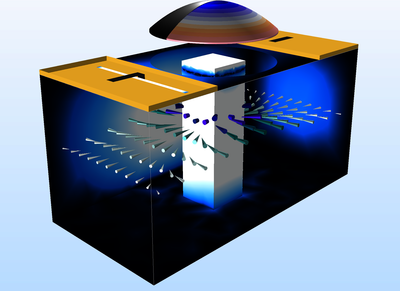
An evanescent mode cavity filter can be realized by adding a structure inside of the cavity. This structure changes the resonant frequency lower than the dominant mode of the unfilled cavity. A piezo actuator is used to control the size of a small air gap which provides the tunability of ... Read More
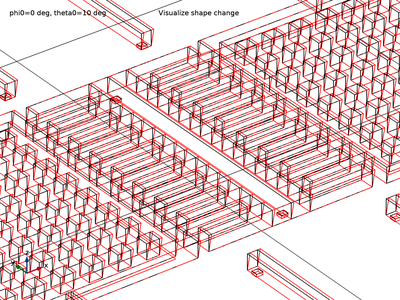
This tutorial example is kindly provided by Dr. James Ransley at Veryst Engineering, LLC. This model continues from the base model “A Micromachined Comb-Drive Tuning Fork Rate Gyroscope”, which is also provided by Dr. Ransley. The model demonstrates how to accurately compute the effects ... Read More
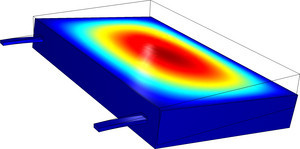
Squeezed-film gas damping is a critical aspect of many MEMS transducers and actuators. In accelerometers, for example, inertia produces a motion that the device detects. A typical structure connects a large proof mass to surrounding structures with elastic beams, which forms a mechanical ... Read More
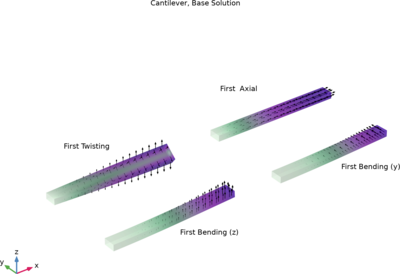
This example explores the shift in natural frequencies caused by changing the temperature. One study investigates a doubly clamped beam where both ends are fixed, while the other study looks at a cantilever beam where only one end is fixed. The following effects are studied: Stress ... Read More


