
The Application Gallery features COMSOL Multiphysics® tutorial and demo app files pertinent to the electrical, structural, acoustics, fluid, heat, and chemical disciplines. You can use these examples as a starting point for your own simulation work by downloading the tutorial model or demo app file and its accompanying instructions.
Search for tutorials and apps relevant to your area of expertise via the Quick Search feature. Note that many of the examples featured here can also be accessed via the Application Libraries that are built into the COMSOL Multiphysics® software and available from the File menu.
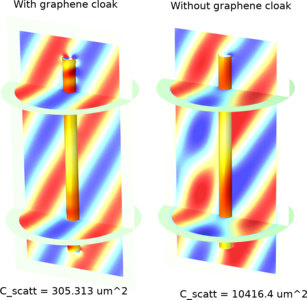
In this model, we introduce a cloaking method using an electrically tuned monolayer of graphene. We will show that when a cylindrical dielectric scatterer is covered in graphene, the scattering cross section is greatly reduced at the designated frequency, making it electromagnetically ... Read More
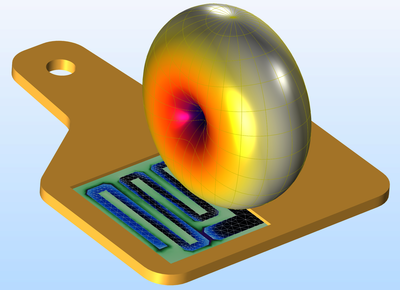
UHF RFID tags are widely used for identifying and tracking animals. This model simulates a passive radio-frequency identification (RFID) tag for the UHF frequency range. With respect to the chip transponder’s complex impedance, a reflection coefficient is computed. This is done using an ... Read More
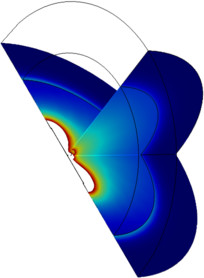
Feeding antennas with proper signals can be difficult. The signal is often described as a voltage, and voltages are not well defined in electromagnetic wave formulations. There are several tricks to model voltage generators in such situations, and one is the magnetic frill. This model ... Read More
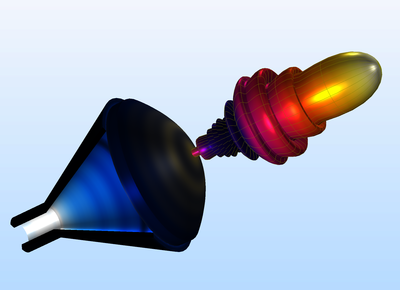
An axisymmetric 3D structure such as a conical horn antenna can be simulated in a fast and efficient way using only its 2D layout. In this model, the antenna radiation and matching characteristics are computed very quickly with respect to the dominant TE mode from the given circular ... Read More
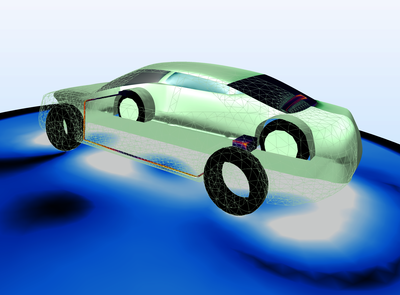
Modern cars have rear-windshield FM antennas to play FM radio. The radiation emitted from an antenna induces an electric current on the outer surface of any cable harnesses in the car, which can have negative effects. This model uses the RF Module to compute the far-field radiation ... Read More
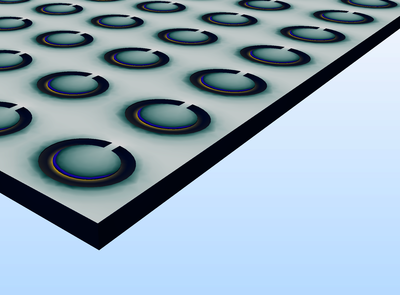
Frequency-selective surfaces (FSS) are periodic structures with a bandpass or a bandstop frequency response. This model shows that only signals around the center frequency can pass through the periodic complementary split ring resonator layer. Read More

A plane electromagnetic wave is incident on a metallic sphere partially embedded on a substrate. In this electromagnetic scattering problem, the far-field variables are computed for a few elevation angles of incidence. Read More

Frequency selective surfaces (FSS) are periodic structures with a bandpass or a bandstop frequency response. This model shows that only signals around the center frequency can pass through the periodic complementary split ring resonator layer. Read More
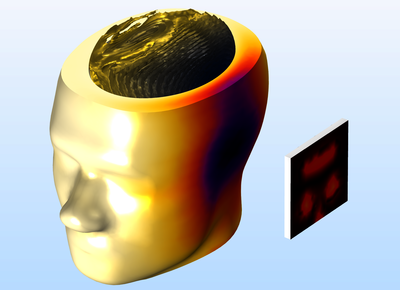
Users of consumer electronics with radiating devices are exposed to radio frequency (RF) emission. The amount of exposure is defined as the specific absorption rate (SAR). That is, the SAR value represents the radio frequency (RF) energy rate absorbed by a body. This model computes local ... Read More
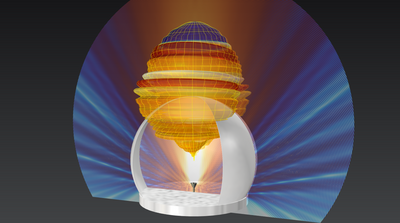
This model demonstrates an efficient approach to simulating a thin, spherical, large radome using a 2D axisymmetric formulation with cubic discretization. The axisymmetric method captures full 3D behavior for azimuthally symmetric geometries at only a fraction of the computational cost. ... Read More