
The Application Gallery features COMSOL Multiphysics® tutorial and demo app files pertinent to the electrical, structural, acoustics, fluid, heat, and chemical disciplines. You can use these examples as a starting point for your own simulation work by downloading the tutorial model or demo app file and its accompanying instructions.
Search for tutorials and apps relevant to your area of expertise via the Quick Search feature. Note that many of the examples featured here can also be accessed via the Application Libraries that are built into the COMSOL Multiphysics® software and available from the File menu.
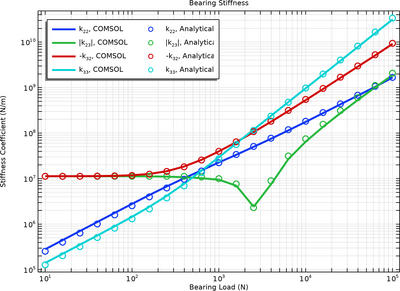
When analyzing rotors, it is common that bearings are modeled through their effective dynamic coefficients about a static equilibrium position. This model illustrates how to compute such coefficients for a cylindrical journal bearing. The bearing length is kept much smaller than its ... Read More
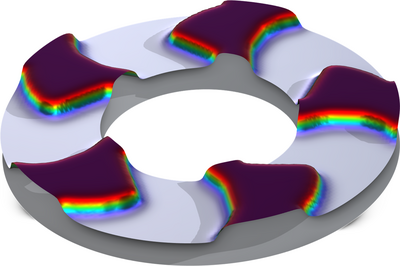
In this tutorial model, a step thrust bearing is topology optimized to maximize the bearing capacity. A step thrust bearing consists of a stepped bearing surface on which the end of the shaft rotates. The entire assembly is submerged in a lubricant. The shaft collar is assumed to be ... Read More
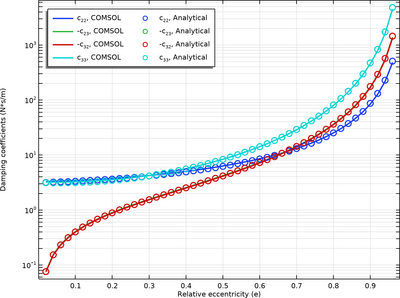
Squeeze film dampers are components that provide additional damping to rotating machines. To simplify the modeling of a rotor assembly, squeeze film dampers are modeled in terms of their damping coefficients which are a functions of the journal location in the damper. This model computes ... Read More
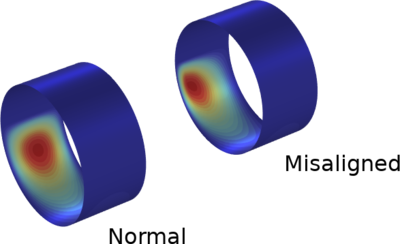
In this example, a rotor supported by two hydrodynamic bearings is analyzed. An eccentric disk located between the bearings induces rotor whirl. One of the bearings is misaligned with the rotor axis. The Beam Rotor interface with Hydrodynamic Bearing interface in the Rotordynamics ... Read More
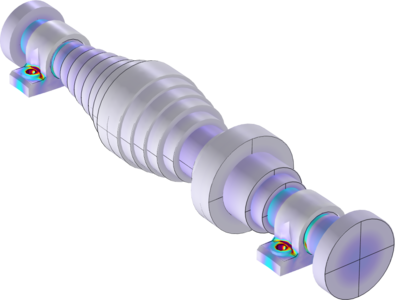
Hydrodynamic bearings generate heat due to the viscous losses in the lubricant. As a result, the temperature of the rotor increases, causing deformation and thermal stresses in both the rotor and the bearing housing. This example shows how to model different physical phenomena involved ... Read More
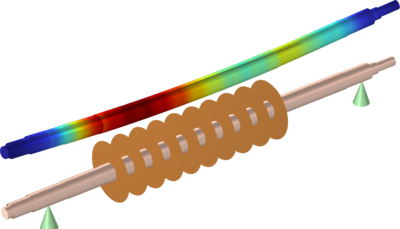
The fluid flow in seals causes a strong restoring radial force, opposing the shaft motion. Also, there is a cross-coupled force due to the axial variation of the circumferential flow. The first type of force always has a stabilizing effect on the rotor, whereas the second one can cause ... Read More
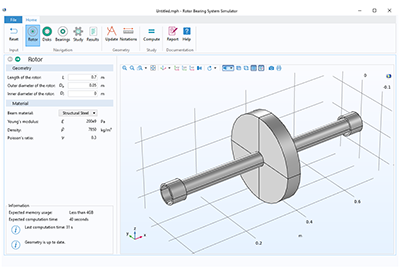
This app demonstrates the following: Navigation system using toggle buttons in the ribbon and Back/Forward buttons in the settings window Selecting predefined or user-defined materials Using a table for input of geometry objects The app simulates a rotor bearing system consisting of ... Read More

This example demonstrates how modeling can be used to investigate the performance of different hydrodynamic journal bearings. The model uses the Hydrodynamic Bearing interface, which solves the Reynolds equation to compute the pressure developed in a thin fluid film for four bearing ... Read More


