
The Application Gallery features COMSOL Multiphysics® tutorial and demo app files pertinent to the electrical, structural, acoustics, fluid, heat, and chemical disciplines. You can use these examples as a starting point for your own simulation work by downloading the tutorial model or demo app file and its accompanying instructions.
Search for tutorials and apps relevant to your area of expertise via the Quick Search feature. Note that many of the examples featured here can also be accessed via the Application Libraries that are built into the COMSOL Multiphysics® software and available from the File menu.
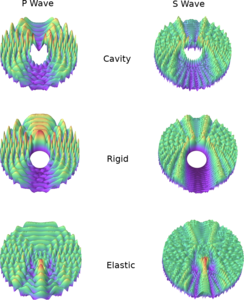
This model showcases how to solve for the scattered field when knowing the incident field for three different types of scatterer, that is, an infinitely rigid one, a cavity and an elastic inclusion. This formulation can be useful when the scatterer is in the far field of the source, so ... Read More
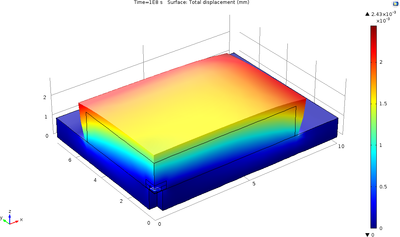
Modern integrated circuits are available as plastic encapsulated microcircuits (PEM). These devices are molded out of polymeric materials and epoxy resins in order to protect the internal semiconductors. Unfortunately, polymeric mold compounds absorb moisture when exposed to a humid ... Read More
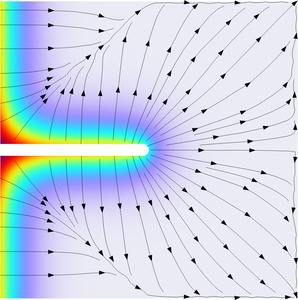
Hydrogen embrittlement refers to the degradation of metal ductility due to the absorption of hydrogen. The metal becomes more brittle and thus cracks might initiate at lower stress levels. It is important to estimate hydrogen concentration and the speed at which it diffuses into the ... Read More
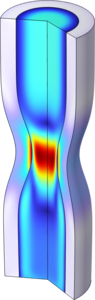
In this example of a peristaltic pump, rollers squeeze a flexible tube and the compression drives a fluid through the tube. The model demonstrates how to use the Fluid-Structure Interaction interface. The main advantage of the peristaltic pump is that no seals, valves or other internal ... Read More
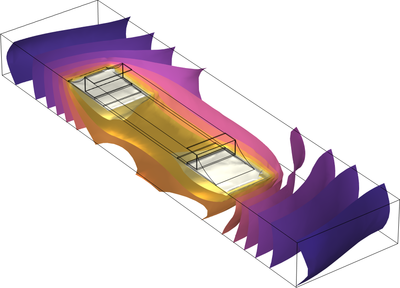
The drive for miniaturizing electronic devices has resulted in today’s extensive use of surface-mount electronic components. An important aspect in electronics design and the choice of materials is a product’s durability and lifetime. For surface-mount resistors and other components ... Read More
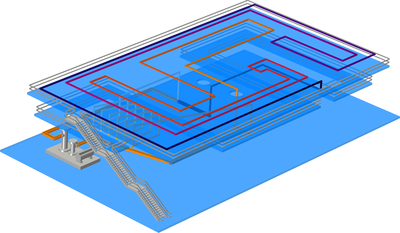
This example demonstrates how to model coupled flow, heat transfer, and structural deformation and stress in a pipeline network. Gravity loads from the pipe and fluid are also taken into account. Read More

This model shows how to use the scattered-field formulation to compute the transmission coefficient for impinging P and S plane elastic waves onto a finite-size phononic crystal. The transmission tends to zero in the frequency ranges corresponding to P- and S-wave band gaps, as ... Read More
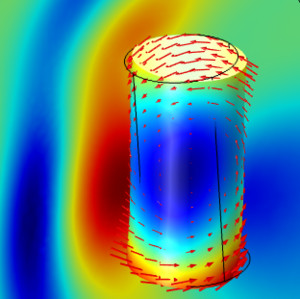
Coupling acoustics in liquids or gases with structural mechanics has applications in many engineering fields, including loudspeakers, acoustic sensors, nondestructive testing, and medical ultrasound diagnostics. This tutorial model demonstrates how to model the interaction between sound ... Read More


