
The Application Gallery features COMSOL Multiphysics® tutorial and demo app files pertinent to the electrical, structural, acoustics, fluid, heat, and chemical disciplines. You can use these examples as a starting point for your own simulation work by downloading the tutorial model or demo app file and its accompanying instructions.
Search for tutorials and apps relevant to your area of expertise via the Quick Search feature. Note that many of the examples featured here can also be accessed via the Application Libraries that are built into the COMSOL Multiphysics® software and available from the File menu.
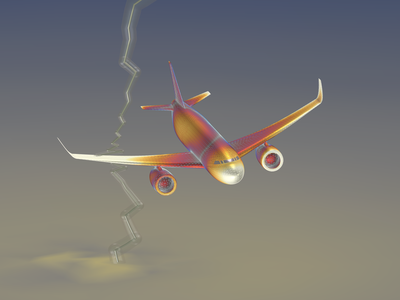
The model demonstrates how to compute the induced voltage of a wire loop inside an airplane under different electromagnetic shielding conditions. Read More
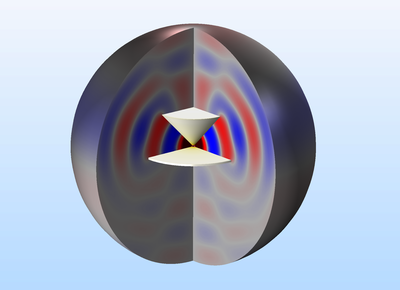
Conical antennas are useful for many applications due to their broadband characteristics and relative simplicity. In this example, we study the antenna impedance and radiation pattern as functions of frequency for a monoconical antenna with a finite ground plane and a 50 ohm coaxial ... Read More
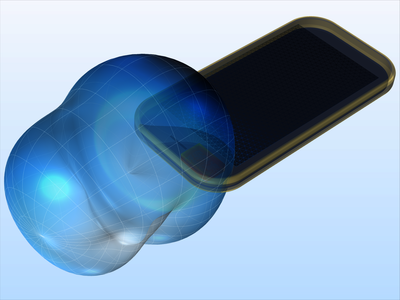
Electrical components in wireless communication systems are designed to be small and lightweight while maintaining decent performance and efficiency. Antennas are essential components in mobile devices and are required to fit in the limited space allowed by industrial specifications. To ... Read More
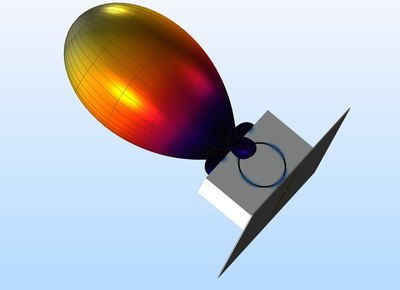
A dielectric resonator placed near a radiating element can be used to increase directivity and gain. Here, a block of quartz dielectric, with additional passive metallic antenna elements, is placed above a slot antenna. The fields in and around the antenna are solved for. The far field ... Read More
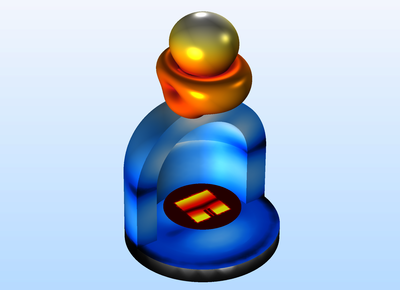
A radome minimizes losses and improves radiation characteristics of an antenna through its design. The structure can be optimized to minimize the transmission loss and also designed to improve radiation characteristics including antenna directivity and side lobes. Shown in the model is ... Read More
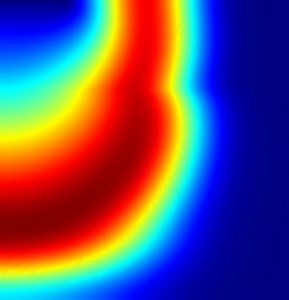
Aldicarb is a commercial pesticide, used on a variety of crops, including cotton, fruits, potatoes, and beans. This arises in the possibility that the general population may be exposed to aldicarb through the ingestion of contaminated water and foods. This example looks at the ... Read More
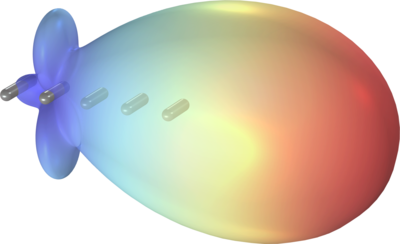
This model demonstrates the use of boundary element method in the Electromagnetic Waves, Boundary Element interface to model an optical Yagi-Uda antenna. The antenna is driven by an electrical point dipole, which is implemented through the background field. The field distribution around ... Read More
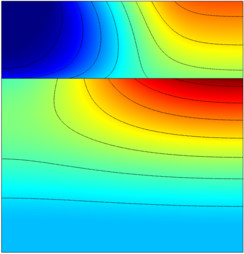
In this example water ponded in a ring on the ground moves into a relatively dry soil column and carries a chemical with it. As it moves through the variably saturated soil column, the chemical attaches to solid particles, slowing the solute transport relative to the water. Additionally ... Read More
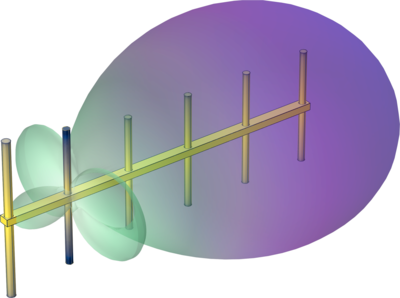
The Yagi–Uda antenna is designed for a specific Wi-Fi band and can reduce eavesdropping by directing signals with the help of directors. This antenna consists of one uniformly spaced reflector and four directors. Simulated results show a maximum 10 dBi gain and a front-to-back ratio of ... Read More
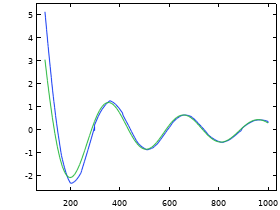
In this tutorial model, the far-field radiation pattern of a dipole antenna is computed in a 3D model component. Then, in a separate 3D model component, a ray is released using the far-field radiation pattern to initialize the ray's intensity, polarization, and phase. Read More


