
COMSOL Conference 2025 Proceedings
Collection of Papers, Posters, and Slideshows Accepted by the Program Committee
At the COMSOL Conference 2025, engineers, researchers, and scientists from around the globe showcased their use of modeling and simulation across all major industries and in academia. Use the Quick Search tool to find a specific presentation or filter by topic or event location.
ISBN: 978-1-7364524-3-1

To overcome the uneven heating during the process of microwave heating of food inside microwave oven, a geometrical model based on domestic microwave oven with a cylindrical container composed of multi-materials(with two different kinds of materials, one half is glass and the other half ... Read More

A patch antenna based on metamaterials of composite split-ring-resonators (CSRRs) and strip gaps is designed with COMSOL Multiphysics® software. The antenna is constructed by using CSRR structures in forms of circular rings on the patch and employing strip gaps on the ground plane. The ... Read More

Two-generation superconducting coils carrying large current in alternating magnetic fields is very common in electrical applications such as HTS linear motor. So it is meaningful to study the characteristics of coated superconductors in the presence of travelling magnetic field. In this ... Read More

Metamaterial-based absorbers play a significant role in applications ranging from energy harvesting and thermal emitters to sensors and imaging devices. The middle dielectric layer of conventional metamaterial absorbers has always been solid. Researchers could not detect the near field ... Read More

Many numerical coupling thermo-hydro-mechanical-chemical models for methane hydrate bearing sediments(MHBS) have been proposed to analyze the mechanical behavior of MHBS during methane gas production. However, most of them are based on finite differential method (FDM) or finite volume ... Read More

Recently, the researchers usually use the hydrodynamic Drude model (HDM) to investigate the nonlocal optical response of metallic nanostructure. The advantage of the HDM is easy to implement numerical calculation for larger and more complex-shaped nanoplasmonic structures. For the HDM, ... Read More
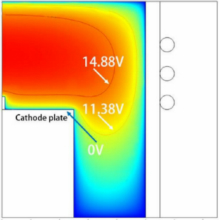
Inductively Coupled Plasma Chemical Vapor Deposition (ICPCVD) has been widely used for carbon-based nanomaterial synthesis because it provides high plasma densities and uniform plasma distribution and allows plasma to be generated in room temperature.[1] During the ICPCVD process, the ... Read More

The thermal behavior of lithium ion batteries could be investigated by efficient simulation method [1,2]. Here, we developed an electrochemical-lumped thermal analytical model to analyze the thermal response and heat breakdown of a pouch LiNi1/3Co1/3Mn1/3O2 battery (3Ah) under fast ... Read More


