Explore the innovative ways multiphysics simulation is being used worldwide to advance research
Multiphysics modeling and simulation drives innovation across industries and academia — as is evidenced by the many uses showcased in the technical papers and posters presented by engineers, researchers, and scientists at the COMSOL Conference each year.
Draw inspiration from the recent proceedings collected below, or, to find a specific presentation or filter by application area or conference year/location, use the Quick Search tool.
View the COMSOL Conference 2025 Collection
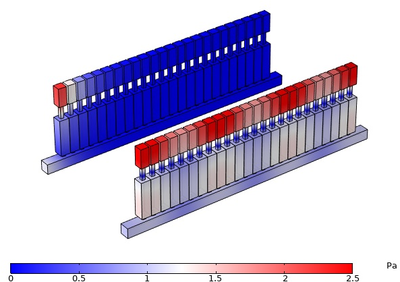
New design structure for generating and tuning the multi-bands of negative modulus is presented by introducing metamaterial concept. To effectively achieve selective noise reduction and sound transmission, acoustic metamaterial consisted of arrayed multiple resonators with extended necks ... Read More
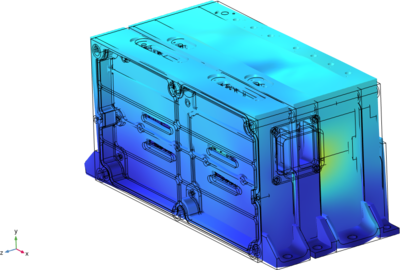
RAKON is a worldwide expert in high performance crystal oscillator. The company decided to expand its product range to larger space equipment, the Master Reference Oscillator (MRO). This product is composed of stacked mechanical modules, joined together by structural screwed assemblies. ... Read More

For automotive applications, acoustical simulation methods are used to optimize the position and orientation of the loudspeakers to get the best audio system performance. The goal of the presented paper is to evaluate the accuracy of the Pressure Acoustics interface (Finite Element, wave ... Read More
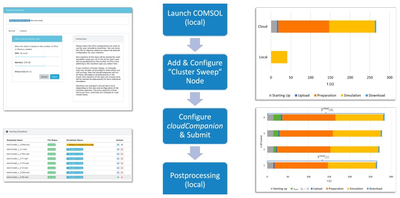
To this day seamless accessibility of local or cloud hardware for high performance computing as well as time consuming workflows involving sequencing and orchestration of available hardware for multiple simulation runs, remain limiting factors within the field of Multiphysics simulation ... Read More

Technical advancements in miniaturization in the last decades have, among others, brought forth the technology of so called “Lab-on-a-Chip” (LOC) systems. These systems provide the possibility to automate and accelerate certain laboratory processes, e.g., biomedical diagnostics, on the ... Read More

The ideal way to measure the acoustic performance of heavy items such as vehicles or machines is in a semi-anechoic chamber, i.e. in an environment with no reflections except from the solid floor where the noise source is standing. To accurately measure low frequencies down to 20 Hz ... Read More

The COMSOL® app library of the Technical University of Munich is a collection of applications for simulating acoustic phenomena. They are used in the teaching of acoustics to visually represent fundamental vibrational aspects and provide learners with a visual understanding. In the ... Read More

This study involves a comparative analysis focusing on the transmission loss (TL) exhibited by both the Helmholtz resonator (HR) and the quarter-wavelength resonator (QWR). These resonators are designed to attenuate sound energy specifically at their respective resonance frequencies. ... Read More
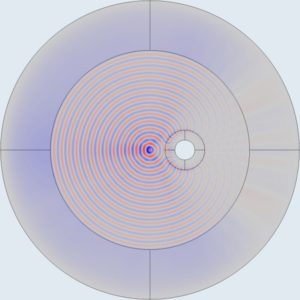
This poster presents a passive noise control of sound emananted from a vibrating cylinder using acoustic superscatterers. Acoustic superscatterer is a type of metamaterial whose scattering cross-section is larger than its real size. Numerical studies are conducted using pressure ... Read More

Vibration-based Piezoelectric Energy harvesters convert ambient vibration energy into an applicable electrical charge for wireless sensors, IoT applications, and charging the battery, which is most important to range improvement of the Electric Vehicle. This study analyses different ... Read More