
Explore the innovative ways multiphysics simulation is being used worldwide to advance research
Multiphysics modeling and simulation drives innovation across industries and academia — as is evidenced by the many uses showcased in the technical papers and posters presented by engineers, researchers, and scientists at the COMSOL Conference each year.
Draw inspiration from the recent proceedings collected below, or, to find a specific presentation or filter by application area or conference year/location, use the Quick Search tool.
View the COMSOL Conference 2025 Collection
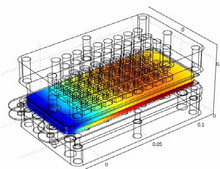
Phosphoric acid doped polybenzimidazole (PBI) membranes are commonly used in today’s high-temperature polymer-electrolyte-membrane (HTPEM) fuel cell technology. COMSOL Multiphysics is used to model and simulate the three-dimensional, single-phase, non-isothermal overall cell behaviour ... Read More

The present work focuses on modeling a new experimental technique: Scanning Electro-chemical Potential Microscopy (SECPM), which is used to probe the potential profile of the electric double layer (EDL). We used an electrostatic approach to compute the EDL potential measured within the ... Read More

Corrosion of metals in confined zones is a big industrial problem. The electrochemistry of such localized corrosion processes is complicated by the impact of the corrosion processes on the composition of the local solution. In the present problem, local interaction with the atmosphere ... Read More
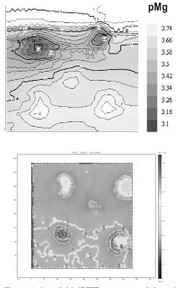
Progress in coating technology has allowed for the development of free-chromate corrosion inhibitors, which are able to smartly migrate when required. In order to support the coating design, we propose a hybrid mathematical model to study the inhibitor's release by taking into account ... Read More
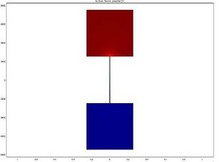
The steady-state non-equilibrium distributions of two species of mono-valent ions around a charged nanofluidic channel have been examined. Large reservoirs were placed on either side of the nanoscale channel to simulate bulk concentration of ions in a fluid. Results from COMSOL ... Read More

Restoration of archaeological materials from oceans is a major activity of Arc’ Antique. Organic materials such as wood, tissues, leathers, papers and ceramics found in sea water are always impregnated with salts. Rinsing such archaeological objects with pure water to extract the salts ... Read More

Corrosion and contact ohmic resistance of the stainless steel current collectors in molten carbonates is one of the greatest obstacles to widespread application of molten carbonate fuel cells (MCFC). We simulate the variation of material parameters values, accounting for the impact of ... Read More

Modeling of mass transport is an important step in evaluating lithium-ion battery electrolytes and understanding cell performance. For high-power applications, concentration gradients in the electrolyte lead to limiting currents, which limit the power-density of the battery. The model ... Read More

Due to computational considerations most models of lithium storage particles in batteries incorporate spherical particles. However most storage particles used in battery electrodes tend to be irregular in shape with sharp edges and extended aspect ratios. The change of the relative ... Read More

In general battery cells are charged/discharged using constant current or constant power expressed as C-Rates and P-Rates respectively. We are developing a single cell-level Li-Ion battery model in order to simulate the performance and the physicochemical phenomena under power ... Read More


