
Explore the innovative ways multiphysics simulation is being used worldwide to advance research
Multiphysics modeling and simulation drives innovation across industries and academia — as is evidenced by the many uses showcased in the technical papers and posters presented by engineers, researchers, and scientists at the COMSOL Conference each year.
Draw inspiration from the recent proceedings collected below, or, to find a specific presentation or filter by application area or conference year/location, use the Quick Search tool.
View the COMSOL Conference 2025 Collection
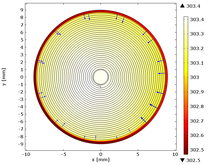
The characterization of Li-ion batteries is a relevant topic due to the recent developments in Electric Vehicles (EV’s) and Hybrid Electric Vehicles (HEV’s) applications. In order to manage these devices, accurate models are required. At NEXT ENERGY a two dimensional cell-level thermal ... Read More
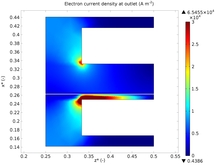
Fuel cells (FCs) are promising as an energy producing device, which at this stage of development will require extensive analysis and benefit from numerical modeling at different time- and length scales. COMSOL Multiphysics® is used to describe an intermediate temperature solid oxide fuel ... Read More
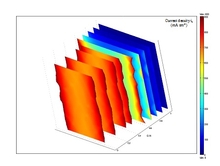
This computational implementation presents a new strategy of coupling two 3D models to satisfy the requirements of the comprehensive model of a unitary Proton Exchange Membrane fuel cell, including its internal geometries and constitutive materials, as well as distinct physical and ... Read More
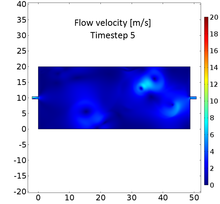
Precise electrochemical machining (PEM) is an innovative machining technology which results from further development of the electrochemical sinking. PEM works with pulsed low frequency direct current and oscillation of the tool electrode. As part of the project ‘Electrochemical machining ... Read More
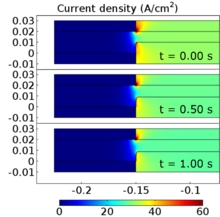
In the Collaborative Research Centre 692 at TU Chemnitz several academic institutions work on aluminum matrix composites (AMCs). These materials consist of an aluminum matrix, which is reinforced by SiC or Al2O3 particles with dimensions less or equal 1 µm. One main task is finishing ... Read More
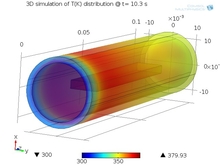
A mathematical model based on a finite element method (FEM) is presented as an initial approach for a system converting waste heat energy into chemical energy. This system consists of a pyroelectric LiNbO3 plate placed into a cylinder which undergoes a laminar water flow with an ... Read More
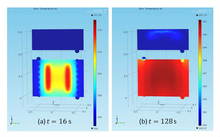
A design for the thermal management of the media used for packing Li-ion batteries used in hybrid and electric vehicles has been developed. The design satisfies all thermal and physical issues relating to the battery packs used in vehicles such as operating temperature range and volume, ... Read More
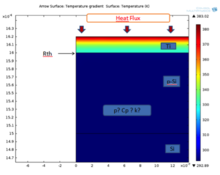
The silicon is mainly known under its single-crystal shape and polycrystalline. Since a few decades, a new type of morphology is developed: the porous silicon (p-Si). Meso-porous silicon (Mp-Si) is one of promising materials for future microelectronic chips multi-functionalization ... Read More
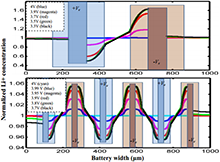
The adoption of micro- and nanostructured electrodes is a promising technique to improve the performance of Li-ion battery, which increases the electrode surface area and improves the efficiency of ion exchange between the electrode and electrolyte. This performance improvement is ... Read More

A planar anode-supported intermediate temperature solid oxide fuel cell operating on syngas fuel at 750°C was analyzed in this study. The effects of varying syngas fuel inlet compositions on species and temperature distributions, water gas shift reaction rate, potential for carbon ... Read More


