
Explore the innovative ways multiphysics simulation is being used worldwide to advance research
Multiphysics modeling and simulation drives innovation across industries and academia — as is evidenced by the many uses showcased in the technical papers and posters presented by engineers, researchers, and scientists at the COMSOL Conference each year.
Draw inspiration from the recent proceedings collected below, or, to find a specific presentation or filter by application area or conference year/location, use the Quick Search tool.
View the COMSOL Conference 2025 Collection
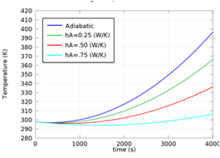
COMSOL® "Single Particle Model for Lithium-Ion Batteries” (Model ID: 14527) is generalized to include an energy balance. This is accomplished by approximating the solution phase polarization as a function of current and temperature. The theoretical approach for this work is similar to ... Read More

Solid Oxide Fuel Cells (SOFCs) are one of the most attractive technologies for meeting our future energy demands. They promise the efficient conversion of chemical to electrical energy and are a growing area of both academic and industrial interests. Typical electrode-supported SOFCs ... Read More

The temperature distributions inside two packs (in-line and staggered) made of large cylindrical lithium iron phosphate cells (of 18 Ah nominal capacity) are analysed in this paper during a 90 A constant discharge current. The analysis of the battery packs temperature distributions is ... Read More

The present work demonstrates that a simple half-cell model is capable of reproducing qualitatively the main features of the measurements of the current density distribution in a high-temperature polymer electrolyte fuel cell, pointing that computational modeling and simulation are an ... Read More

Electropolishing is an electrochemical process that radiofrequency accelerating cavities undergo in order to improve their inner metal surface finishing. This is performed prior to their installation into particle accelerators, in order to enhance their accelerating properties. Using ... Read More

The use of numerical techniques in PEM fuel cell sensoring represents an advantage of project engineering, reducing the costs and accelerating the manufacturing of prototypes. In this work some numerical responses are shown, relating to numerical sensoring of water and oxygen mole ... Read More
A Proton Exchange Membrane Fuel Cell (PEMFC) comprises a membrane-electrode assembly sandwiched between two conducting ‘monopolar’ plates having engraved gas flow channels, also called the flow field. The purpose of the flow field is to provide sufficient residence time for the gases to ... Read More
A Proton Exchange Membrane Fuel Cell (PEMFC) is an electrochemical device, which converts a part of heat from the formation of water into electricity. Each cell has a Membrane-Electrode Assembly (MEA) which is placed between two electrically conducting plates having gas flow channels. An ... Read More

A three-dimensional mathematical model under stationary conditions have been established to understand the corrosion of carbon steel cylindrical samples immersed in flowing NaCl solution through an annular duct. The migration, diffusion and convection mass transfer mechanisms were solved ... Read More
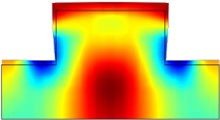
The ubiquitous commercial use of Lithium-Ion batteries (LIBs) has increased interest in their implementation into efficient energy storage systems for clean and renewable power sources and the electrical transportation industry. Unfortunately, LIBs are not yet technological mature to ... Read More


