
Explore the innovative ways multiphysics simulation is being used worldwide to advance research
Multiphysics modeling and simulation drives innovation across industries and academia — as is evidenced by the many uses showcased in the technical papers and posters presented by engineers, researchers, and scientists at the COMSOL Conference each year.
Draw inspiration from the recent proceedings collected below, or, to find a specific presentation or filter by application area or conference year/location, use the Quick Search tool.
View the COMSOL Conference 2025 Collection

In an experimental nuclear fusion facility dust is generated both during normal machine operations and by macroscopic erosion of the plasma facing materials due to intense thermal loads. This dust can be mobilized by air ingress in case of LOVA (Loss of Vacuum Accident) threaten safety ... Read More

The roof of a well known shopping place in Amsterdam collapsed during a storm with heavy rain showers in 2002. One of the main problems was the malfunction of the draining system. Another problem was that driving rain water apparently washed over edges that where designed to hold the ... Read More

Outline of presentation: Missions of SACM (Accelerator, Cryogenics and Magnetism Division) Context : The Large Hadron collider at CERN, Geneva Cooling large superconducting magnet Thermosiphon open loops for cooling superconducting magnets Experimental facility and ranges of the study ... Read More
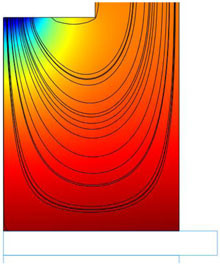
Oxygen transfer through ceramic membranes at high-temperature can substantially reduce costs respect to conventional separation methods. With the aim to improve the determination of the properties of the ceramic materials, a lab-scale permeation set-up was modeled using the Chemical ... Read More
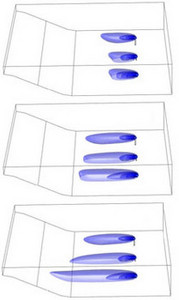
HazRes has developed a gas discharge and dispersion model in COMSOL which takes into account the effects of localized wind profiles and turbulence generated by buildings, structures and terrain on the dispersion of gases in question. The main focus of this work is to develop and provide ... Read More
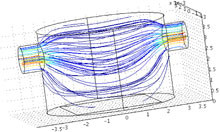
We use finite elements simulations in order to study the fluid flow behavior in a chamber of a preconcentrator. We realized that most part of the fluid does not affect our preconcentrator because it is going out the chamber at high distance above it and parallel to the preconcentrator. ... Read More
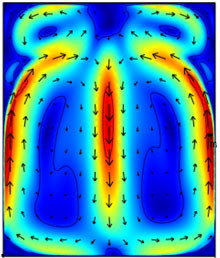
A numerical simulation study, using COMSOL Multiphysics®, was carried out to examine the temperature and concentration fields in the dissolution process of silicon into germanium melt. This work utilized a simplified configuration which may be considered to be similar material ... Read More
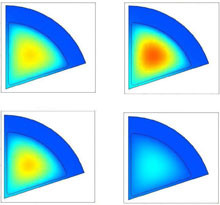
A two-dimensional mathematical model for the absorption and desorption of H2 in LaNi4.8Al0.2 was developed and experimentally validated. The model is composed of an energy balance, a mass balance and a momentum balance. These differential equations are numerically solved by means of the ... Read More

In the pool type Fast Breeder Reactors the roof structure is penetrated by a number of pumps and heat exchangers which are cylindrical in shape. Argon gas in reactor is sandwiched between the free surface of sodium and the roof structure and can flow in the annular space between the ... Read More
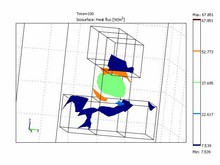
One of the major challenges faced by the semiconductor industry is that electronic circuits produce a lot of heat energy during their operation. And with the current scenario where the gates are packed so much close together, then the problem of heat generation has become extremely ... Read More


