Explore the innovative ways multiphysics simulation is being used worldwide to advance research
Multiphysics modeling and simulation drives innovation across industries and academia — as is evidenced by the many uses showcased in the technical papers and posters presented by engineers, researchers, and scientists at the COMSOL Conference each year.
Draw inspiration from the recent proceedings collected below, or, to find a specific presentation or filter by application area or conference year/location, use the Quick Search tool.
View the COMSOL Conference 2025 Collection
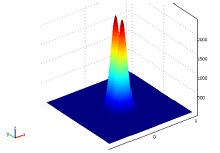
The main purpose of this paper is to develop a proof of concept software that can simulate the geometry of engraved surfaces and can estimate the depth and width of engraved groove and associated laser parameters. For this purpose, COMSOL has been used to simulate the moving laser beam ... Read More
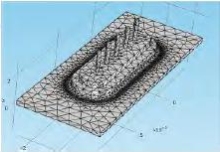
In all implantable medical devices, one main challenge is to assure no water penetrates in the electronic part of the system. To be able to transmit the electronic information from the inside of the device to the lead without any water infiltration, we used a complex part called feed ... Read More

Multiphysics optimization of thermal-fluid systems is an emerging area of interest with application to the development of high performance cooling technologies for electronic systems. This paper builds on previous work focused on the development of a computational platform for numerical ... Read More

The microwave heating and processing of heterogeneous material is usually simulated using a set of coupled PDE equations in an homogeneous medium. Nowadays it is possible to describe more accurately the process with a suitable description of the heterogeneities that is at the grain ... Read More

A 1D phase change problem, known as Stefan’s problem, for which analytical solutions are available, is solved as a 2D problem using COMSOL Multiphysics. The PCM medium is semi-infinite, initially solid at its melting temperature Tm, and at t = 0, the wall temperature is raised to Tw > ... Read More

The Dynamic Transmission Electron Microscope (DTEM) at Lawrence Livermore National Laboratory is a unique instrument able to capture images of fast-evolving microstructure with exposure times of only 15 ns. This is more than six orders of magnitude faster than conventional in situ ... Read More

A 3-D model for compost was constructed taking as geometry basis a truncated cone, with dimensions of 4 m radius and 3 m height; in this structure an energy balance is applied for a two phase system (solid-air). Compost energy processes are modeled using COMSOL with a modified heat ... Read More
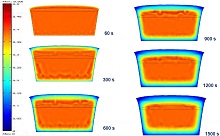
Bread baking is a complex process where various physiochemical and biological transformations take place simultaneously. A two dimensional model was developed for the bread baking process taking into account of volume expansion, heat and mass transfer processes. Phase change and ... Read More