Explore the innovative ways multiphysics simulation is being used worldwide to advance research
Multiphysics modeling and simulation drives innovation across industries and academia — as is evidenced by the many uses showcased in the technical papers and posters presented by engineers, researchers, and scientists at the COMSOL Conference each year.
Draw inspiration from the recent proceedings collected below, or, to find a specific presentation or filter by application area or conference year/location, use the Quick Search tool.
View the COMSOL Conference 2026 Collection
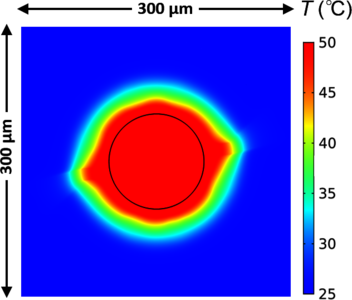
Evonetix is a Cambridge-based start-up company working on a revolutionary new technology to synthesize high-fidelity DNA at scale. Our technology is based on a silicon MEMS chip with a large number of reaction sites that facilitate multiple parallel synthesis channels. We operate a ... Read More
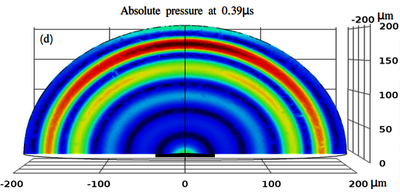
In our work, simulations of a piezoelectrical micromachined ultrasonic transducer compatible with CMOS-MEMS process are presented. The piezoelectric material of the PMUT is AlN sandwiched between two Al layers and a top Si3N4 passive layer. The piezoelectric and the metal materials have ... Read More

This work explores the implications of wholly random and non-linear nanostructures on electromagnetic wave propagation within a multiphysics simulation environment. Showcased is a way to noticeably bypass the inaccuracies drawn from the linearity dependency of traditional simulation ... Read More

MEMS microphones consist of a conductive backplate and a conductive flexible membrane. The backplate and the membrane are at a certain distance from each other to be interpreted as parallel plates of a capacitor. When a bias voltage is applied to the electrodes, membrane deflection ... Read More
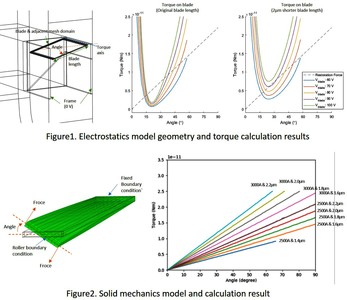
Micro shutter array (MSA) is a programmable optical spatial filtering device fabricated by micro electro-mechanical system (MEMS) technology. It was originally developed for James Webb Space Telescope (JWST) to enable multi-object spectroscopy and operated by a moving magnet. Next ... Read More

The challenge of our current research is to design large aperture MEMS scanning mirrors for Light Detection and Ranging (LIDAR) applications such as in unmanned driving or Unmanned Aerial Vehicle. The current MEMS scanning mirrors have a smaller aperture which limits application, it can ... Read More

From microelectronics cooling to biological analysis and wearable therapeutic infusion systems, micropumps are steadily becoming a valuable and ubiquitous tool for fluid transport and thermal management. Hence, the development of novel actuation mechanisms that allow for precise ... Read More

A defining characteristic of atomic layer deposition (ALD) is the sequential exposure of a surface to self-limiting, saturating reactions. Temporal ALD operates through intermittent purge cycles, while spatial ALD relies on physical separation accomplished by delivering reactants through ... Read More