
Explore the innovative ways multiphysics simulation is being used worldwide to advance research
Multiphysics modeling and simulation drives innovation across industries and academia — as is evidenced by the many uses showcased in the technical papers and posters presented by engineers, researchers, and scientists at the COMSOL Conference each year.
Draw inspiration from the recent proceedings collected below, or, to find a specific presentation or filter by application area or conference year/location, use the Quick Search tool.
View the COMSOL Conference 2026 Collection

Solid oxide electrolysis cells (SOECs) are a promising pathway for green hydrogen production, but their commercial viability is limited by oxygen-electrode delamination that accelerates performance degradation. This work presents a microstructure-resolved electro-chemo-mechanical model ... Read More
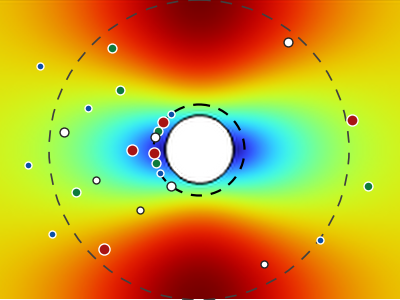
Acoustics is reported to enhance fibrous filter efficiency; however, the degree of improvement against non-acoustic case is difficult to quantify in the absence of a reference model. We developed a COMSOL reference model that predicts capture efficiency across a wide range of fibrous ... Read More
Lightweight polymeric cellular solids are central to transportation, impact protection, thermal isolation, packaging, soft robotics, and biomedical systems, yet conventional foam manufacturing remains constrained by molds, multistep processing, high external energy demand, and limited ... Read More
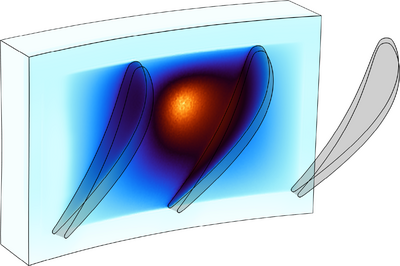
Blade-tip clearance and turbine inlet temperature are critical efficiency parameters in turbomachinery design. Smaller clearances reduce leakage losses, but increase the risk of rubs between blades and the casing. Higher operating temperatures improve efficiency, but reduce the finite ... Read More
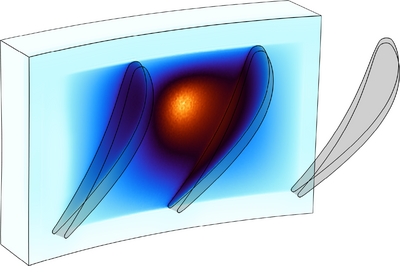
Blade-tip clearance and turbine inlet temperature are critical efficiency parameters in turbomachinery design. Smaller clearances reduce leakage losses, but increase the risk of rubs between blades and the casing. Higher operating temperatures improve efficiency, but reduce the finite ... Read More
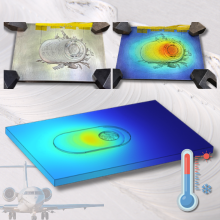
Additive Friction Stir Deposition (AFSD) is a solid-state additive manufacturing process capable of producing structural repairs with mechanical properties approaching those of wrought material, making it particularly attractive for restoring damaged aerospace components such as those ... Read More
We study energy distributions in unmodulated metal-dielectric-metal (MDM) structures. Two modes are observed: cavity mode and gap plasmon mode. The electric and magnetic fields behave differently in these modes. In the gap plasmon mode, electric energy is strongly confined in the ... Read More
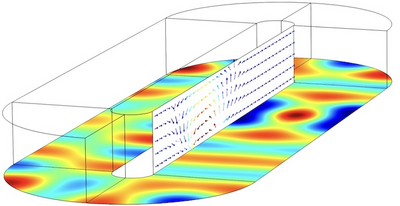
Electrical dispersal deterrents are the most mature technology for deterring invasive species in open waterways. However, they pose human safety risks, incur high operational costs, and exhibit reduced efficacy against smaller fish. Consequently, current research focuses on optimally ... Read More
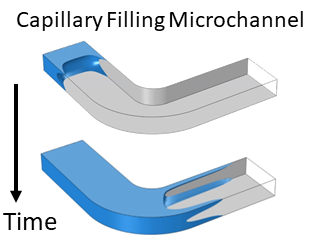
Capillary filling—the autonomous wicking of liquids through hydrophilic microchannels driven by surface tension and wettability—enables pump-free fluid handling in microfluidic devices for point-of-care diagnostics, lab-on-a-chip systems, and biomedical applications. A critical design ... Read More
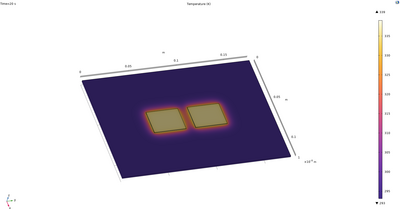
The transition to glass-core PCB substrates is driven largely by electrical advantages — low dielectric loss, CTE match to silicon. The glass substrate itself is a substantially better thermal conductor compared to FR-4 epoxy (kglass ≈ 1.4 W/m·K vs. kFR4 ≈ 0.3 W/m·K), producing broader ... Read More


