
See How Modeling and Simulation Is Used Across Industries
Multiphysics modeling and simulation drives innovation across industries and academia — as is evidenced by the many uses showcased in the technical papers and posters presented by engineers, researchers, and scientists at the COMSOL Conference each year.
Draw inspiration from the recent proceedings collected below, or, to find a specific presentation or filter by application area or conference year/location, use the Quick Search tool.
View the COMSOL Conference 2025 Collection

Gas-liquid falling film microreactors carry out fast exothermic and mass transfer limited reactions. Since the major rate limiting steps occur on the liquid side, it is important to account for a realistic liquid film profile within the reactor simulation. Based on realistic channel ... Read More

Increased concentrations of greenhouse gases in the atmosphere are known to be the main cause of global warming. Among the various decarbonisation strategies proposed, geological storage of CO2 is one of the most interesting options for reducing net carbon emissions to the atmosphere. ... Read More

Smart materials, due to their ability to undergo structural and functional changes in response to external stimuli have garnered significant attention in different applications. Among these, metal hydrides have been extensively studied as potential candidates for hydrogen storage. ... Read More

The DOE BETO consortium "ChemCatBio" has developed a packed bed catalyst for use in a Catalytic Fast Pyrolysis (CFP) process for producing biofuels and chemicals from lignocellulosic biomass. Another BETO consortium known as "CCPC" (Consortium for Computational Physics and Chemistry) is ... Read More

Steam drums of a nuclear power plant separate steam from the steam water mixture and sub cooled incoming feed water returns to the reactor. The entire feed water flow is delivered to the steam drum through the feed water sparger. The feed water sparger is provided with number of ... Read More
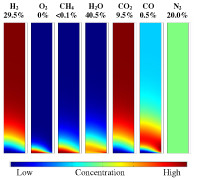
This paper intends to show a model of a monolithic reactor for the autothermal reforming process (ATR), a process that uses hydrocarbons to produce H2. The ATR chemical reactions take place on the surface of monolith channels coated with a catalyst. The isothermal ATR reactor is modeled ... Read More

Magnesium hydride (MgH2) has been one of the most promising hydrogen storage methods that can be applied to commercial hydrogen energy systems due to magnesium’s safety, low cost, and excellent storage capacity for hydrogen, compared to other reversible metal hydrides. But hydrogen ... Read More

Electrochemistry is inherent a surface process, requiring the transport of reagents towards the electrode surface. In electrochemical reactors this typically results in mass transfer limitation problems, limiting the yield and efficiency of the reactor. While the academic community is ... Read More

Present work is done in the framework of the SisAl Pilot EU project, which aims at optimising the silicon production in Europe by recycling materials and using a carbon-emission friendly technology. The silicon production experiments are conducted on laboratory and pilot scales in ... Read More

At Oak Ridge National Laboratory (ORNL), the COMSOL Multiphysics software has become a reliable and important resource to estimate and assess thermal safety margins for several nuclear applications. This poster presentation will highlight some of the ongoing activities in the following ... Read More


