
See How Modeling and Simulation Is Used Across Industries
Multiphysics modeling and simulation drives innovation across industries and academia — as is evidenced by the many uses showcased in the technical papers and posters presented by engineers, researchers, and scientists at the COMSOL Conference each year.
Draw inspiration from the recent proceedings collected below, or, to find a specific presentation or filter by application area or conference year/location, use the Quick Search tool.
View the COMSOL Conference 2025 Collection
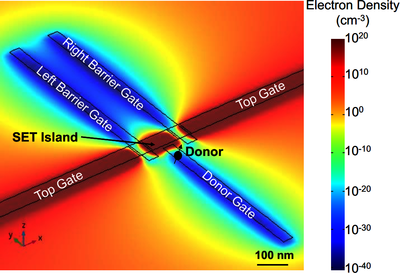
Electronic devices operating at cryogenic temperatures are critical for a wide variety of applications including quantum computing, space, medicine and fundamental research [1]. The design of these devices requires accurate physical modeling of the electric fields, currents, conduction ... Read More
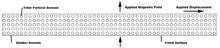
Magnetorheological Elastomers (MREs) are a composite that consist of magnetic micrometer sized particles suspended within rubber matrix filler. By placing this material within an external magnetic field during the rubber curing process, the poles of the particles are forced to align and ... Read More
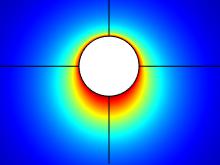
Very recently, the synthesis and experimental study of a new class of highly charged polymer particles has been described, which spontaneously charge in non-aqueous low-polarity solvents [1,2]. These suspensions are an example of what is known as salt-free systems. The study of ... Read More
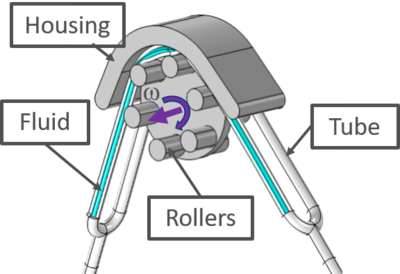
Peristaltic pumps are used during pharmaceutical manufacturing processes, for filling, filtration and mixing operations. Goal of this work was to develop a computational model of a peristaltic pump used for filling operations, to predict shear stresses and mass flow rates. For this ... Read More
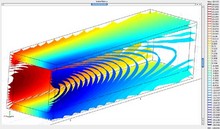
Traditionally the design cycle for magnetic fields involves guessing at a reasonable conductor / magnetic material configuration, using FEA software to calculate the resulting field, modifying the configuration, and iterating to produce the desired field. Our method involved solving the ... Read More
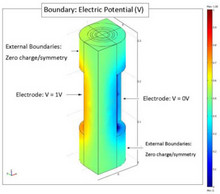
A beneficial method for transporting highly viscous hydrocarbons (e.g. heavy oil and bitumen) through a pipeline is known as Lubricated Pipe Flow (LPF). A major challenge for this technology is flow instability caused by the formation of a wall-coating of oil or the thinning and/or loss ... Read More
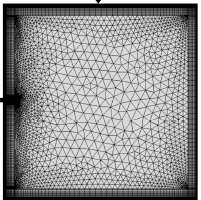
Introduction Throughout the field of micro- and nanoscale electrokinetics, floating bipolar electrodes (BPEs) have proven to be useful in manipulating charged ionic species and biomolecules for electroanalytical studies. The growing use of integrated electronics in working towards fully ... Read More

Utility-scale photovoltaic (PV) and concentrated solar power (CSP) generation facilities are located in desert environments throughout the world to take advantage of the high availability of sunlight in these areas. Unfortunately, naturally occurring sandstorms in these deserts often ... Read More

Resistive random-access memory (RRAM) is a non-volatile memory that operates via resistive switching between the insulating (OFF) and conducting (ON) states, representing the logical ‘0’ and ‘1’ binary states, in response to external bias. Attributes such as high memory density, fast ... Read More
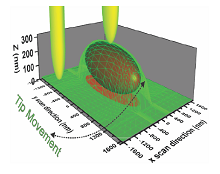
Electrical scanning probe microscopy (SPM) techniques, such as electrostatic force microscopy, nanoscale impedance microscopy or scanning near field microwave microscopy, are a relatively new branch of microscopy techniques that can generate images of the nanoscale electrical properties ... Read More


