
See How Modeling and Simulation Is Used Across Industries
Multiphysics modeling and simulation drives innovation across industries and academia — as is evidenced by the many uses showcased in the technical papers and posters presented by engineers, researchers, and scientists at the COMSOL Conference each year.
Draw inspiration from the recent proceedings collected below, or, to find a specific presentation or filter by application area or conference year/location, use the Quick Search tool.
View the COMSOL Conference 2025 Collection
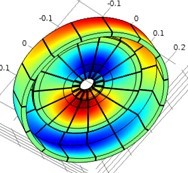
Large centrifugal compressors, which are commonly applied in the oil and gas and in the process industry, may fail due to vibrations of the impeller. These vibrations are induced by pressure pulsations in a compressor stage. These vibrations can be especially strong in so-called dense ... Read More

In the modern food industry one of the most important problems to face is to preserve products from deterioration: a widely used solution is the convective foods drying. Drying is based on a simultaneous transfer of both heat and water that takes place when dry and warm air flows around ... Read More

For the SAFARI Imaging Spectrometer, part of the SPICA satellite payload, a Calibration Source is under development. Challenges in the design include the low cooling power (few mW) available at cryogenic temperatures. COMSOL Multiphysics® simulations were used extensively in the design ... Read More

Heat transfer in a plane shear flow configuration consisting of two infinitely long parallel plates is considered. In laminar flows over undulated substrates eddies can be generated due to the kinematical constraints. A closed form analytical solution for the velocity field, based on ... Read More
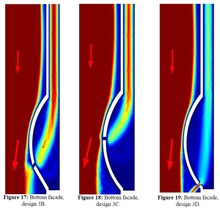
Solar radiation is a prominent contributor of energy in buildings, and can be transmitted directly into a building through opaque surfaces, but it can also be absorbed by building components (i.e. walls, roofs etc.). This study discusses the use and effect of ventilated facades, with an ... Read More

A comparative study is done using optimized single axis accelerometer and dual axis and double gimbal accelerometers are designed with different cantilever beam types i.e. perforated, non perforated, spring type and cross spring type. The models are simulated to find the most sensitive ... Read More

In The Netherlands rising dampness problems due to flooding of rivers and high groundwater levels form an essential treat for monumental buildings and heritage. A number of cases exists where rising dampness problems lead to the deterioration of wall finishes but also of valuable wall ... Read More
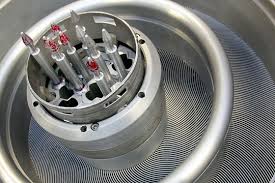
Engineering design studies of the feasibility of conversion of the High Flux Isotope Reactor (HFIR) from high-enriched uranium to low-enriched uranium fuel are ongoing at ORNL as part of an effort sponsored by the U.S. Global Threat Reduction Initiative program. HFIR is a very high flux, ... Read More
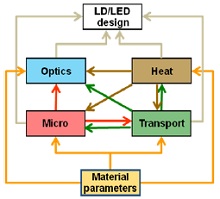
COMSOL-based modeling software developed at Ostendo Technologies allows detailed simulation of semiconductor lasers and light-emitting diodes. In this work, we study the inhomogeneity of the carrier injection into optically active quantum wells of polar and nonpolar III-nitride light ... Read More
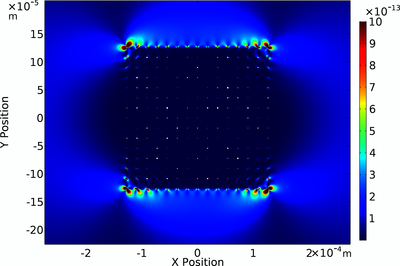
The main mechanisms of acoustic attenuation in a bundle of fibres typical of lightweight fibrous porous materials are the dynamic viscous drag forces on the surface of the fibres, and the thermal heat transfer between the solid fibres and the surrounding fluid. Microstructure models ... Read More


